
In the early 1960s, Puerto Vallarta was a remote fishing village with dirt streets. A couple of years later, it was in newspapers around the world. The reason was a John Huston movie, a cast of big stars, and an off-screen romance that nobody could keep quiet. Here is the full story of The Night of the Iguana: where it came from, how it was shot at Mismaloya, the Mexican film legends who worked on it, and the places you can still visit in Vallarta today.
Before the Movie: From a 1940 Mexico Trip to Broadway
The story starts more than twenty years before the cameras rolled. In 1940, a young Tennessee Williams traveled to Mexico. It was cheap, and he was getting over a breakup. In his memoirs he describes staying at a hotel near Acapulco called the Costa Verde, and that summer gave him details that show up again and again in his work: the seaside hotel, the hammock on the veranda and a group of German guests. He wrote about the trip in a 1961 essay, "A Summer of Discovery," published shortly before the Broadway opening.
The idea took its time reaching the screen:
- 1948: Williams publishes the short story The Night of the Iguana in One Arm and Other Stories. It already features the Costa Verde hotel and a tied-up iguana that is eventually set free.
- 1959: He stages a one-act version.
- December 28, 1961: The full play opens at Broadway's Royale Theatre, directed by Frank Corsaro, with Bette Davis as Maxine, Patrick O'Neal as Shannon and Margaret Leighton as Hannah. It ran for 316 performances. Leighton won the Tony for Best Actress in a Play, and the show was nominated for Best Play.
The film rights sold in May 1961, before the play even opened. James Garner later said he turned down the part of Shannon, and producer Ray Stark wanted Huston himself to play Nonno, the elderly poet; Huston preferred to direct.
What Is The Night of the Iguana?
The Night of the Iguana is a 1964 film directed by John Huston, adapted from Tennessee Williams' 1961 play. Huston co-wrote the screenplay with Anthony Veiller, Ray Stark produced it for Seven Arts, and MGM distributed it.
Richard Burton plays Lawrence Shannon, a defrocked minister working as a tour guide in Mexico. He is dogged by scandal and losing control of his tour group. His trip ends at a remote seaside hotel run by the recently widowed Maxine Faulk, where a group of troubled characters collide. At the heart of the story is the bond between Shannon and Hannah Jelkes, a painter traveling with her grandfather Nonno, who is trying to finish one last poem.
The main cast:
- Richard Burton as Rev. T. Lawrence Shannon
- Ava Gardner as Maxine Faulk, the innkeeper
- Deborah Kerr as Hannah Jelkes
- Sue Lyon as Charlotte Goodall
- Grayson Hall as Judith Fellowes
Sue Lyon had just played Lolita, and her role was expanded once she was cast. A bit of trivia for film buffs: the original trailer was narrated by a young James Earl Jones.
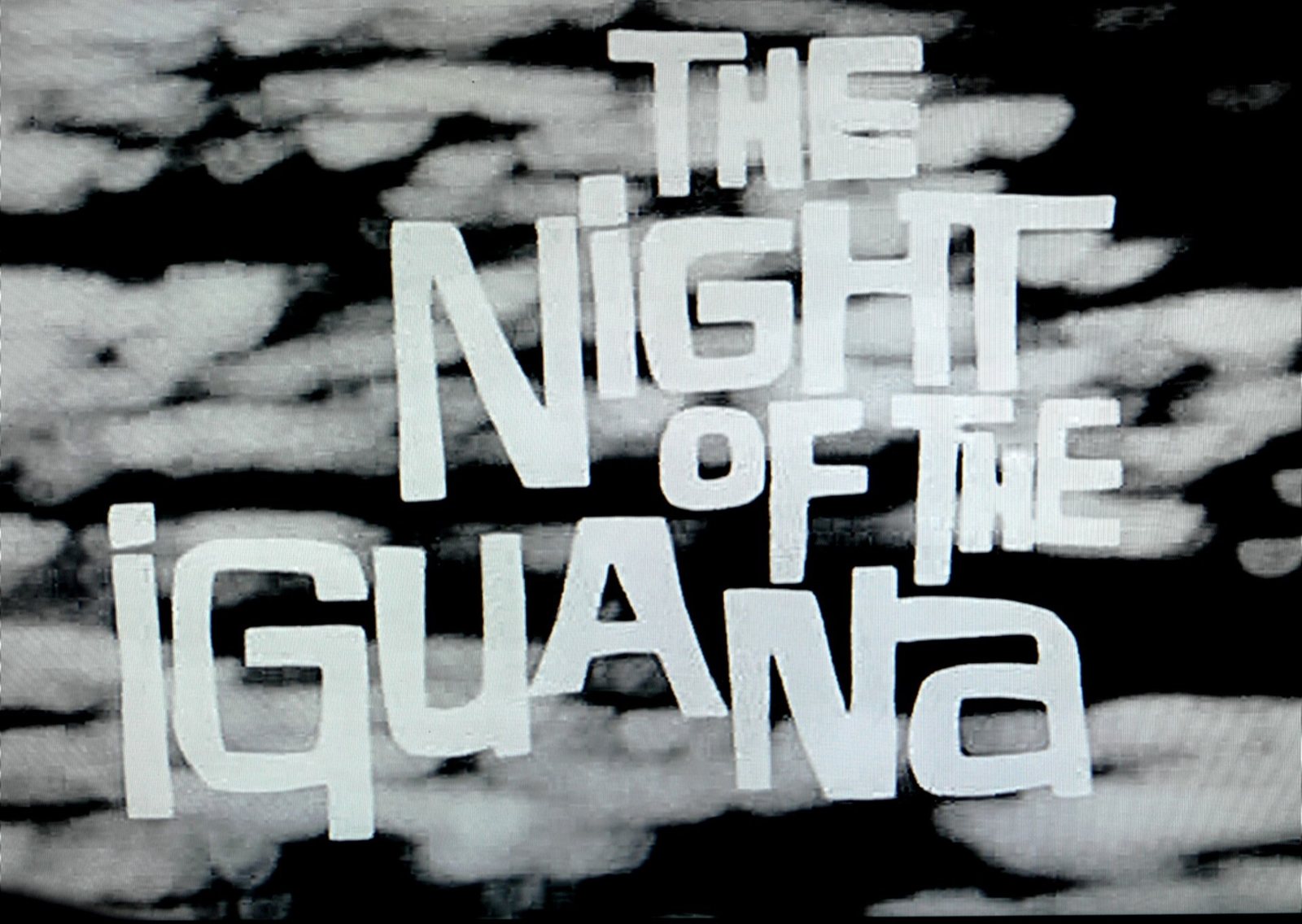 The title card from the original 1964 trailer for The Night of the Iguana.
Mexican Talent Behind and in Front of the Camera
It is an American, English-language production, but The Night of the Iguana owes a lot to Mexican cinema:
- Gabriel Figueroa (1907–1997) shot the film. He is regarded as one of the great cinematographers of Mexico's Golden Age of cinema, known for his framing and dramatic light and shadow, with more than 200 films to his name. This movie earned him an Oscar nomination for Best Black-and-White Cinematography, making him the first Mexican-born cinematographer nominated in that category.
- Emilio "El Indio" Fernández (1904–1986), one of the most celebrated directors of the same era, appears on screen as the barkeep. His film María Candelaria was the first Mexican film to win the Palme d'Or at Cannes, in 1946. The American Film Institute catalog also credits him as associate director.
- Local actors Fidelmar Durán and Roberto Leyva play Pepe and Pedro.
The production also had to deal with Mexico's censors. According to Variety in December 1963, Huston agreed to cut a scene of a drunk Indigenous man lying in a road after censors objected to it as a stereotype.
Where Was The Night of the Iguana Filmed?
Huston and Veiller scouted Puerto Vallarta before meeting Tennessee Williams in Key West. The company arrived in September 1963. Principal photography took place at Mismaloya, a small cove on the Bay of Banderas south of town, and according to the AFI catalog ran from September 25 to December 3, 1963; other sources put it at about 72 days. Many locations could only be reached by boat, so the production built a small village of 25 houses for the cast and crew. The Mismaloya jungle set reportedly cost around $60,000, out of a total budget of roughly $3 million.
The shoot produced stories people still tell:
- The golden pistols. Huston reportedly handed his stars, and Elizabeth Taylor, gold-plated derringers with bullets engraved with each other's names. With that many egos and romances on one set, the joke wrote itself.
- More reporters than iguanas. In his memoir, Huston recalled that the location had more journalists than iguanas.
- Cows on the runway. According to a local legend repeated in the press, Huston's plane had to buzz the Vallarta airstrip several times before landing so the cows would clear off.
Despite the drama everyone expected, accounts agree the cast got along well.
The movie premiered in New York in August 1964. It was one of the 10 highest-grossing films of the year, earning about $12 million worldwide. It received four Academy Award nominations (Grayson Hall for Supporting Actress, art direction, cinematography and costume design) and won one: Best Costume Design, Black-and-White, for Dorothy Jeakins. Ava Gardner won Best Actress at the San Sebastián International Film Festival, and the film picked up five Golden Globe nominations.
The old set still stands on the hill on the south side of Mismaloya cove, now in ruins. For the beach, Los Arcos and more, see our Mismaloya Beach guide.
Elizabeth Taylor in Puerto Vallarta
Elizabeth Taylor was not in the cast, but she drew more attention than anyone on set. She and Burton had met while making Cleopatra, and their relationship was already big news. In 1963 both were still married to other people: Burton to Sybil Williams, and Taylor to Eddie Fisher, whom she had already left.
When Burton came to Vallarta to film, Taylor came with him. While much of the crew bunked in the Mismaloya village, Burton stayed at Casa Kimberly in town, and Taylor joined him there. Reporters and photographers from around the world followed, and gossip columnists filed stories from the set almost daily.
All that coverage had an unexpected side effect. Photos of the couple against the bay showed Puerto Vallarta to the world, and many sources, including the local tourism office, point to this moment as the start of Vallarta as an international destination. There is a nice irony here: Burton wrote in a piece for Vogue that there was no lovelier place on earth, and begged readers to stay away so they wouldn't ruin it. It had exactly the opposite effect.
One common mix-up: Ava Gardner was not part of the romance. She starred in the film; the love story the press chased was Burton and Taylor's.
Taylor and Burton married in Montreal on March 15, 1964, just days after Taylor's divorce was finalized. They kept coming back to Vallarta for years.
Casa Kimberly and the "Bridge of Love"
Up the hill in Old Town Puerto Vallarta, on Calle Zaragoza, are the houses most linked to the couple. Burton and Taylor acquired two homes, one on each side of the narrow street. In 1964 Burton had an elevated bridge built across the street so they could go from one house to the other without stepping outside. Locals call it the Puente del Amor, or "Bridge of Love." Several sources say it was modeled on Venice's Bridge of Sighs.
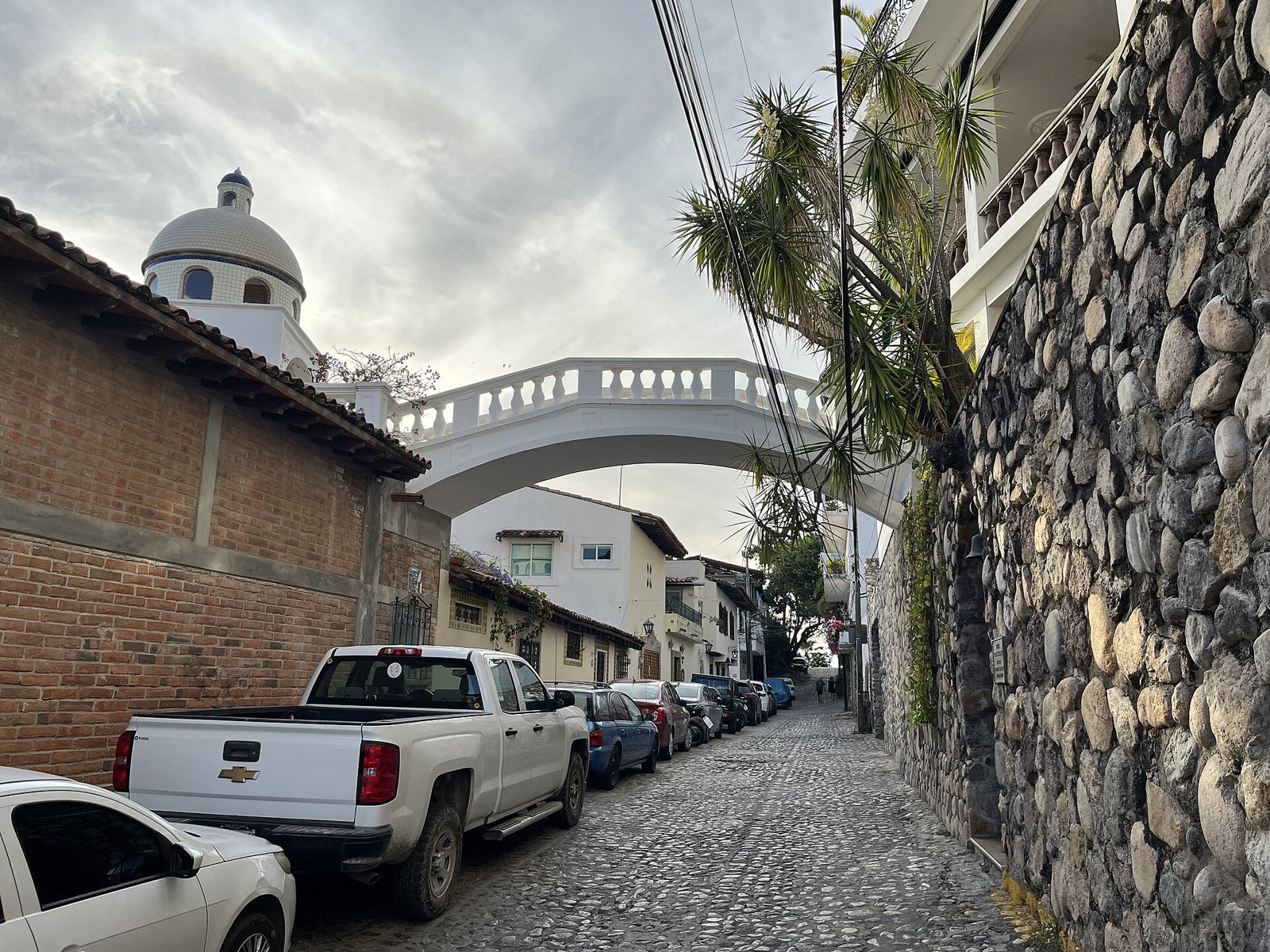 The "Bridge of Love" at Casa Kimberly spans the street in downtown Puerto Vallarta.
The property is known as Casa Kimberly. According to several accounts, Burton gave it to Taylor for her 32nd birthday in 1964, while other accounts call it a wedding gift, so the details depend on who is telling the story. What everyone agrees on is that it was their home base in Vallarta for years. After a long period of neglect it was restored, and today it operates as private accommodation. You can see the bridge from the street. Read the full story in our Casa Kimberly history.
The neighborhood has a nickname of its own: Gringo Gulch. A few Americans and Canadians lived there as early as the 1950s, and after the shoot, writers, filmmakers and artists drawn by the couple's fame settled on the same hillside.
How Puerto Vallarta Changed After the Movie
When Huston's crew arrived, Vallarta was a fishing village; an NBC News retrospective puts it at about 12,500 people. Before there was a highway, most visitors came by sea or by air. The film's fame lined up with a decade of big changes:
- 1968: Puerto Vallarta is officially made a city, on its 50th anniversary as a municipality. That same year, funding goes to a bridge over the Ameca River, the coastal highway and a new airport.
- 1970: Local histories date the airport's inauguration to a visit by President Gustavo Díaz Ordaz that August.
Other productions followed The Night of the Iguana. The most famous: parts of Predator (1987) were filmed at El Edén, in the jungle across Highway 200 from Mismaloya. For the city's full story, going back to its founding in 1851, read our Puerto Vallarta history.
What Happened to Them Next
- Burton and Taylor divorced in 1974, remarried in 1975 and split again in 1976. Taylor kept Casa Kimberly in the 1974 divorce. In 1977 Burton gave his new wife, Susan Hunt, another house close to the old one. Burton died on August 5, 1984, in Céligny, Switzerland.
- Elizabeth Taylor kept visiting Vallarta after Burton's death and sold Casa Kimberly in the 1990s. She died on March 23, 2011, in Los Angeles.
- John Huston never really left. He bought a house in the area after the shoot and, in his later years, retired to Las Caletas, a cove south of Boca de Tomatlán reachable only by sea. In a letter from around 1980, he described it as an island cut off from roads, with parrots at dawn and whales and dolphins in the bay. He died on August 28, 1987, in Middletown, Rhode Island.
Night of the Iguana Timeline
- 1940: Tennessee Williams travels to Mexico and stays at a hotel near Acapulco.
- 1948: The short story The Night of the Iguana is published.
- December 28, 1961: Broadway opening.
- September 1963: Huston, Burton, Sue Lyon and Elizabeth Taylor arrive in Puerto Vallarta.
- September 25 – December 3, 1963: Filming at Mismaloya and in Vallarta.
- March 15, 1964: Burton and Taylor marry in Montreal.
- August 1964: New York premiere.
- April 1965: The film wins the Oscar for black-and-white costume design at the 37th Academy Awards.
- 1968: Puerto Vallarta becomes a city.
- 1988: The John Huston statue is installed on Isla Cuale.
The Film's Legacy in Puerto Vallarta
- The John Huston statue. On Isla Cuale, in the Río Cuale, a statue of the director installed in 1988, credited to sculptor Carlos Ramírez, honors the film and its place in local history.
- Old Town. The cobblestone streets Burton and Taylor walked are now the heart of the city. Read more in our Puerto Vallarta Malecón and Old Town guide and our Romantic Zone guide.
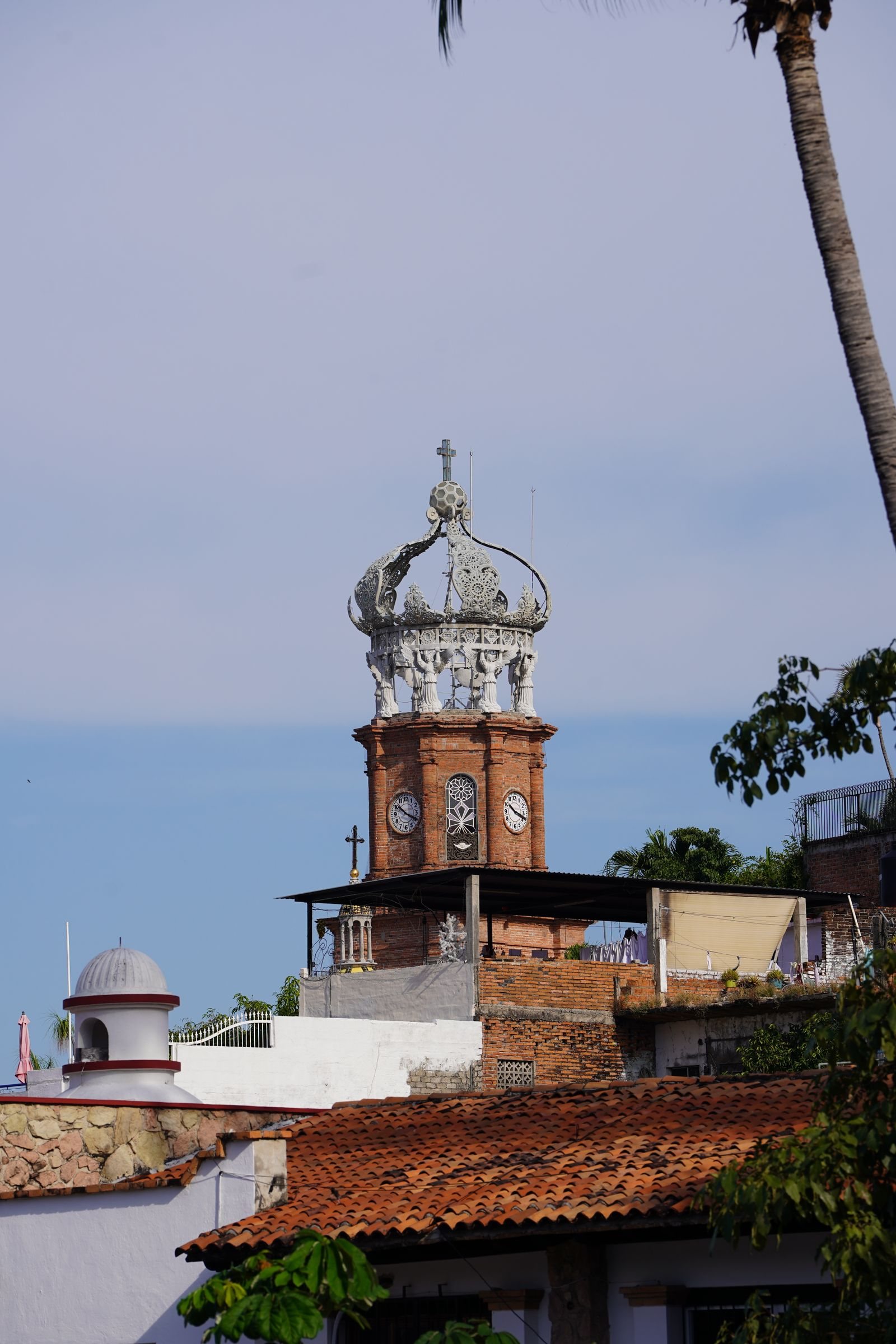 The crowned tower of the parish church, a landmark of downtown Puerto Vallarta.
A One-Day Night of the Iguana Itinerary
You can easily do this route on your own:
Morning: Mismaloya. The cove is about 6–7.5 miles (10–12 km) south of downtown on Highway 200. City buses leave from the Romantic Zone (the corner of Constitución and Basilio Badillo is a well-known stop). From the beach you can see the hill where the set ruins stand and Los Arcos offshore. If you walk up to the ruins, be careful: these are old, crumbling structures, and it's worth asking locally whether access is allowed.
Midday: Isla Cuale. Back in town, find the Huston statue on the river island between the Romantic Zone and downtown.
Afternoon: Calle Zaragoza and the Bridge of Love. Climb the cobblestone streets into Gringo Gulch to see the Casa Kimberly bridge from the street. Then head down to the parish church and the Malecón for sunset.
Only have half a day? Stick to downtown: Isla Cuale, Calle Zaragoza, the parish church and the Malecón are all within walking distance.
Best time to go: The dry season runs from November through May, and the rainy season from June through October. For walking and seeing the set in good light, the dry months are the most comfortable.
Explore Downtown Vallarta with Riviera Tours & Transfers
Our City Tour is not a movie-themed tour, but it takes you through the historic downtown where this story started. The Vallarta City Tour runs daily, lasts about 7 hours and is offered in English and Spanish. It includes:
- Guided walking tour of downtown Puerto Vallarta
- Visit to a traditional jewelry shop
- Free time for shopping
- Tequila stop
- Visit to a regional-cuisine restaurant (lunch not included)
Want lunch included? The Vallarta Plus City Tour adds a distillery tour, a tequila tasting and lunch at a regional-cuisine restaurant.
See dates and book the Vallarta City Tour →
Tips for Following the Night of the Iguana Trail
- Watch the movie before your trip. Spotting the Mismaloya coastline on screen makes the visit more fun. If you like theater, read the play too and see what Huston changed.
- Wear comfortable shoes. Old Town streets are cobblestone and some are steep, especially the climb toward Calle Zaragoza.
- Respect private property. Casa Kimberly and other historic homes are private; enjoy them from the street, and don't wander into courtyards or block driveways for photos.
- Split history and beach days. Mismaloya is south of town, so if time is short, plan downtown for a separate day.
- Check the road. Highway 200 south of town sometimes closes because of rain or accidents, so check conditions before you head out.
- For the rest of your itinerary, check our list of things to do in Puerto Vallarta.
FAQ
Where was The Night of the Iguana filmed? Mainly at Mismaloya, just south of Puerto Vallarta, from September 25 to December 3, 1963, with some scenes in Vallarta itself.
Was Elizabeth Taylor in The Night of the Iguana? No. She was not in the cast. She traveled with Richard Burton during the shoot, and that is what brought the international press to Vallarta.
Did The Night of the Iguana win an Oscar? Yes, one: Best Costume Design, Black-and-White (Dorothy Jeakins), out of four nominations, including one for Gabriel Figueroa's cinematography. Ava Gardner also won Best Actress at the San Sebastián film festival.
Is the story set in Puerto Vallarta? Not exactly. Tennessee Williams drew on a 1940 stay at a hotel near Acapulco, and the play takes place at a fictional hotel on Mexico's Pacific coast. It was the movie that was shot on the Vallarta coast.
Is the movie set still at Mismaloya? Its ruins remain on the hill on the south side of the cove, badly deteriorated. You can see them from the beach; if you want to get closer, ask locally whether access is allowed and watch your step.
Can you visit Casa Kimberly? It is private property that now operates as accommodation. You can see the bridge connecting the two houses from Calle Zaragoza in Old Town.
Photos: colorqueeny / CC BY-SA 3.0 via Wikimedia Commons · Trailer screenshot (MGM, 1964 trailer) / Public domain via Wikimedia Commons · Another Believer / CC BY-SA 4.0 via Wikimedia Commons · Ham Chitnupong / Pexels License via Pexels




