
The heart of Puerto Vallarta fits in a walk: a seaside boardwalk, a crown-topped church, a main square with a bandstand and cobblestone streets climbing the hillside. Every corner has a story behind it: a hamlet founded to ship salt to silver mines, a church that took almost 70 years to finish, a crown toppled by an earthquake and a boardwalk wiped out by a hurricane and rebuilt. Here's what to see in Puerto Vallarta's Old Town, where it all came from and how to explore it at your own pace.
A Little History: From Las Peñas to Today's Old Town
Downtown Vallarta sits exactly where the town began. According to tradition, on December 12, 1851, Guadalupe Sánchez Torres arrived with his family and a few other families at the mouth of the Cuale River. Because it was the feast day of the Virgin of Guadalupe, they named the spot Las Peñas de Santa María de Guadalupe. The settlement made its living receiving salt by sea and hauling it up to the silver mines in the Sierra Madre, including those of San Sebastián del Oeste.
For decades Las Peñas was governed by other towns: in 1888 it was annexed to the municipality of San Sebastián, and only in 1918 did it become a municipality of its own, renamed Puerto Vallarta in honor of Jalisco jurist and former governor Ignacio L. Vallarta. For the full story, read our Puerto Vallarta history guide.
You can still feel those roots: the church carries the name of the Virgin who named the town, and the Cuale River still splits downtown in two. In 2018, according to Puerto Vallarta's tourism board, the Historic Center was recognized as cultural heritage of the state of Jalisco.
Malecón and Old Town Timeline
- 1851: traditional founding of Las Peñas de Santa María de Guadalupe by the Cuale River.
- 1901: a first chapel to the Virgin of Guadalupe goes up on the site of today's church.
- 1918: Las Peñas becomes the municipality of Puerto Vallarta.
- October 12, 1921: official start of construction of the current church and its first Mass.
- 1925: a cyclone shifts the Cuale River's course, and the island in the middle of the river begins to form.
- 1935–1936: the first Malecón is built; it's extended between 1940 and 1952.
- 1965: the crown is placed atop the church tower.
- 1970: stone arches from a hacienda near Guadalajara are installed on the Malecón for a meeting between Presidents Gustavo Díaz Ordaz and Richard Nixon.
- 1976: the large version of the Boy on the Seahorse is installed on the Malecón.
- 1995: an earthquake brings down the church's crown.
- 2002: Hurricane Kenna destroys much of the old Malecón and the original arches.
- 2009: the rebuilt crown returns to the tower.
- 2011: the Malecón's renovation as a wide pedestrian promenade is completed.
- 2024: the "Puerto Vallarta" letters are restored to Manuel Lepe's original design.
The Puerto Vallarta Malecón: An Open-Air Art Gallery
The Malecón is a pedestrian boardwalk about 12 blocks, or roughly a mile, long, running along Banderas Bay. It was first built in the 1930s and grew over the following decades. In October 2002, Hurricane Kenna left it badly damaged, and the city began a long rebuild. The result is the promenade you see today: about 20,000 square meters (215,000 sq ft) of stone and concrete designed by Estudio 3.14 and Trama Arquitectos and completed in 2011. That same year, car traffic was removed from the stretch by Los Arcos, making the walk even more pleasant.
What really sets it apart is the sculpture collection, close to twenty pieces. These are the ones you shouldn't miss.
The Boy on the Seahorse
Rafael Zamarripa's Boy on the Seahorse, known locally as El Caballito, is Vallarta's symbol. It comes with a fun backstory: the first, smaller version stood at Playa de los Muertos in the late 1960s until a storm swept it away. The larger Malecón version was installed in 1976. Today there's a seahorse at Playa de los Muertos again, so you can go looking for both.
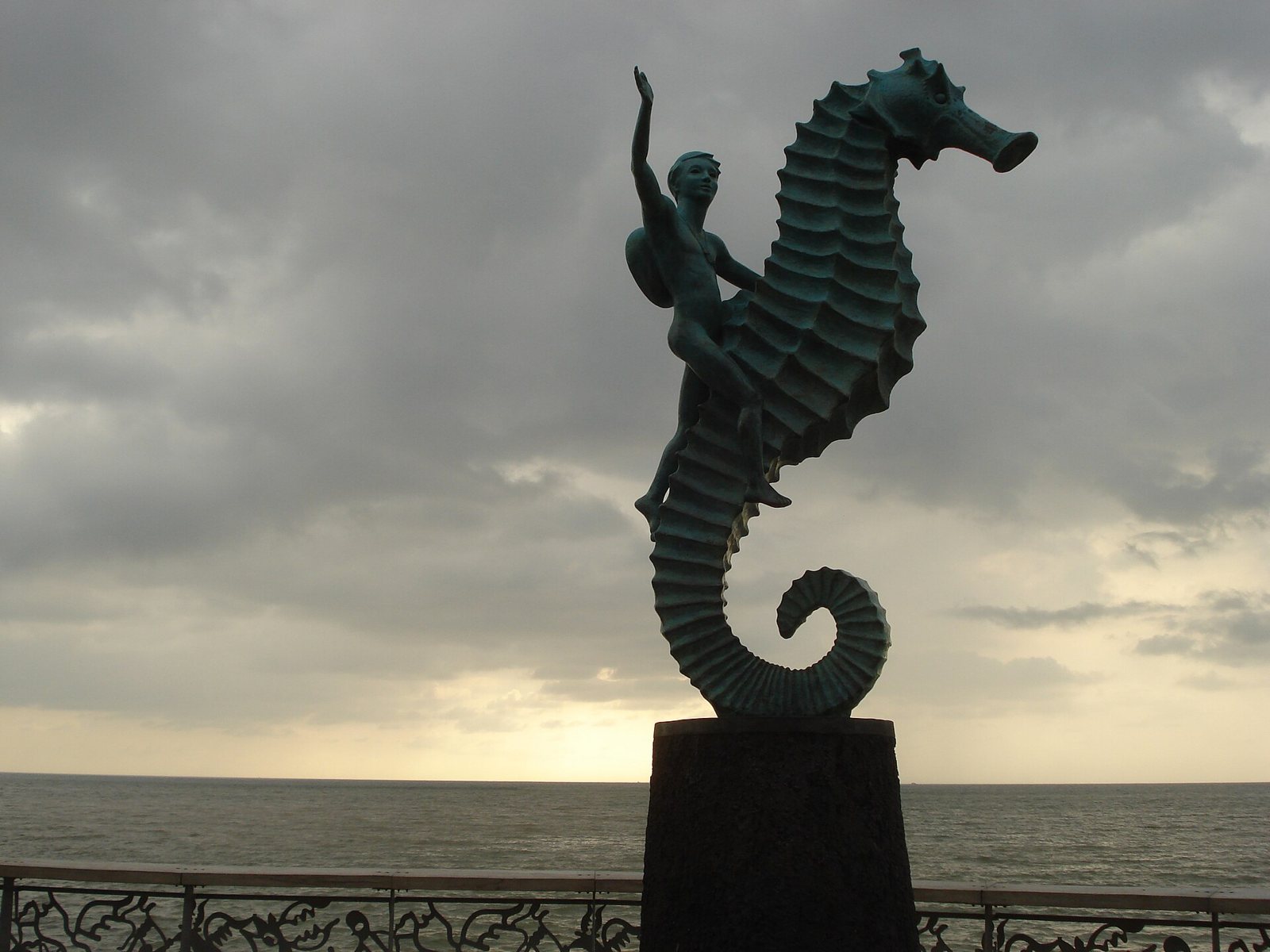 The Boy on the Seahorse by Rafael Zamarripa, Puerto Vallarta's best-known symbol.
The Rotunda by the Sea
Alejandro Colunga's piece was unveiled in 1996: eight fantastical bronze thrones, half chair and half creature, arranged in a circle. They're meant to be sat on, which makes this one of the must-have photos on the walk.
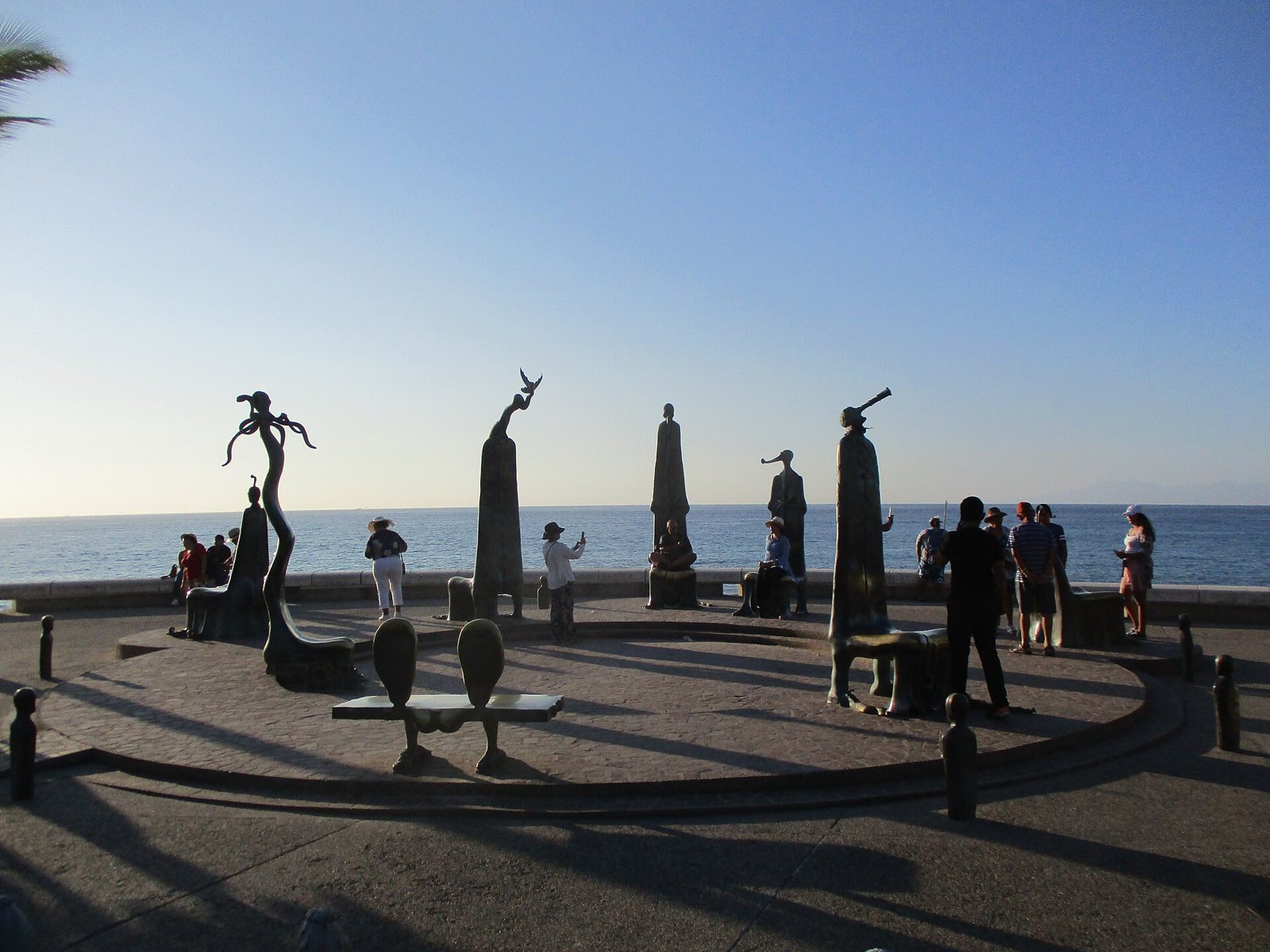 The Rotunda by the Sea by Alejandro Colunga on the Puerto Vallarta Malecón.
More Sculptures With a Story
- In Search of Reason by Sergio Bustamante (2000). A towering bronze of figures reaching for the sky. Bustamante has said he drew on the writings of philosopher Bertrand Russell and that the piece is "about freedom."
- Millennium by Mathis Lídice (2001), at the north end of the Malecón. It depicts the passage of time: DNA at the base, a dove of hope at the top and historical figures in between.
- Nostalgia by Ramiz Barquet (1984), which the sculptor dedicated to his wife.
- Triton and Mermaid by Carlos Espino (1990), one of the most photographed pieces by the sea.
- Erizados by Maritza Vázquez (2006) and The Washer Woman by Jim Demetro round out the walk.
Los Arcos Amphitheater
Facing the main square is the open-air amphitheater known as Los Arcos, where you'll often find free cultural events, live music, folk dancing and street performers. Its four stone arches are almost as famous as the seahorse. The originals were brought in 1970 from a hacienda on the outskirts of Guadalajara for a summit between the presidents of Mexico and the United States, Gustavo Díaz Ordaz and Richard Nixon. Hurricane Kenna knocked them down in 2002; the city of Zapopan donated a replica by sculptor Martín Distancia, finished that December.
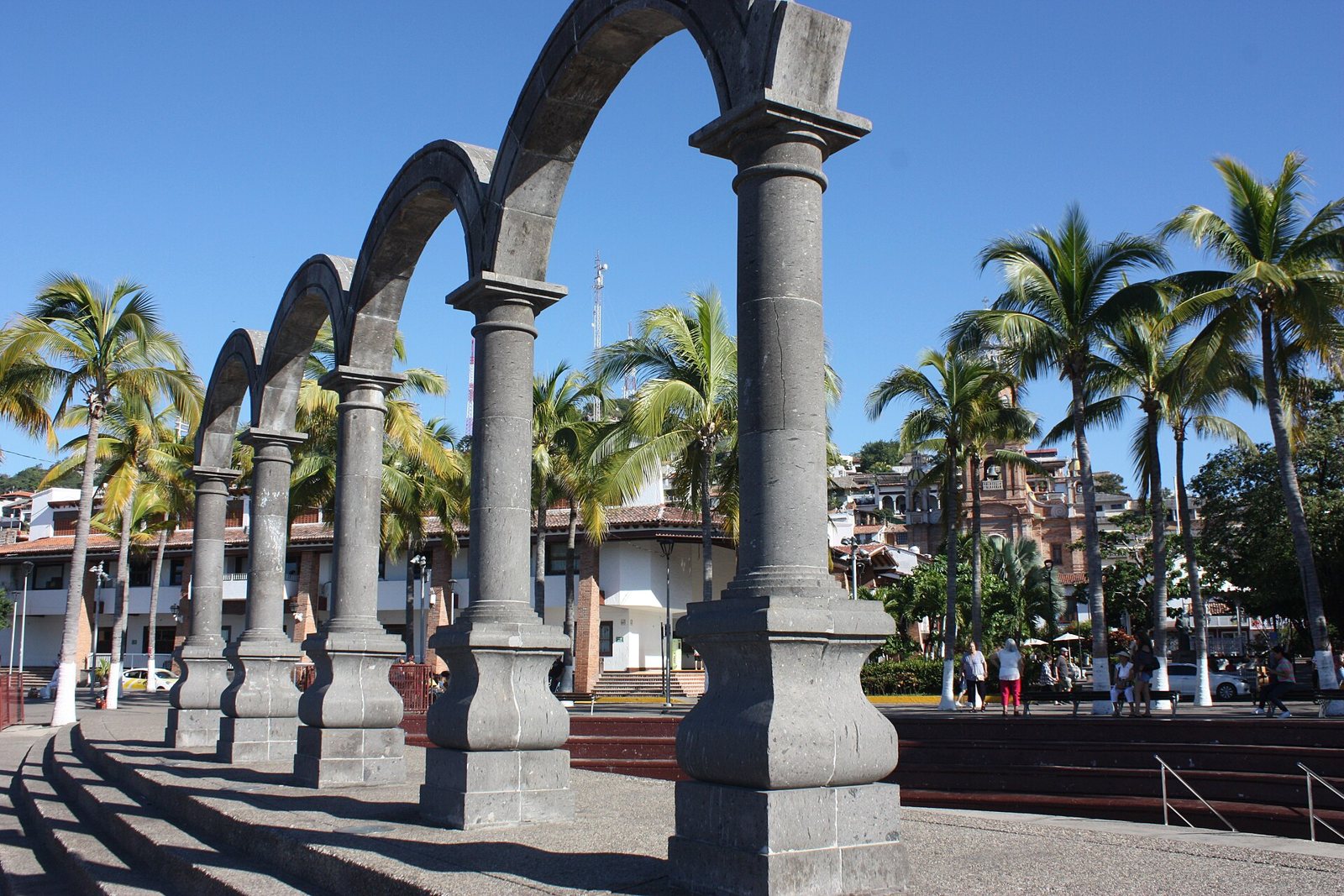 Los Arcos on the Malecón, a 2002 replica; the church tower peeks through the palms behind it.
The Puerto Vallarta Letters and Manuel Lepe
The colorful "Puerto Vallarta" letters everyone photographs were originally designed and painted by Manuel Lepe Macedo (1936–1984), the city's most beloved painter. Born in Vallarta, he had no formal art training and painted the port's landscapes and daily life in a naïve style. In August 2024, his daughter Marcela Lepe restored the letters to their original colors. The city celebrates April 17, his birthday, as Manuel Lepe Day.
Tip: go at sunset. The sun drops over the bay and the Malecón fills with people, music and street vendors.
The Church of Our Lady of Guadalupe
One block from the Malecón stands the city's icon, a building that went up in stages.
Nearly 70 Years in the Making
A rustic chapel stood on this site from 1901. In 1915 Father Francisco Ayala had it torn down to lay stronger foundations, and October 12, 1921 is considered the official start of construction and the date of its first Mass. Work stopped in 1926 during the Cristero War and resumed in 1930, starting with the dome. The main building was done by 1940, the bell tower in 1952 and the upper tower in 1955. The facade and the smaller side towers weren't completed until 1987, under Father Luis Ramírez.
That's why the church blends styles: a neoclassical nave, Renaissance-inspired towers and a baroque-flavored crown, with each parish priest leaving his mark. Above the altar hangs a painting of the Virgin of Guadalupe by Ignacio Ramírez, from 1945.
The Crown: An Earthquake, a Rebuild and a Myth
The crown was placed atop the tower in 1965, and its angels and silhouette quickly made it the emblem of the city. In October 1995, a strong earthquake off the coast of Colima and Jalisco brought it down. For years the tower wore a temporary fiberglass crown, until Jalisco sculptor Carlos Terres led its reconstruction and the new crown returned in 2009.
A fun fact: you'll often hear that the crown is a copy of the one worn by Empress Carlota. It's repeated in plenty of guidebooks, but a local publication flatly denies it. Treat it as what it is: an urban legend.
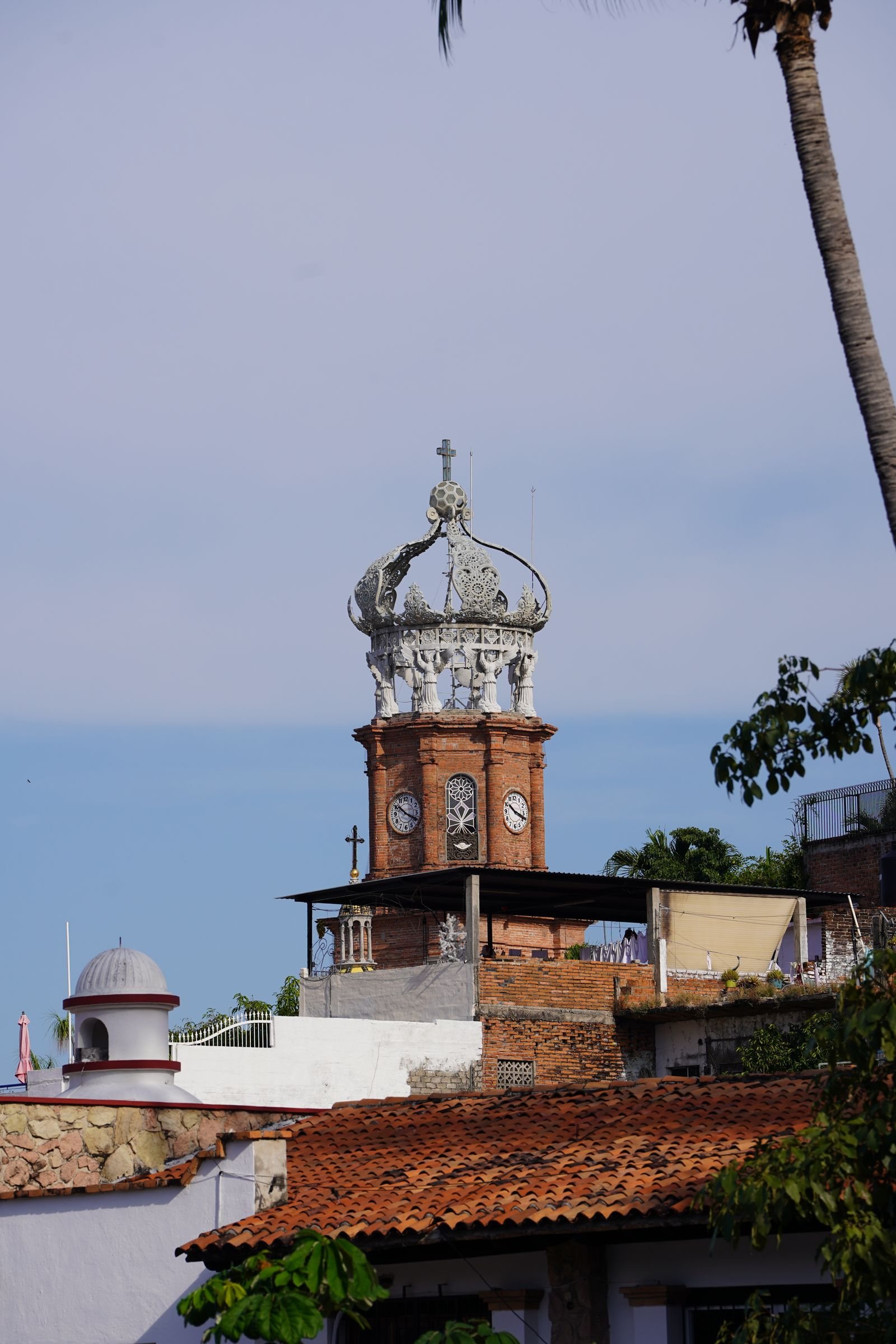 The crown of the Church of Our Lady of Guadalupe rising above downtown rooftops.
The Guadalupe Festival
Every year from December 1 to 12, pilgrimages honoring the Virgin of Guadalupe fill downtown. Each afternoon, groups from businesses, trade associations, community organizations and families set out, traditionally from the corner of 31 de Octubre and Juárez streets, and parade down to the church's altar with floats, dancers, live music and fireworks. In 2024 a record 455 pilgrimages were registered. December 12, the Virgin's feast day and the town's founding anniversary, is the high point. According to the tourism board, the festival was recognized as intangible cultural heritage of Jalisco in 2018. If you're visiting then, check that year's schedule with the parish.
The Main Square and City Hall
Next to the church is the main square, or plaza de armas, with its bandstand, a gathering spot for locals and visitors alike. Facing it is City Hall (Presidencia Municipal), and it's worth peeking inside: there's a mural by Manuel Lepe titled Puerto Vallarta, about 64 square meters (690 sq ft), in the cheerful naïve style he's known for. In 2020 his daughter and grandnephew cleaned it, because the sea breeze had left salt stains on its surface.
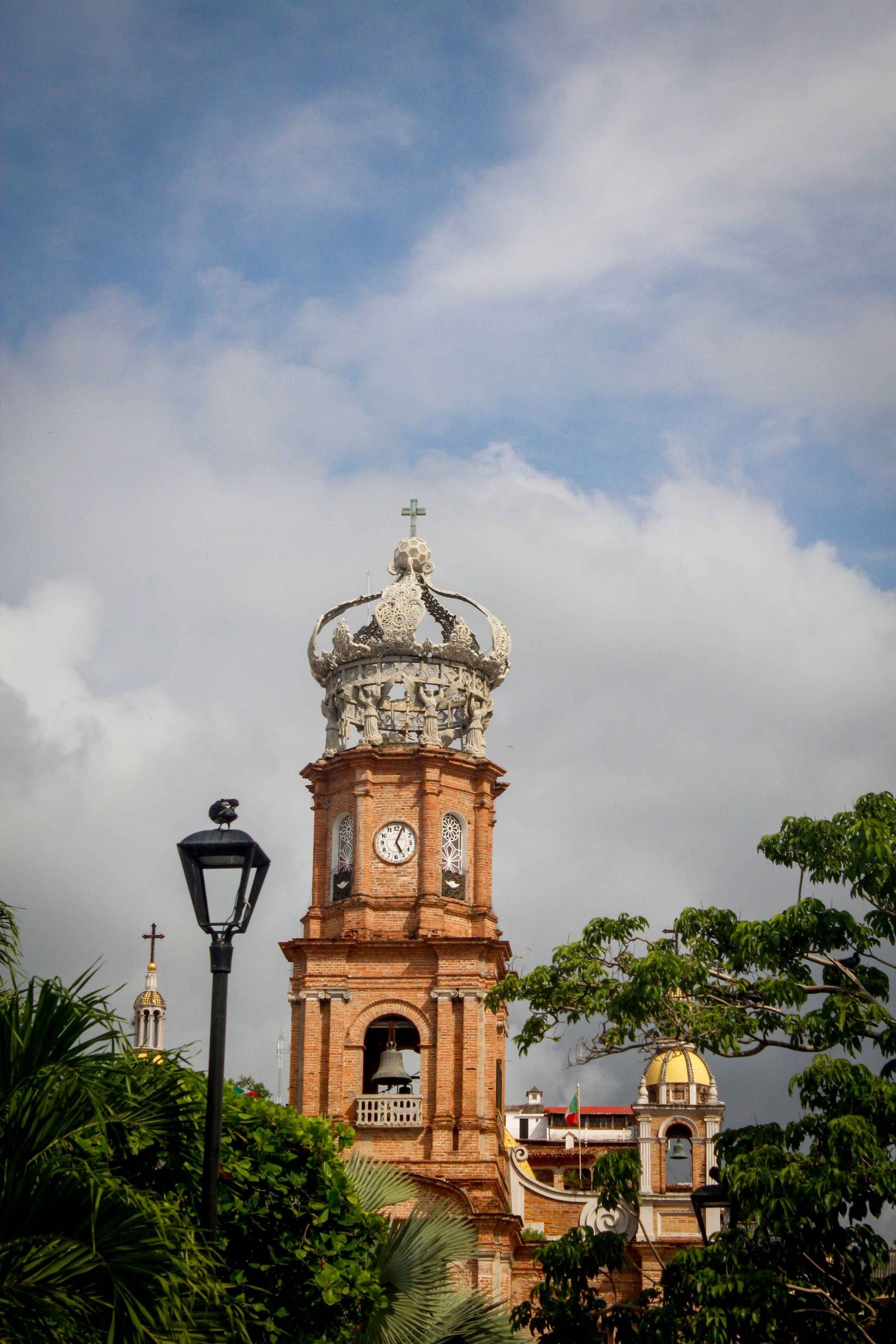 The Church of Our Lady of Guadalupe tower seen from the main square area.
The Cuale River: Craft Market and Island
A few blocks south of the square, the Cuale River marks the line between downtown and the Romantic Zone.
The municipal craft market, on the riverbank, is the classic place for souvenirs. Look for silver jewelry, leather, painted ceramics, textiles, Mexican candy, tequila and Huichol art. Sources disagree on its founding year, but the current building dates to the late 1970s. Take your time comparing and ask about handmade pieces. The city has announced a renovation, so check that it's open before you go. For more options, see our guide to Puerto Vallarta markets.
Isla del Río Cuale isn't a true island: it formed after a 1925 cyclone shifted the river and split it into two channels. It was first called Isla de Santa Clara, then Isla de los Niños, because local kids played there. Today it has shady paths, craft stalls, suspension bridges to the Romantic Zone and the headquarters of the Vallarta Institute of Culture. You'll also find a statue of John Huston, director of The Night of the Iguana, the movie that put Vallarta on the map, plus a bust of Elizabeth Taylor. The small Museo del Cuale, devoted to the ancient cultures of western Mexico, is listed as temporarily closed on the INAH website, so double-check before planning a visit. The island turned 100 in October 2025.
Gringo Gulch and the Lovers' Bridge
Behind the church, the streets climb the hillside. Since the 1950s this neighborhood has been known as Gringo Gulch, after the Americans and Canadians who settled there. Its most famous resident was Elizabeth Taylor: in 1964 Richard Burton had a bridge built over Zaragoza Street to connect two houses, the so-called Lovers' Bridge (Puente del Amor). We tell the whole story in our article on Casa Kimberly.
Weather: When to Explore Old Town
Puerto Vallarta has two clear seasons. November through May is the dry season: sunny days, little rain and more bearable humidity, the most comfortable time to walk around. June through October brings the rains, usually as afternoon or evening downpours; July and August are the hottest, most humid months, with highs around 88 to 90°F (31 to 32°C). The eastern Pacific hurricane season runs from May 15 to November 30, so keep an eye on the forecast in summer and fall. Year-round, early morning and sunset are the best times to stroll.
Suggested Old Town Itinerary
Half day (3 to 4 hours) 1. Start at the north end of the Malecón by the Millennium sculpture and walk south past the sculptures. 2. Stop at the Boy on the Seahorse and the Rotunda by the Sea. 3. Reach Los Arcos and cross to the main square; step into City Hall to see Manuel Lepe's mural. 4. Visit the church (quietly if Mass is underway) and walk a block or two uphill for a closer look at the crown. 5. Finish at the craft market by the Cuale River.
Full day Add Isla del Río Cuale and Gringo Gulch, try some local food (see our Puerto Vallarta food guide for ideas) and head back to the Malecón for sunset.
Budget: walking the Malecón, the square, the church and the island is free; you'll mainly spend on transportation, food and shopping.
How to Explore Downtown
You can easily do it on foot: the Malecón, the church and the square are a few blocks apart. If you want the stories behind each place, go with a guide.
Our City Tours run every day, last about 7 hours, are offered in English and Spanish and include round-trip transportation and a certified guide:
| Vallarta City Tour | Vallarta City Tour Plus | |
|---|---|---|
| Guided downtown walking tour | ✅ | ✅ |
| Traditional jewelry shop visit | ✅ | ✅ |
| Free time for shopping | ✅ | ✅ |
| Tequila | Tequila stop | Distillery tour and tasting |
| Lunch | Visit to a regional restaurant (lunch not included) | Lunch included |
Book the Vallarta City Tour → · Book the Vallarta City Tour Plus →
Looking for more ideas? Check out our guide to things to do in Puerto Vallarta.
Tips
- Comfortable shoes: downtown streets are cobblestone and some are steep.
- Cash (pesos) for the market, tips and snacks.
- Hat, sunglasses, water and biodegradable sunscreen: the midday sun is strong.
- Be respectful at the church: it's an active place of worship. Dress modestly, keep your voice down and skip the flash during Mass.
- Friendly haggling: it's fine to ask for a better price at the market, as long as you're polite.
- Photos of people: ask before photographing artisans, musicians or dancers.
- In December, plan ahead: the pilgrimages close downtown streets in the afternoon.
FAQ
How long is the Puerto Vallarta Malecón? About 12 blocks, or roughly a mile. You can stroll it at a relaxed pace in an hour or two, with photo stops.
Can you go up into the church's crown? No, the crown is part of the church tower. Admire it from the square or the Malecón.
Is the church crown a copy of Empress Carlota's crown? It's a popular story, but it isn't proven and a local publication denies it. What is documented is that the crown went up in 1965, fell in the 1995 earthquake and returned, rebuilt, in 2009.
When is the Virgin of Guadalupe festival in Puerto Vallarta? December 1 to 12, with daily pilgrimages through downtown that end at the church. The main day is December 12.
When is the best time to visit Old Town? November through May, during the dry season. Summer works too, but head out early and check the forecast.
What's the difference between the City Tour and the City Tour Plus? The Plus adds a distillery tour with tequila tasting and includes lunch at a regional restaurant.
Photos: Sailverz / CC BY 4.0 via Wikimedia Commons · August Dominus / CC BY-SA 4.0 via Wikimedia Commons · Ham Chitnupong / Pexels License via Pexels · Fernando González / Pexels License via Pexels · Feedmepaperr / CC BY-SA 4.0 via Wikimedia Commons · Andresnavarroforever / CC BY-SA 3.0 via Wikimedia Commons




