
Walk through downtown Puerto Vallarta or the streets of Sayulita and you will see it everywhere: glowing yarn paintings, jaguar heads and deer covered in tiny beads, bowls packed with color. This is Huichol art, more respectfully called Wixárika art, and it is far more than a souvenir. Each piece carries the beliefs of one of Mexico's most distinctive Indigenous cultures. Here is the history, the symbolism and the people behind it, plus what to know before you buy.
Who Are the Huichol (Wixárika) People?
The Huichol call themselves Wixárika (singular) or Wixaritari (plural), usually translated as "the people." "Huichol" is the Spanish name. Their homeland is the Sierra Madre Occidental, mainly northern Jalisco (Mezquitic and Bolaños) and Nayarit (La Yesca, El Nayar and Tepic), with smaller communities in Durango and Zacatecas. It is rugged canyon country, roughly 3,300 to 9,800 feet (1,000 to 3,000 m) above sea level.
According to the Atlas of Indigenous Peoples published by Mexico's INPI, about 71,000 Wixaritari lived in Mexico in 2015, and more than 400 of them lived in the municipalities of Puerto Vallarta and Bahía de Banderas. So the artisan selling beadwork near you may well live on the coast or travel down from the mountains to sell.
Their language, also called Wixárika, belongs to the Uto-Aztecan family and is closely related to Cora (Náyeri). It has regional dialects and is legally recognized as one of Mexico's national languages.
Community life revolves around five communities, each with a ceremonial seat: Tateikie (San Andrés Cohamiata), Tuapurie (Santa Catarina Cuexcomatitlán), Wautia (San Sebastián Teponahuaxtlán), Kuruxi Manuka (Tuxpan de Bolaños) and Xatsitsarie (Guadalupe Ocotán, Nayarit). Extended families live on scattered ranches with a family shrine (xiriki), grouped around larger ceremonial centers (tukipa). Traditional authorities change every year in the Cambio de Varas (Changing of the Staffs) ceremony in early January.
A Short History of the Wixárika People
Archaeological and linguistic studies suggest the Wixaritari descend from several Uto-Aztecan groups that settled in the sierra. Their own oral tradition tells it differently: according to Wixárika stories, the gods emerged from the sea and walked east, founding the mountain villages along the way. Before the Spanish arrived they traded with neighboring peoples, especially in salt, and their territory was larger than it is today.
Timeline
- 1531. Nuño de Guzmán leads the brutal Spanish conquest of what is now Jalisco.
- 1540–1541. During the Mixtón War, many Wixaritari retreat deeper into the sierra.
- 1592 and 1702. Recorded uprisings alongside Tepehuan neighbors at El Teúl and Nostic.
- After 1722. Following the war of the Mesa del Nayar, missionaries begin evangelizing much of the territory.
- Late 1700s. Communities receive land titles that still define their boundaries.
- Around 1850. Missionaries finish Catholic churches in the sierra and destroy several ceremonial centers; the Wixaritari rebuild them during Manuel Lozada's rule in the region.
- 1890–1910. Norwegian explorer Carl Lumholtz leads expeditions in Mexico for the American Museum of Natural History, documenting Huichol designs in the 1890s; his two-volume Unknown Mexico appears in 1902.
- Cristero War. Communities split into opposing sides, and some families move to Nayarit and Durango, founding new villages.
- 2000–2001. Wirikuta is declared a Sacred Natural Site in San Luis Potosí.
- July 12, 2025. The Wixárika Route through Sacred Sites to Wirikuta is inscribed on UNESCO's World Heritage List.
The Sacred Map: Five Directions and Wirikuta
The Wixaritari recognize a sacred place in each cardinal direction and one at the center:
- East: Wirikuta, in the desert of San Luis Potosí near Real de Catorce.
- West: Haramara, the sea, at San Blas, Nayarit. Yes, the Pacific of the Riviera Nayarit is part of their sacred geography.
- North: Hauxamanaka, on Cerro Gordo in Durango.
- South: Xapawiyemeta, on Isla de los Alacranes in Lake Chapala.
- Center: Te'akata, in Santa Catarina, Jalisco.
The pilgrimage to Wirikuta is the heart of Wixárika religion. Between October and March, pilgrims travel some 250 miles (400 km) to retrace the journey the gods once made, and there they gather hikuri (peyote). According to Wixárika tradition, the sun was born at Cerro Quemado in Wirikuta, lifted into the sky by a deer's antlers.
In 2025 UNESCO recognized that route as World Heritage: a corridor of about 500 km (310 miles) crossing Nayarit, Durango, Jalisco, Zacatecas and San Luis Potosí, with 20 sacred sites, including Tatei Jaramara on the Nayarit coast. INAH calls it the first living Indigenous tradition in Latin America to be recognized this way. It came after years of defending the land, including disputes over mining concessions in Wirikuta beginning in 2009.
Huichol Yarn Paintings and Beadwork: The Two Main Techniques
Yarn paintings (nierika)
The nierika began as a ceremonial object: a small disc or board that mara'akate (ritual specialists) made to record their visions, left as an offering at shrines, springs and caves. Modern yarn paintings grew out of it. The artist coats a wooden board with beeswax and resin, then presses colored yarn into it strand by strand until the whole surface is filled. The first large yarn paintings were shown in Guadalajara in 1962.
The breakthrough happened in Zapopan. A Franciscan priest, Ernesto Loera Ochoa, opened a small Huichol museum beside the Basilica, where the mara'akame Ramón Medina Silva showed and sold his work. American anthropologist Peter Furst saw it and suggested he tell Wixárika beliefs by pressing yarn into waxed boards. A new art form was born.
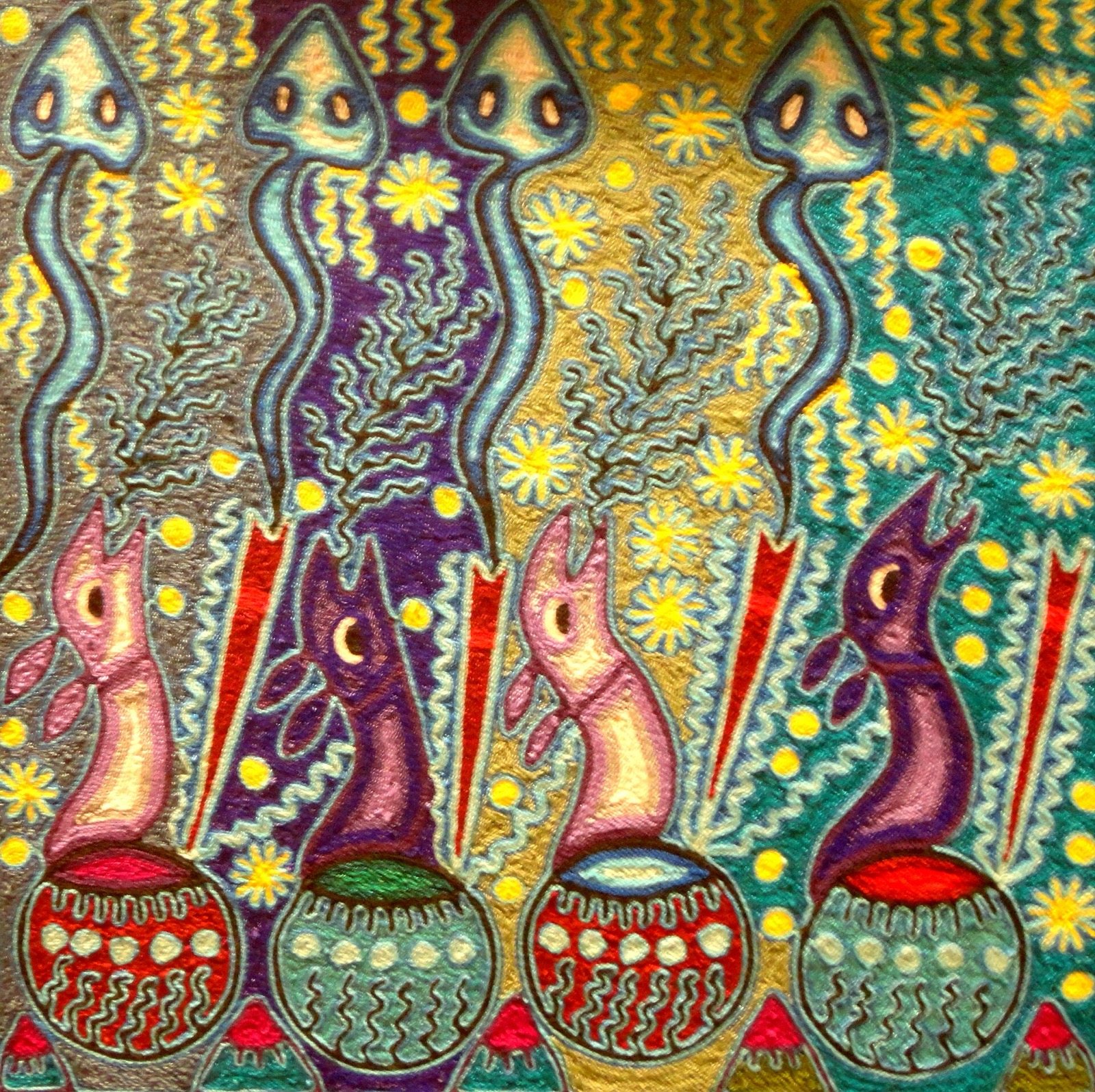 Another Wixárika yarn painting. Each strand is pressed by hand into a wax base.
Beadwork (chaquira)
Chaquira are tiny glass beads set one at a time into a layer of wax and resin, covering carved wood figures, gourd bowls, masks and jewelry. Long before glass beads, Wixárika artisans worked with seeds, bone, clay, shell, stone, coral, turquoise and jade; some sources date the arrival of European glass beads to the 1700s. Over time, beaded gourd bowls led to masks and then to the sculptures you see today: jaguars, deer, skulls.
Masters like Santos de la Torre work with Czech glass beads and Campeche wax. The work is painstaking: the Vochol, a beaded VW Beetle, carries roughly 2.3 million beads and took eight artisans about 4,760 hours.
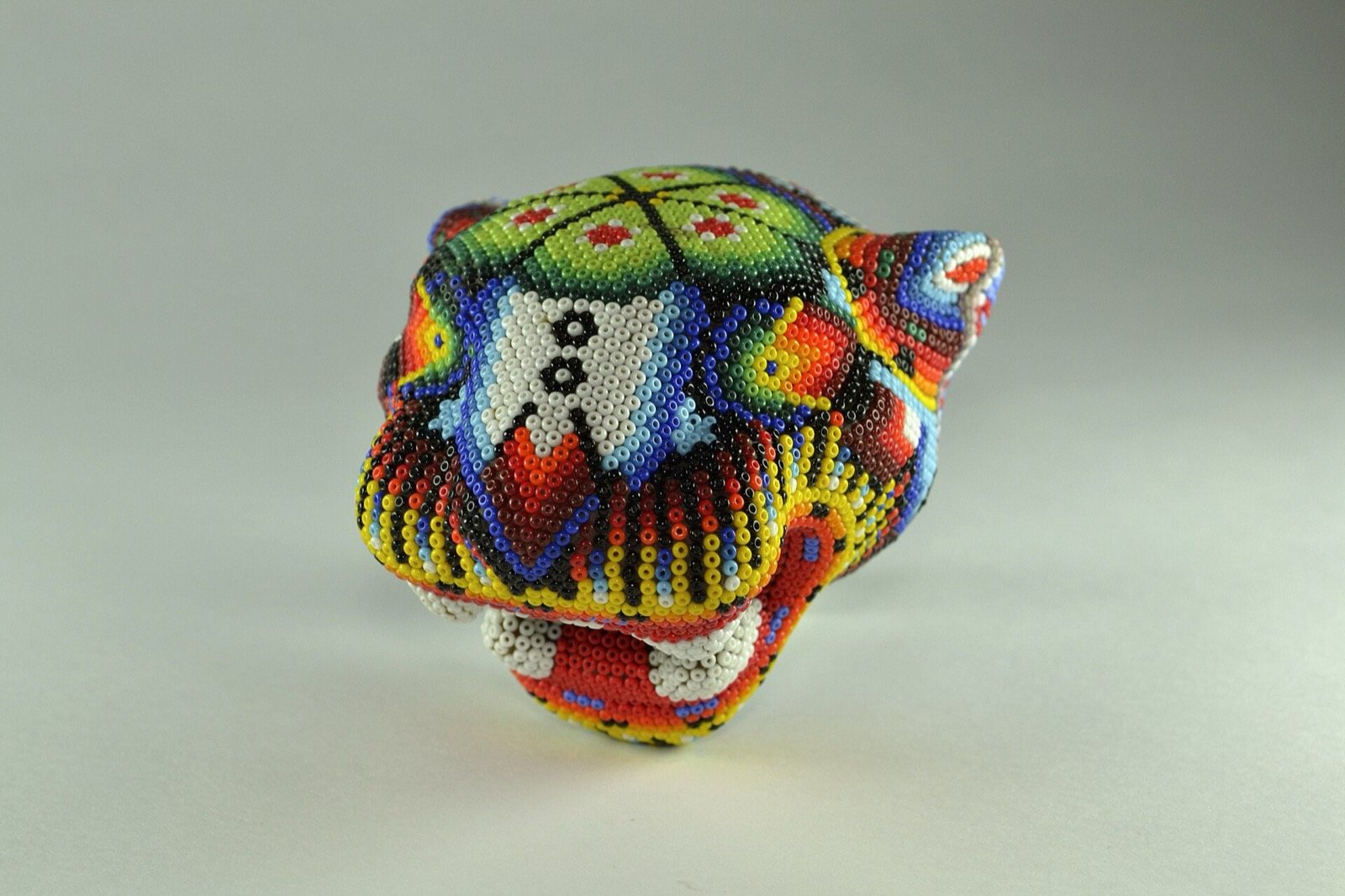 A beaded jaguar head, one of the best-known forms of Wixárika art.
Other Wixárika crafts
- God's eye (ojo de Dios). A wooden cross wrapped in colored yarn. When a child is born, the father weaves the central eye, and one more is added each year until age five, to protect the child.
- Woven bags and sashes. Made on a backstrap loom. Designs that mimic snakeskin are linked to rain, crops, health and long life.
- Embroidery and jewelry. Cotton garments with colorful embroidery, wide hats trimmed with feathers or flowers, and beaded necklaces, bracelets and earrings.
Huichol Art Symbols: Deer, Corn and Peyote
Meanings vary between communities and artists, so there is no single "dictionary." Still, INPI explains that Wixárika religion centers on the bond between corn, the deer and peyote: corn and deer stand for sustenance, while peyote is the way to communicate with the gods, who are also ancestors.
- The deer. A sacred guide; Kauyumari, the Blue Deer, appears in many stories and pieces, often with the sun, arrows or candles.
- Corn. Life and abundance, shown as an ear of corn or a growing plant, sometimes tied to female deities.
- Peyote (hikuri). A sacred plant gathered in Wirikuta and used in ceremonies led by mara'akate. Many yarn paintings depict visions connected to those ceremonies.
Other common motifs: fire (Tatewari, Grandfather Fire), the sun (Tayaupá, Father Sun), serpents linked to rain, scorpions, feathered arrows used to communicate with the sacred, and offering bowls. Zigzag lines radiating from living beings are read as communication with the deities. If a piece speaks to you, ask the artist what story it tells.
Out of respect, remember that peyote belongs to a living religious practice, and it is also a protected species in Mexico (NOM-059) that takes years to mature. Enjoy the art, but don't go looking for "experiences" with the plant.
Festivals, Music and Ceremonial Life
The main festivals follow the corn cycle: Hikuri Neixa (the peyote festival, when fields are prepared), Namawita Neixa (planting) and Tatei Neixa (first harvest). They run one or more nights, with mara'akate chanting the creation of the world while people dance in circles and stamp to the rhythm.
Music is everywhere, from healing songs and farewells for the dead to tunes on the xaweri (a small violin) and kanari (a small guitar), with improvised verses about myths or the journey to Wirikuta. Daily food is built on corn, beans and squash; in ceremonies people drink tejuino, a fermented corn drink you'll also find on the coast (see our guide to tuba and tejuino).
Masters of Wixárika Art
- Ramón Medina Silva. Mara'akame and artist who pioneered the yarn painting in the 1960s with anthropologist Peter Furst. Furst and Barbara Myerhoff, who began fieldwork with the Wixaritari in 1965, were the first outsiders to join a peyote pilgrimage to Wirikuta; Myerhoff told the story in her book Peyote Hunt.
- José Benítez Sánchez (1938–2009). Born in El Nayar, Nayarit, he learned from Ramón Medina and began his yarn paintings in 1963. He danced and played the xaweri at the 1968 Mexico City Olympics. His mural La semilla del mundo (The Seed of the World) has been in Guadalajara's Juárez light rail station since 2001, and in 2003 he received Mexico's National Prize for Arts in the Popular Arts and Traditions category.
- Santos de la Torre (born 1942). From Santa Catarina, Jalisco. He worked with architect Eduardo Terrazas on the Huichol-inspired visual identity of the 1968 Olympics, and in 1997 created a bead mural of about two million beads for the Palais-Royal–Musée du Louvre station of the Paris Métro.
- The Bautista and Ortiz families. Eight artisans from these families, from Jalisco and Nayarit, beaded the Vochol in 2010 under the direction of Francisco Bautista.
How to Buy Authentic Huichol Art (and Support Fair Trade)
The popularity of Wixárika art has also brought mass-produced imitations and middlemen who keep much of the money. A few tips:
- Ask who made it and where they are from. Some yarn paintings carry the artist's name and a description of the piece on the back.
- Look for handwork. Beads should be set individually into wax; yarn should be pressed into a wax-and-resin base, not glued flat onto cardboard.
- Be wary of very low prices and identical pieces repeated across many stalls.
- Buy direct or from sellers who name and fairly pay their artists, so more money reaches the mountain communities.
Where to See Huichol Art in Puerto Vallarta, Sayulita and Beyond
Puerto Vallarta
Downtown (Centro) and the Romantic Zone have several galleries and shops specializing in Wixárika art, some with artists working on site. Pair a gallery stroll with our guides to the Puerto Vallarta Romantic Zone, the Malecón and Old Town and Puerto Vallarta markets.
Sayulita and San Pancho
In Sayulita, the streets around the main plaza are packed with Wixárika crafts, and artisans often sell their beadwork directly. Several galleries carry Huichol work too. In San Pancho, stalls near the beach entrance often sell Wixárika jewelry and art. See our guides to things to do in Sayulita, San Pancho and Riviera Nayarit beach towns.
Museums and public art
- Museo de Arte Huichol Wixárika (Zapopan, Jalisco). A small museum next to the Basilica of Zapopan, with everyday and ceremonial objects, yarn paintings and beadwork. Worth a stop if you visit Guadalajara.
- La semilla del mundo mural (Guadalajara). By José Benítez Sánchez, in the Juárez light rail station.
- Museo de Arte Popular (Mexico City). The Vochol received its finishing touches here and was exhibited here after its December 2010 debut.
We recommend confirming current hours and exhibits directly with each museum before you go.
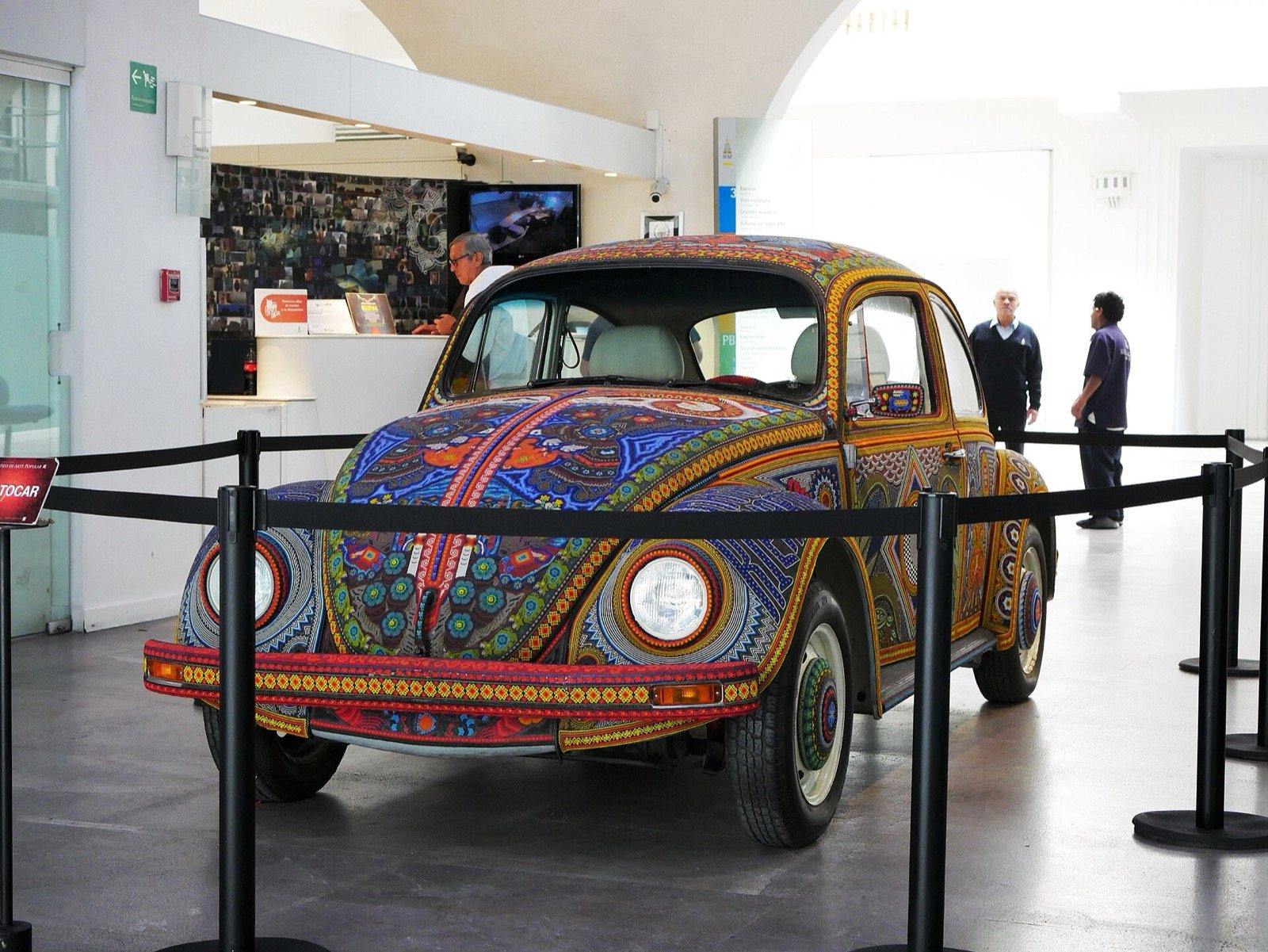 A VW Beetle covered in Huichol-style beadwork at the Museo de Arte Popular in Mexico City.
Suggested Huichol Art Itinerary
- Half day in Puerto Vallarta. Malecón and downtown, then cross the Cuale River into the Romantic Zone and browse the galleries slowly.
- Full day in Sayulita and San Pancho. Sayulita's plaza and side streets, then the stalls near San Pancho's beach.
- With more time. Guadalajara and Zapopan: the museum beside the Basilica and the Juárez station mural.
Etiquette with Wixárika Artisans
- Ask before taking photos of people or their work.
- Bargain gently: every piece holds many hours of work.
- Don't ask for ceremonies or peyote. These are religious practices, not tourist attractions.
- Use the right name. Saying "Wixárika" shows respect and often starts a good conversation.
Explore Vallarta and Sayulita with Riviera Tours & Transfers
Our tours do not include a dedicated visit to a Huichol gallery, but they do give you time on foot in the areas where you'll find this art:
- Vallarta City Tour: daily, about 7 hours, in English and Spanish. Guided walk through downtown Puerto Vallarta, a traditional jewelry stop, free time for shopping, a tequila stop and a visit to a regional-cuisine restaurant (meal not included). The Vallarta Plus City Tour adds a distillery tour, tequila tasting and lunch.
- Sayulita & San Pancho Tour: Tuesday, Thursday and Saturday, full day, max. 17 guests. Round-trip transportation, certified guide, traditional sweets tasting, San Pancho's plaza and beach, a guided walk through Sayulita and free time there.
See dates and book the Vallarta City Tour →
Tips for Shopping
- Bring cash: many street artisans don't take cards.
- Pack carefully: yarn paintings and beadwork are set in wax, so keep them out of direct sun and hot cars.
- Get the story in writing: if the artist explains the meaning, ask them to note it on the back.
FAQ
What is Huichol art? It is the art of the Wixárika people of the Sierra Madre Occidental, best known for yarn paintings (nierika) and beaded pieces featuring symbols such as the deer, corn and peyote.
Is Huichol the same as Wixárika? Yes. Wixárika is what the people call themselves; Huichol is the Spanish name.
What does the deer mean in Huichol art? It is a sacred guide. According to Wixárika tradition, a deer lifted the sun into the sky at Wirikuta.
Where can I buy Huichol art in Puerto Vallarta? In galleries and shops downtown and in the Romantic Zone. In Sayulita, look around the main plaza, where artisans also sell directly.
How can I tell if a piece is authentic? Ask for the artist's name and community, check that it is handmade on a wax base, and be cautious with very cheap or identical mass-produced pieces.
Why is Huichol art expensive? Every bead and strand is placed by hand. The Vochol alone took about 4,760 hours of work.
What is Wirikuta, and why is it a World Heritage Site? It is the sacred desert in San Luis Potosí where the Wixaritari make pilgrimage. In 2025 UNESCO added the pilgrimage route and its sacred sites to the World Heritage List.
Photos: Juan Carlos Fonseca Mata / CC BY-SA 4.0 via Wikimedia Commons · Juan Carlos Fonseca Mata / CC BY-SA 4.0 via Wikimedia Commons · U. Rodrigo López E. / CC BY-SA 4.0 via Wikimedia Commons · Thayne Tuason / CC BY 4.0 via Wikimedia Commons




