
Colorful papel picado flags over the streets, surfboards leaning on every wall, Huichol art, live music and a beach with waves almost all year. Sayulita grew from a small fishing village into one of the best-known towns on the Riviera Nayarit, and it still keeps its laid-back, bohemian vibe.
There is a lot more to it than surf and selfies, though. The town sits on a harbor that shows up in a 16th-century Spanish report, it was once part of a coconut-oil estate the size of a small country, and it still throws an old-fashioned town fiesta with brass bands, a rodeo and fireworks. This guide covers the best things to do in Sayulita, the story behind the town, and how to plan your day.
Sayulita at a Glance
Sayulita is in the municipality of Bahía de Banderas, in southern Nayarit, about 40 km (25 miles) north of Puerto Vallarta. In December 2015 it was named a Pueblo Mágico ("Magic Town"), a designation Mexico gives to towns with special cultural value.
It is a small place: Mexico's 2020 census counted roughly 3,400 residents, though in high season the crowds make it feel much bigger. Like the rest of Bahía de Banderas, Sayulita runs on Central Time, the same as Puerto Vallarta, so there is no clock change on the drive up, even though most of Nayarit is an hour behind.
Surfing put Sayulita on the map. Its waves are consistent and forgiving, which makes it a good spot for experienced surfers and first-timers alike. For the details, see our guide to surfing in Sayulita.
Sayulita History: From a Colonial Harbor to a Surf Town
An old harbor under another name
According to the municipal chronicle of Bahía de Banderas, as reported in the local press, the spot already appears in Lázaro Blanco's Relación de Compostela of 1584, under the name Santa Cruz Saloc, a coastal settlement in the Valle de Banderas. The chronicler bases the identification on two neighboring landmarks, Pontoque and San Francisco, which still carry those names today. A map of the coast of Nueva Galicia drawn in 1798 still labels it simply Santa Cruz.
Where the name "Sayulita" comes from
The most widely cited version comes from Federico Munguía, the town historian of Sayula, Jalisco. Around 1920, Lauro González Guerra, a native of Sayula who managed the Jaltemba hacienda, named the village after his hometown. "Sayulita" is simply "little Sayula." Sayula itself is a word of Nahuatl origin linked to flies, usually translated as "place where flies abound."
There is a twist: an 1880 report by the parish priest of Mascota, Homobono Anaya, already mentions a place in the area called "Sayulilla." That is why the chronicle suggests the name may go back to an earlier generation of the González family, who also ran the estate.
The coconut hacienda
For centuries this land belonged to the Jaltemba hacienda, which in the late 1700s was owned by a Romero family from Guadalajara and covered about 50,000 hectares (roughly 125,000 acres), stretching from Punta de Mita to La Peñita. By the early 1900s, the money was in palms: workers gathered and split coconuts to extract oil that was used to make soap. According to local history, a ship called at the little harbor every week to carry the oil away.
Many of the families who are now "Sayuleros" born and raised arrived to work on that estate. Oral histories published in the town's newsletter recall that in the 1930s the main settlement sat farther south, around Pátzcuaro, and that grandparents came from nearby coastal villages to work the coconut groves.
The ejido and the turn to the sea
In 1936 the hacienda lands passed to the workers and the Sayulita ejido, a community-owned land trust, was created. Sources disagree on the details: some say the Camarena family, the owners at the time, donated the land, while others describe a government expropriation. Either way, the ejido still exists today, covers villages from Lo de Marcos to Higuera Blanca and celebrates its anniversary every November.
In the 1940s coconut production collapsed and people turned to farming and fishing: red snapper, jack, Spanish mackerel, grouper, lobster and shrimp. In April 1951, President Miguel Alemán opened several schools in what is now Bahía de Banderas, Sayulita's among them. Town elders credit that first class of teachers with starting the town fiesta that is still celebrated today.
The highway and the surfers
The big turning point came in 1965, when the highway from Las Varas to Puerto Vallarta opened and connected Sayulita to tourism. Surfers began showing up in the 1960s, camping in front of the waves. Later, a government tourism project paved streets and built the plaza, the bandstand, the market and sidewalks. By the 1990s tourism had become the town's main livelihood, and in 2015 Sayulita became a Pueblo Mágico.
Sayulita Timeline
- 1584: The Relación de Compostela mentions Santa Cruz Saloc on the coast of the Valle de Banderas.
- 1798: A map of Nueva Galicia shows it as Santa Cruz, part of the Jaltemba hacienda.
- 1880: A report by Mascota's parish priest mentions "Sayulilla."
- c. 1920: Lauro González Guerra names the village Sayulita.
- 1936: The Sayulita ejido is formed.
- 1940s: Coconut oil declines; fishing and farming take over.
- 1951: The village school opens.
- 1965: The Las Varas–Puerto Vallarta highway opens; surfers start arriving during the decade.
- 2015: Sayulita is named a Pueblo Mágico.
Top Things to Do in Sayulita
- Hang out in the main square. It is the center of town life, surrounded by cafés, stalls and shops. It is where locals sing, dance and gather during festivals, and it stays lively well into the night.
- Wander the colorful streets. Murals, painted façades and papel picado make every block photo-worthy. Wear real shoes: the cobblestones are uneven and get slippery after rain.
- Watch the surfers or take a lesson. Surf schools and board rentals line the main beach. The water is warm most of the year and the sandy beach break is a friendly place to learn.
- Relax on the beach. Even if you don't surf, it is a great place to unwind and people-watch. Swim with care, follow the beach flags and stay away from the creek mouth.
- Walk to Playa de los Muertos. South of town, past the hillside cemetery, is a calm cove popular with families. Our Sayulita beaches guide explains how to get there.
- Shop for local art. Look for Huichol (Wixárika) beadwork, textiles, beachwear and pieces by local artists. Wixárika artisans from the Nayarit mountains sell yarn paintings and beadwork on the plaza every day. Before you buy, read our Huichol art guide.
- Look for folk art from other states. Shops in town often carry Michoacán pottery, like the little devils of Ocumicho and the green glazed pineapples of Patamban, carved wooden figures from Oaxaca and hammered copper.
- Eat well. From fish tacos and fresh seafood to coffee shops and bakeries, there is something for every budget. Our guide to Sayulita food covers what to order.
- Catch the sunset. The town faces west, so the sun drops right into the Pacific.
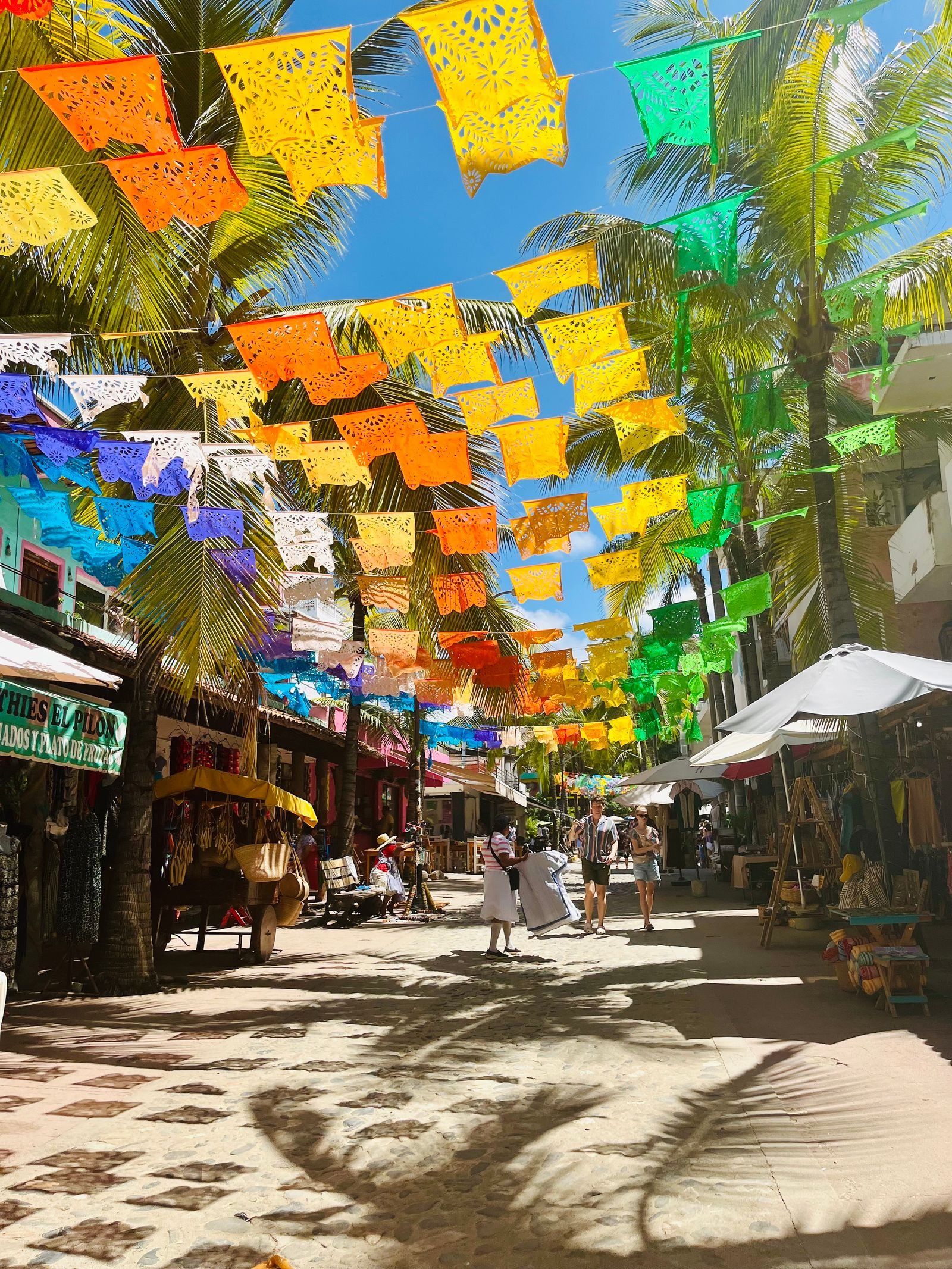 A Sayulita street strung with papel picado, one of the town's trademarks.
Festivals and Local Traditions in Sayulita
Sayulita is not just a visitor town. Its festivals still belong to the people who live here, and if your trip lines up with one, it is worth joining in respectfully.
- Sayulita Days (February). The town fiesta centers on February 24, Mexico's Flag Day, and runs for several days. According to local accounts, families gather in the plaza before dawn to sing Las Mañanitas; a parade follows with the Queen and Princess of Sayulita, charros (Mexican cowboys) and musicians; in the afternoon there is a jaripeo (bull-riding), and a carnival with rides sets up at the baseball field. Brass bands play until the small hours.
- Our Lady of Guadalupe (December). From December 4 to 12, each neighborhood organizes a pilgrimage with floats depicting the apparition of the Virgin, ending at the plaza. Expect fireworks, toritos (fireworks-loaded bull frames), music and food, especially on the night of the 11th.
- Day of the Dead (October 31 to November 2). The cemetery on the way to Playa de los Muertos fills with flowers, candles and photos, and altars and catrinas appear around town. If you walk through, keep your voice down and never step on the graves.
- Ejido anniversary (November). A quieter date, but an important one for the founding ejido families.
Dates and programs change every year, so check before you go, and expect fireworks and music at unexpected hours during fiesta season.
One more local detail from the kitchen: Nayarit has its own traditional dessert called cuala, made with coconut and corn masa, a fitting sweet for a coast that once lived off coconuts. Older women in Sayulita still remember making nixtamal (lime-treated corn) at home, long before it was sold ready-made at the tortilla shops.
Nature and Weather in Sayulita
Sayulita sits between the tropical dry forest of the hills and the ocean. The hills around town are home to coatis, armadillos, iguanas, chachalacas (a noisy native bird), wild boar and deer, while offshore anglers go after mahi-mahi, tuna, Spanish mackerel, marlin and roosterfish. That mix of jungle and sea is what turns the town so green in the rainy season.
The climate is tropical with two clear seasons. Using Puerto Vallarta's records as a reference, about 40 km away:
- Dry season (roughly November to May): clear skies, little rain and cool winter mornings. This is high season. Sea temperatures hover around 24 °C (75 °F) from January to March.
- Rainy season (roughly mid-June to mid-October): heat, humidity and downpours, mostly in the afternoon and evening. Mosquitoes are at their worst (bring repellent) and the ocean reaches about 30 °C (86 °F). It overlaps with Pacific hurricane season, so keep an eye on the forecast.
In winter, humpback whales visit the region; see our whale watching guide. And from summer into fall, sea turtles nest on several Nayarit beaches, as we explain in sea turtles in the Riviera Nayarit.
How to Get to Sayulita from Puerto Vallarta
Sayulita is about 40 km north of Puerto Vallarta on Federal Highway 200. The drive takes roughly 50 minutes to an hour, depending on traffic.
Your options:
- Rental car. Parking in the town center is limited, especially on weekends and in high season. Avoid driving outside town after dark and watch for unmarked speed bumps (topes).
- Public bus from Puerto Vallarta, cheaper but slower: with all the stops, the ride can take around an hour and a half.
- Guided tour, with round-trip transportation, a guide, and a stop in San Pancho on the same day.
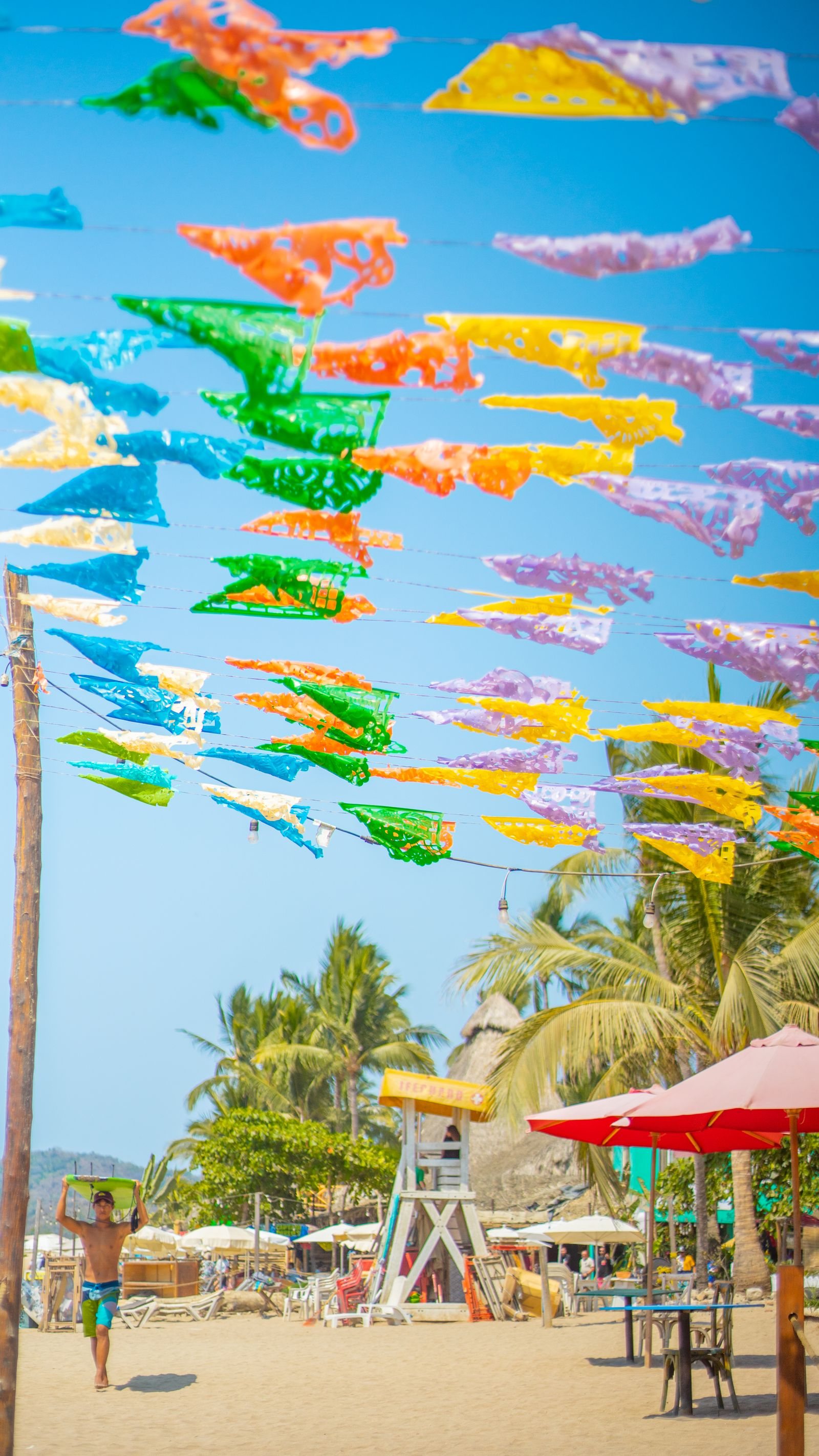 Papel picado over the beach in Sayulita.
Sayulita Day Trip Itinerary
Half day: 1. Arrive early and stroll the plaza and downtown streets before the heat kicks in. 2. Head to the main beach to watch the surfers. 3. Browse Huichol art on the plaza. 4. Grab fish tacos or seafood, then head back.
Full day: 1. Morning: surf lesson (or the walk to Playa de los Muertos, passing respectfully through the cemetery). 2. Midday: a long lunch and some shade during the strongest sun. 3. Afternoon: shopping, coffee and a mural walk. 4. Sunset: on the beach, watching the sun sink into the Pacific.
Staying longer? Pair Sayulita with San Pancho or other Riviera Nayarit beach towns. Not sure where to base yourself? Read Sayulita vs. Puerto Vallarta.
Sayulita and San Pancho in One Day
Just a few minutes from Sayulita is San Pancho (San Francisco), a quieter town with a wide beach and an artsy community. Together they make a perfect pair: the calm of San Pancho and the energy of Sayulita.
Our Sayulita & San Pancho tour from Puerto Vallarta runs Tuesday, Thursday and Saturday. It is a full-day tour offered in English and Spanish, and it includes:
- Round-trip transportation in a van (17 people maximum)
- Certified tour guide
- Tasting of regional Mexican candy
- Visit to San Pancho's main square and beach
- Guided walking tour of downtown Sayulita
- Free time in Sayulita
- 1 or 2 bottles of water
Want to surf? Tour guests get a 50% discount on surf lessons (extra cost).
See dates and book the Sayulita & San Pancho tour →
Tips for Your Visit to Sayulita
What to pack - Biodegradable sunscreen, a hat, sunglasses and a beach towel. - Comfortable shoes for the cobblestones; flip-flops get slippery after rain. - Bug repellent, especially in the rainy season. - In winter, a light layer for mornings and evenings.
Money and budget - Carry some cash for street stalls, artisans and small shops. If you need an ATM, use one inside a bank and go during the day. - Sayulita works for every budget, from taco stands to beachfront dining. Prices rise in high season. - Food: meals are not included on the tour, so plan to eat in Sayulita during your free time.
Health and safety - Don't drink the tap water; stick to bottled or jug water. - Follow the beach flags. If a rip current pulls you out, don't fight it: swim parallel to shore, then angle back in. - Avoid the midday sun and stay hydrated. - The nearest full-service hospital is in Puerto Vallarta, so travel insurance is a good idea.
Respect the community - Go early if you are driving: the center gets busy by midday. - Ask before photographing artisans or families during festivals. - People live here year-round: keep it down at night and pack out your trash.
FAQ
Is Sayulita a Pueblo Mágico? Yes, since December 2015.
How much time do I need in Sayulita? Half a day is enough for the square, the main streets and some beach time. If you want to surf, plan for a full day.
Can I visit Sayulita and San Pancho on the same day? Yes, they are very close. Our tour visits both.
What does the name Sayulita mean? It means "little Sayula." The most cited story says that around 1920 the manager of the Jaltemba hacienda, who was from Sayula, Jalisco, named the village after his hometown.
When is the best time to visit Sayulita? November to May brings drier, more comfortable weather, though it is high season. Summer is quieter but hotter, more humid and rainy.
What festivals are held in Sayulita? The main ones are Sayulita Days around February 24, the Our Lady of Guadalupe celebrations from December 4 to 12, and Day of the Dead. Check each year's schedule.
Is Sayulita in the same time zone as Puerto Vallarta? Yes. Sayulita belongs to Bahía de Banderas, which uses Central Time, just like Puerto Vallarta.
Is it safe to swim in Sayulita? Yes, with care: follow the flags, stay away from the creek mouth and check the latest COFEPRIS water-quality report before you go.
Photos: Archie McNicol / Pexels License via Pexels · Stephanie Crephead / Pexels License via Pexels · Vladimir Miranda / Pexels License via Pexels




