
Every winter, Banderas Bay becomes a nursery for one of the ocean's great travelers. Humpback whales swim thousands of miles from cold northern waters to mate and give birth here, and for a few months you can watch them breach, slap their fins and raise their tails just a few miles from the beach. Here is what to know about whale watching in Puerto Vallarta: when the season runs, why the whales come, what their famous song is all about, how they went from hunted to protected, and how to see them responsibly.
When Is Whale Season in Puerto Vallarta?
Mexico's environment ministry (SEMARNAT) publishes an official notice every year with whale-watching dates. For the 2025–2026 season, that notice set the window for Banderas Bay (Puerto Vallarta and Cabo Corrientes in Jalisco, plus the Bahía de Banderas municipality in Nayarit) at December 8 to March 23.
In reality, the first whales often show up in mid-November, and some mothers linger a little longer until their calves are ready for the trip north. Puerto Vallarta's tourism board calls January and February the best months, when surface activity tends to peak.
Seasons are not identical across Mexico: in Los Cabos, for example, whale watching runs until the end of April. Dates also shift slightly each year, so check the current SEMARNAT notice for the 2026–2027 season before you book.
Some years are better than others. Ecobac, the nonprofit that studies the bay's humpbacks, says its surveys averaged 3 to 4 whales per hour over recent seasons. In 2025, a La Niña year with cooler-than-usual seas, that rate climbed to about 8 whales per hour, the highest it had on record.
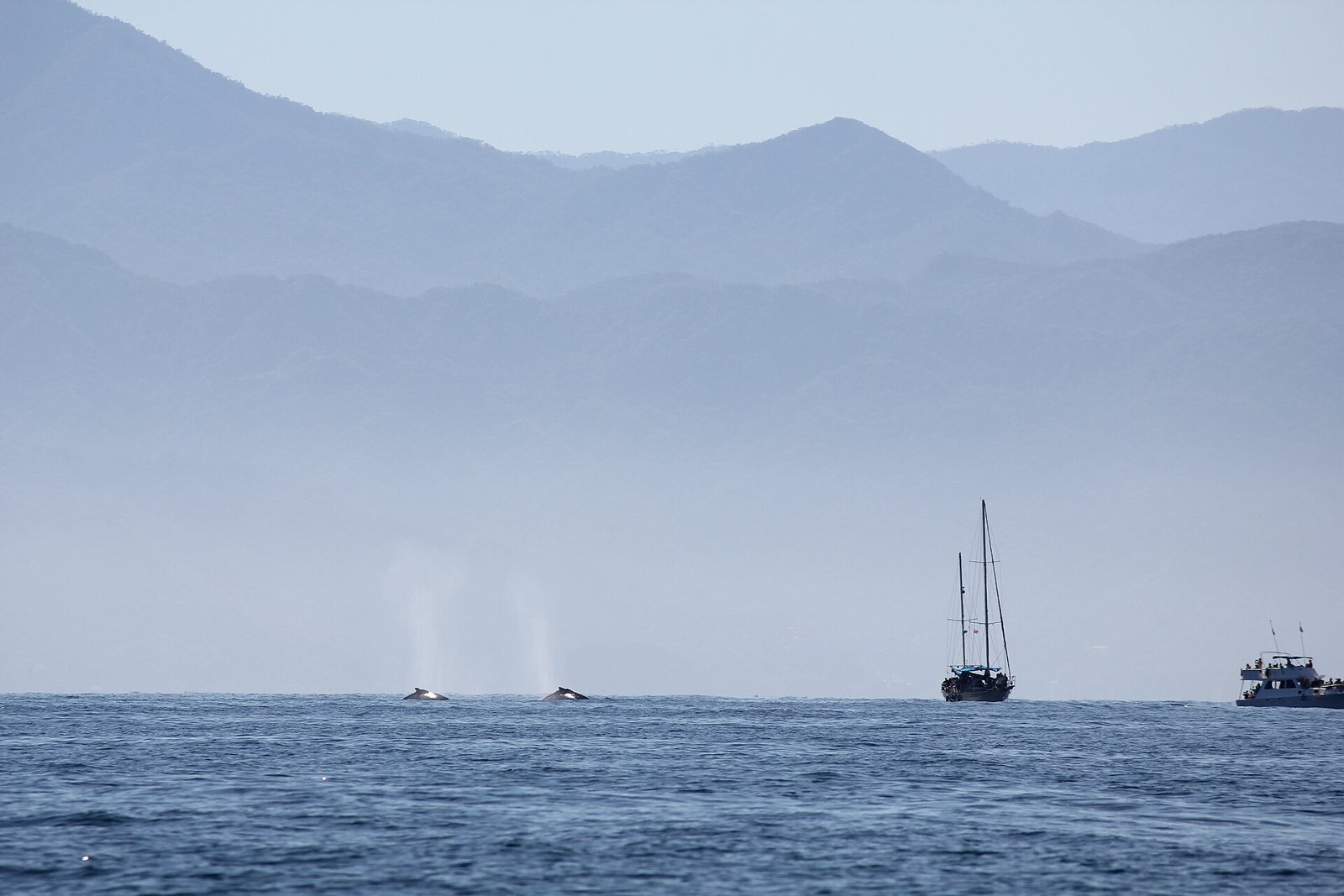 Two humpback whales spouting in Banderas Bay, with the Vallarta mountains in the background.
Meet the Humpback: A Giant by the Numbers
The scientific name, Megaptera novaeangliae, tells part of the story. Megaptera means "big-winged," a nod to pectoral fins that run about a third of the body's length. Novaeangliae means "of New England," where European whalers first came across the species.
- Size: adults typically measure about 46 to 60 feet and can weigh around 40 tons. Females tend to be slightly longer than males.
- Tail: the flukes can be up to 18 feet wide, and the underside carries a pattern of black, white and scars as unique as a fingerprint.
- Calves: born after an 11-month pregnancy, about 13 to 16 feet long, and stay with their mothers for up to a year.
- Lifespan: an estimated 80 to 90 years.
- Diet: they filter krill and small fish through baleen plates. Up north, some groups blow "bubble nets" to trap schools of fish before lunging up through them.
Why Humpback Whales Come to Banderas Bay
Humpbacks spend summer feeding in cold, food-rich waters of the North Pacific, then head to warm, shallow tropical waters in winter to breed. Some populations travel about 5,000 miles between feeding and breeding grounds; NOAA notes the Alaska-to-Hawaii trip alone, about 3,000 miles, can take as little as 28 days.
So where do Vallarta's whales come from? According to NOAA research, humpbacks that winter off Mexico feed mostly in Alaska and, to a lesser extent, Russia. One group that winters off mainland Mexico feeds along California, Oregon and Washington, and between Nayarit and Guerrero they mix with whales from the Central America population.
Several things happen in the bay at once:
- Calves are born. Females arrive to give birth, and calves stay close to their mothers while they build strength for the long migration.
- Courtship and competition. Males compete for females, and, according to NOAA, only the males sing. Their songs are heard mostly on breeding grounds.
- Surface displays. Breaching, pectoral-fin slaps and tail lifts are classic humpback behaviors.
The bay itself is quite a stage. It stretches about 60 miles (100 km) of coastline from Punta de Mita in the north to Cabo Corrientes in the south, with rivers such as the Ameca flowing in. Its human story runs deep too: Spanish explorer Francisco Cortés de San Buenaventura is credited with reaching it in 1525, and in colonial times it served as a refuge port on the Manila galleon route.
What Are You Looking At? A Field Guide to Whale Behavior
Knowing the moves makes any trip more exciting:
- Blow (spout): the column of vapor a whale exhales. Usually the first thing you spot from far away.
- Breach: the whale launches much of its body out of the water and crashes down on its side.
- Fluke-up dive: before a deep dive it arches its back (hence "humpback") and lifts its tail.
- Pec slap and tail slap: repeated smacks on the surface with a long pectoral fin or the tail.
- Peduncle throw: the whale hurls the rear of its body sideways out of the water.
- Competitive group: several males ("escorts") chase a female, shoving, ramming and cutting each other off.
- Mother and calf: swimming side by side; mothers often touch their calves with their flippers.
Scientists think these displays may serve as communication or play, and may even help shed parasites.
The Song of the Humpback Whale
Scientists believe only male humpbacks sing, in sessions that can last anywhere from five minutes to more than 24 hours. A song is built from short units that form phrases; phrases group into themes, and themes follow a set order, much like lines and stanzas in a poem.
Here is the remarkable part: males in the same area sing the same version, and that version keeps evolving. Changes are copied from whale to whale and can spread from one population to another over successive seasons. The sound can carry at least 6 miles underwater.
This song changed the fate of whales. In 1967, on a research trip to Bermuda, biologist Roger Payne and Scott McVay realized the sounds were structured songs. The 1970 album Songs of the Humpback Whale helped fuel the "Save the Whales" movement, and in 1977 Payne's recordings were placed on the Voyager Golden Record, headed out of the solar system.
In Banderas Bay, some tour boats carry hydrophones so you can hear it. Mexico's whale-watching rule even makes room for that moment: near whales, engines may only be switched off to listen to songs with a hydrophone.
From Whaling to Protection: A Brief History
Before commercial whaling stopped, most humpback populations had been cut by more than 95 percent. Their comeback is one of conservation's great stories, and Banderas Bay has its own chapter.
Timeline
- Late 1500s: humpback whaling begins.
- 20th century: an estimated 28,000 humpbacks are killed in the North Pacific alone.
- 1966: the International Whaling Commission (IWC) bans commercial humpback whaling.
- 1967–1970: Payne and McVay discover humpback song, and the album moves the world.
- Mid-1980s: the IWC's moratorium on all commercial whaling takes effect.
- 1996: Ecobac launches its photo-ID catalog of Banderas Bay humpbacks.
- 1998: Mexico publishes its first whale-watching standard (NOM-131, 1998).
- 2002: Mexico declares its national waters a refuge for great whales, and the first humpback whale symposium is held in Banderas Bay.
- 2004: the first entangled-whale rescue in the bay and the birth of RABEN, Mexico's entangled-whale response network.
- 2004–2006: bay researchers join SPLASH, an international study of North Pacific humpbacks.
- 2011: Mexico issues the current rule, NOM-131-SEMARNAT-2010.
- 2016: the U.S. splits humpbacks into distinct populations; the one wintering in Mexico is listed as "threatened."
- 2025: Ecobac records its highest-ever sighting rate in the bay.
Science in the Bay: Whales With Names
Since 1996, Ecobac researchers have photographed the underside of every humpback tail they can find in the bay and matched it against their catalog. Its growth tells the story: 991 individual whales after 10 years, 1,731 after 16, 2,272 after 25, and about 3,600 by the 2023 season, with more than 12,000 sightings on file.
Many come back. A male nicknamed "La Mexicana" was first photographed in 1999 and returned to the bay in 2025. "La Corcholata," a female first recorded with a calf in 2001, was still active in the bay in 2025.
How to See Whales in Puerto Vallarta
The most common option is a boat tour with a licensed operator. Some boats carry marine biologists or specialized guides, and some use hydrophones so you can listen to whale songs.
You can also sometimes spot spouts or breaches from shore. During the season, whales have been filmed right off the Puerto Vallarta Malecón. It is never guaranteed, but bring binoculars on a morning walk; our Malecón and Old Town guide has ideas for the rest of the stroll.
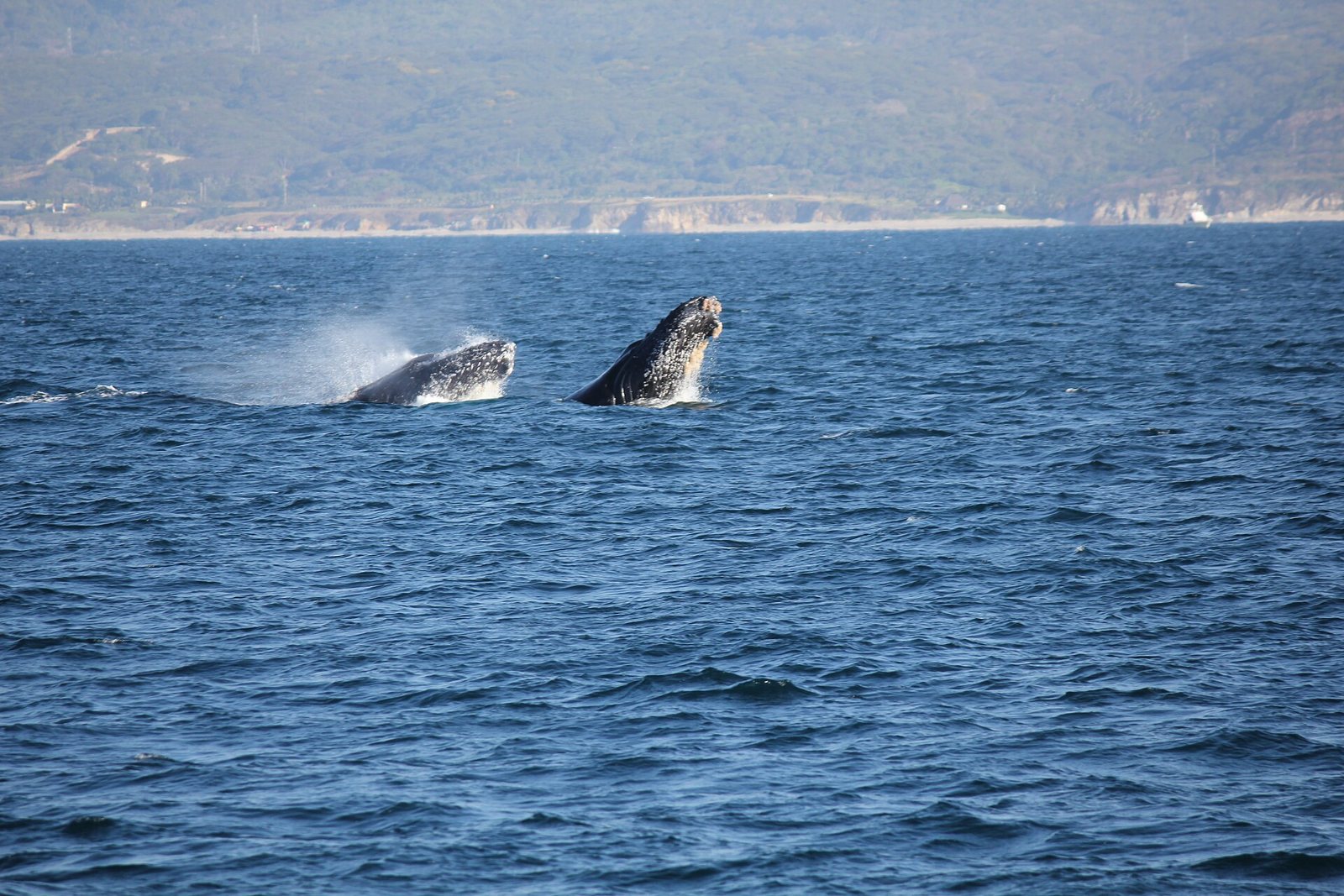 Humpback whales at the surface near the Marietas Islands.
Mexico's Whale-Watching Rules (NOM-131)
Whale watching in Mexico is regulated by the federal standard NOM-131-SEMARNAT-2010. As a passenger, these are the key points:
- Licensed operators only. Boats need SEMARNAT authorization and must display an identification marker during the trip.
- Minimum distance. For humpbacks, the rule sets 60 meters (about 200 feet) for small boats (under 10 meters long). When other boats are already watching, the rest wait 240 meters away.
- Limited boats and time. No more than four boats around the same whale or group, for up to 30 minutes.
- Slow speeds. Under 5 knots in whale-watching areas and 2 knots when entering the zone where whales are. Boats should approach diagonally from behind and never block a whale's path.
- No sonar, no aircraft. Sonar and fish finders can't be used to locate whales, and helicopters or ultralights can't be used to watch them.
- No swimming, diving or feeding, and boats must never come between a mother and her calf.
The 2025–2026 notice also set restricted zones in the bay where whale watching was not allowed because of the number of mothers with calves: a 1.5 km radius around the Marietas Islands and a 2 km coastal strip from Punta de Mita to the mouth of the Ameca River. Check the current rules before you go, since they can change each season.
These rules matter. Ecobac has documented more than twenty whales struck by boats in the bay since 2007, most of them mothers with calves, and warns that many strikes go unreported. It promotes a "Less speed = more lives" campaign for boaters.
Fishing gear is the other big threat. RABEN, created by Ecobac with support from Mexico's protected-areas agency (CONANP), brings together trained teams from the navy, port authorities, environmental enforcers, tour operators and universities, and has freed more than 100 whales in Mexican Pacific waters. If you see an entangled whale, do not try to help it yourself: tell your captain so they can alert authorities or the network through the channels listed at rabenmexico.org.
How to Choose a Whale-Watching Tour
- Ask whether the operator holds a SEMARNAT permit for the season, and look for the marker on the boat.
- Choose trips with guides or biologists who explain what you are seeing, and ask whether they carry a hydrophone.
- If a boat chases whales or gets too close, ask the captain to back off.
- Go in the morning, when the sea is usually calmer. In peak season, book ahead; trips fill up.
- Pack a hat, sunglasses, sunscreen, a light jacket for the cool morning breeze, non-slip shoes and a camera with a good zoom or binoculars.
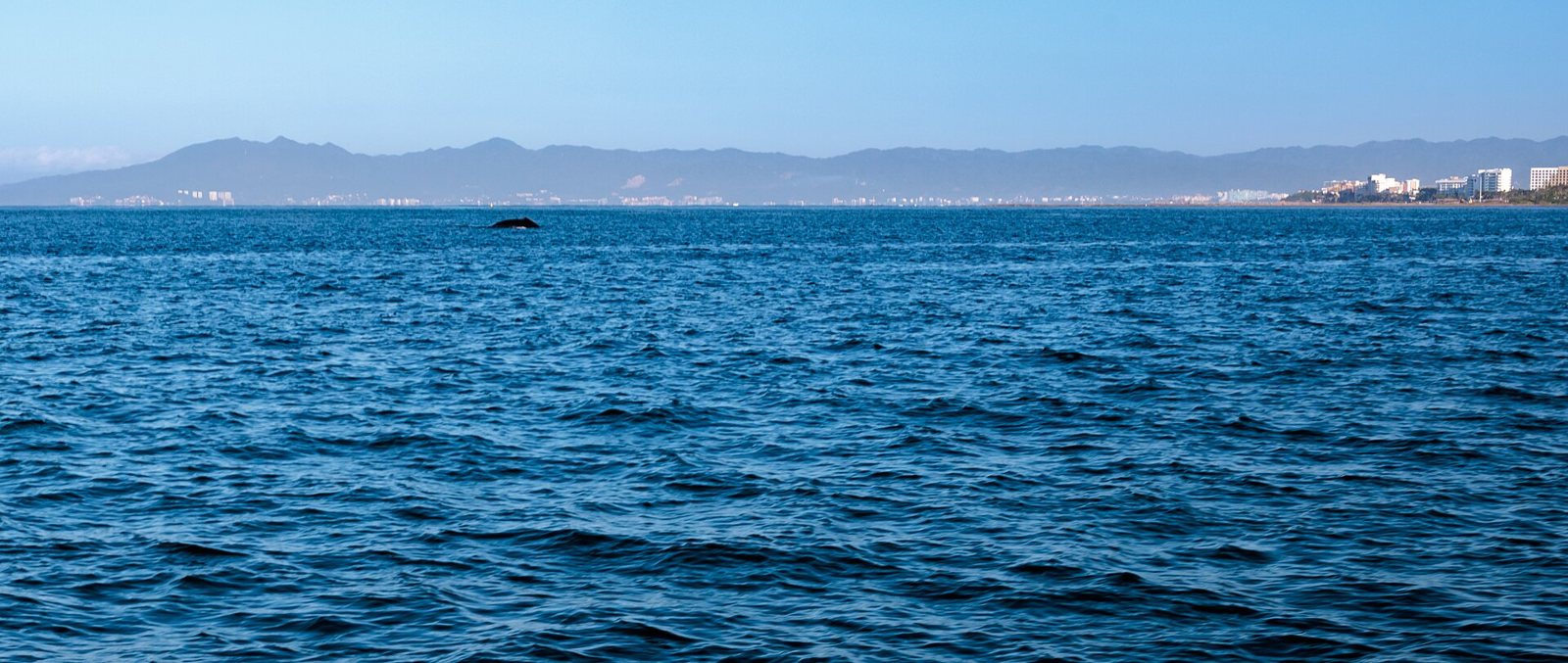 A humpback whale in the middle of the bay, with the Vallarta coastline behind, December 2022.
A Sample Itinerary for Whale Season
Visiting between December and March? Here is one way to mix sea and land over three days:
- Day 1, whales: an early whale-watching trip with a licensed operator; in the afternoon, walk the Malecón with binoculars and catch the sunset over the bay.
- Day 2, classic Vallarta: explore downtown's cobblestone streets and its history. Founded in 1851 as Las Peñas de Santa María de Guadalupe, the town has always faced this bay; read more in our Puerto Vallarta history.
- Day 3, the Nayarit coast: laid-back surf towns like Sayulita and San Pancho. See our guide to things to do in Sayulita.
Budget: the whale-watching trip is usually the day's biggest expense, while scanning for spouts from the Malecón costs nothing.
On Land: Riviera Tours & Transfers Day Trips
To be upfront: Riviera Tours & Transfers does not run whale-watching tours. For that, book with a SEMARNAT-licensed operator.
What we can do is round out your winter trip on land. Our Vallarta City Tour runs every day, lasts about 7 hours and is offered in English and Spanish. It includes:
- A guided walk through downtown Puerto Vallarta
- A stop at a traditional jewelry shop
- Free time for shopping
- A tequila stop
- A visit to a regional-cuisine restaurant (meal not included)
If you would rather have lunch included, the Vallarta Plus City Tour adds a distillery tour and tequila tasting. And to see the Riviera Nayarit coast, our Sayulita and San Pancho tour runs Tuesdays, Thursdays and Saturdays.
Check dates and book the Vallarta City Tour →
Planning the rest of your trip? See our guides to things to do in Puerto Vallarta, visiting the Marietas Islands and, for more marine life, sea turtles in Riviera Nayarit.
FAQ
What is the best month for whale watching in Puerto Vallarta? January and February usually bring the most surface activity. The official 2025–2026 season in Banderas Bay ran from December 8 to March 23; check the current SEMARNAT notice for this year's dates.
Can you see whales from the beach in Puerto Vallarta? Sometimes. Whales have been seen from the Malecón during the season, but a licensed boat tour gives you much better odds.
Can you swim with humpback whales in Banderas Bay? No. Mexico's NOM-131 prohibits swimming, diving with or feeding whales during whale watching.
Do the same whales come back to Puerto Vallarta every year? Many do. Ecobac's catalog includes whales first photographed in the bay in the late 1990s that have returned in recent seasons.
Why do humpback whales sing? Only males sing, mostly on breeding grounds like Banderas Bay. It is thought to relate to courtship and competition between males, though scientists still debate its exact purpose.
What should I do if I see a whale tangled in fishing gear? Keep your distance and don't try to free it. Tell your captain or the authorities so it can be reported to RABEN, which has trained rescue teams.
Does Riviera Tours & Transfers offer whale watching? No. We offer land tours like the Vallarta City Tour and the Sayulita and San Pancho tour, which you can pair with a whale-watching trip from a licensed operator.
Photos: terri_bateman / CC BY 2.0 via Wikimedia Commons · terri_bateman / CC BY 2.0 via Wikimedia Commons · terri_bateman / CC BY 2.0 via Wikimedia Commons · TerryDOtt / CC BY 2.0 via Wikimedia Commons




