
Puerto Vallarta has something hard to find: it is a beach city with the soul of a small town. Cobblestone streets, red-tile roofs, a seaside boardwalk and, less than two hours away, Magic Towns in the mountains and along the Nayarit coast. Behind the postcard is a story few visitors hear: a hamlet founded to ship salt to silver mines, a town that spent nearly a century cut off between the mountains and the sea, and a Hollywood movie that put it on the world map. This guide covers what you shouldn't miss, in town and beyond, with the backstory that makes each place more meaningful.
A Little History
The settlement was founded on December 12, 1851, as Las Peñas de Santa María de Guadalupe. According to the traditional account, that day salt trader Guadalupe Sánchez Torres arrived at the mouth of the Cuale River with his wife, Ambrosia Carrillo, and a few other families. Because it was the feast of the Virgin of Guadalupe, the place took her name.
Its first business was salt, shipped to the silver mines of the Sierra Madre, including those of San Sebastián del Oeste. After decades under the authority of mountain municipalities, it became a municipality in its own right in 1918 and was renamed Puerto Vallarta. For the other end of that salt route, read our piece on San Sebastián del Oeste's mining history.
International fame arrived in 1963, when John Huston filmed The Night of the Iguana in Mismaloya, just south of town. Richard Burton and Elizabeth Taylor's presence put Vallarta in newspapers around the world, and the couple stayed tied to the town: their downtown home, with the famous bridge linking its two houses, still stands. Learn more in Casa Kimberly and The Night of the Iguana in Puerto Vallarta.
Puerto Vallarta Timeline
- December 12, 1851: Las Peñas de Santa María de Guadalupe is founded at the mouth of the Cuale River.
- 1885: the port opens to national shipping and gets a customs house.
- 1886: Las Peñas becomes a district (comisaría) of the municipality of Talpa.
- 1888: the district is transferred to the municipality of San Sebastián.
- May 31, 1918: it becomes a municipality named Puerto Vallarta.
- 1963: The Night of the Iguana is filmed in Mismaloya.
- May 31, 1968: on the municipality's 50th anniversary, Puerto Vallarta is granted city status.
- 1986–1993: Marina Vallarta is built.
- 2002: Hurricane Kenna damages the Malecón, later rebuilt as a pedestrian promenade.
- December 2024: the final stretch of the highway from Guadalajara opens, cutting the drive to about two and a half hours.
For the full story, read our history of Puerto Vallarta.
Who Was Ignacio L. Vallarta?
The city honors Ignacio Luis Vallarta (1830–1893), a lawyer born in Guadalajara. He served as governor of Jalisco, as Mexico's foreign minister and as president of the Supreme Court from 1877 to 1882. He is remembered above all for helping establish the amparo, a constitutional lawsuit that protects individual rights and remains one of the pillars of Mexican law. The tribute came in 1918, 25 years after his death.
Between the Mountains and the Sea: Geography and Climate
Vallarta sits on a narrow coastal plain at the foot of the Sierra Madre Occidental, at the back of Banderas Bay. The bay stretches from Punta de Mita in Nayarit to Cabo Corrientes in Jalisco and is one of the largest on Mexico's Pacific coast. Three rivers run down from the mountains: the Cuale, which splits downtown in two; the Pitillal; and the Ameca, which marks the border between Jalisco and Nayarit.
The climate is tropical, with two clear seasons:
- Dry season (November to May): almost no rain; February, March and April are the clearest months. January lows average around 62 °F (17 °C), so bring a light layer for evenings.
- Rainy season (mid-June to mid-October): hot, humid and stormy, mostly in the afternoon and at night. September is the wettest month. The sea warms up to about 86 °F (30 °C) from August to October.
A handy detail: Puerto Vallarta runs on Central Time, as does the municipality of Bahía de Banderas (Nuevo Vallarta, Bucerías, Sayulita, San Pancho); the rest of Nayarit uses Pacific Time.
Things to Do in Puerto Vallarta Itself
1. Walk the Malecón
Vallarta's famous seaside boardwalk runs about a dozen blocks and works as an open-air sculpture museum. Look for Rafael Zamarripa's Boy on the Seahorse, the city's symbol, and Alejandro Colunga's Rotunda by the Sea (1996), with bronze chairs you can sit on. Don't miss Ramiz Barquet's Nostalgia; Sergio Bustamante's In Search of Reason, with figures climbing a ladder toward the sky; Carlos Espino's Tritón y Sirena (Triton and Mermaid, 1990); and Mathis Lidice's Millennium (2001).
The boardwalk you walk today is fairly new: Hurricane Kenna damaged it in 2002, it was rebuilt, and it was later redesigned as a wide pedestrian promenade. At sunset it fills with families, music and snack vendors. Read more in our Puerto Vallarta Malecón & Old Town guide.
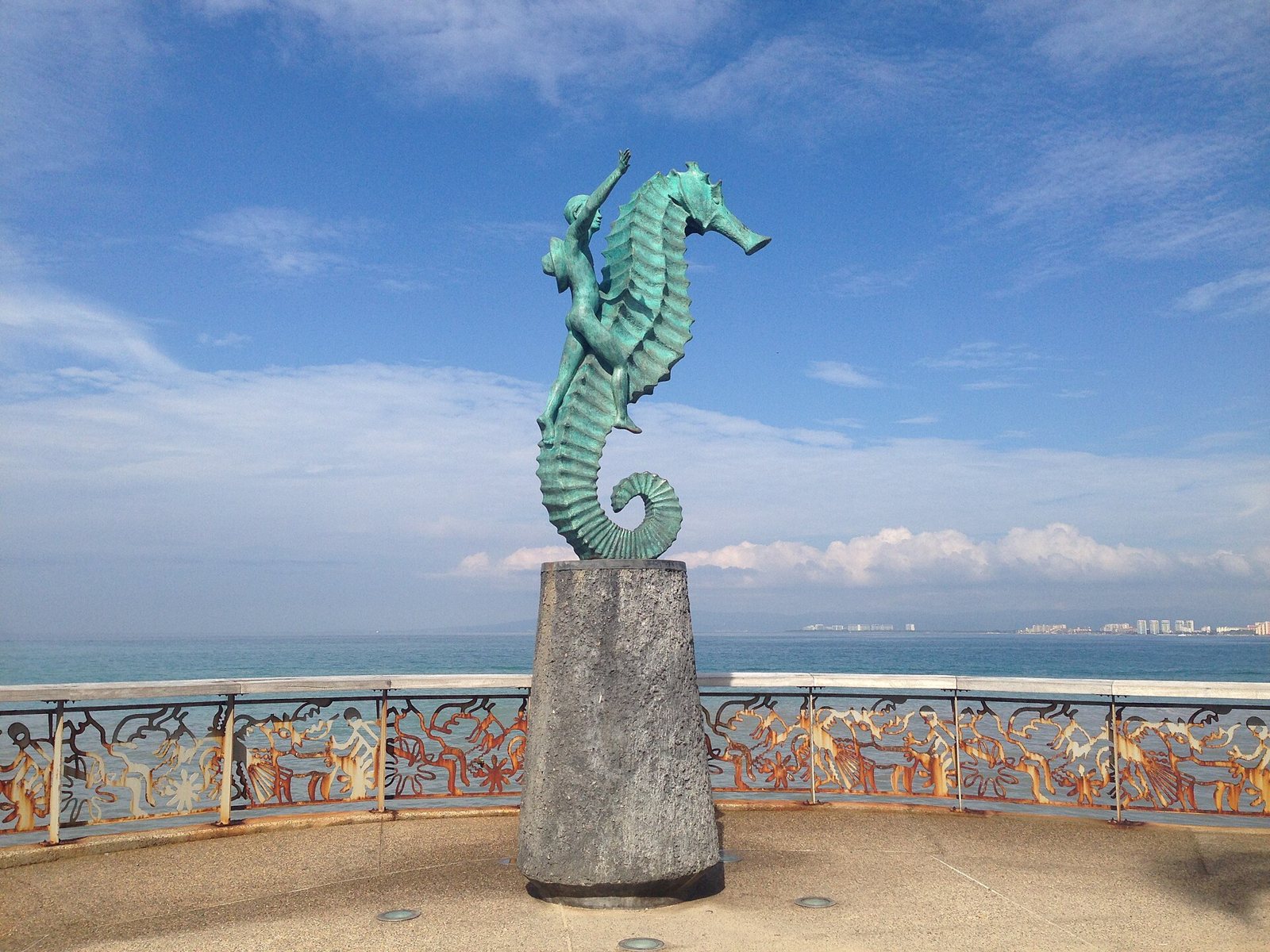 The Boy on the Seahorse by Rafael Zamarripa, the symbol of Puerto Vallarta, on the Malecón.
2. Explore Downtown
The Church of Our Lady of Guadalupe, with its crown-topped tower, is the city's icon. It took decades to build and was dedicated on October 12, 1921; the crown was added in the 1960s and has been rebuilt after storms and an earthquake. Around it you'll find the main square and bandstand and cobblestone streets climbing the hillside.
A few blocks away, on the bank of the Cuale, is the Río Cuale Municipal Market. The market dates to 1957, and its current building, designed by architect Alejandro Zohn, went up between 1977 and 1979. Today it sells crafts, silver, leather and souvenirs, with Mexican food stalls upstairs. The city announced a renovation for 2026, so check whether it's fully open when you go. More ideas in our Puerto Vallarta markets guide.
3. Cross to Isla Cuale and the Romantic Zone
In the middle of the river is a long, narrow island reached by footbridges, one of them a swinging suspension bridge. It has shady paths, craft stalls, the small Museo del Cuale, with pre-Hispanic pieces from the region, and a bronze statue of John Huston sitting in his director's chair.
Across the river begins the Romantic Zone, the Emiliano Zapata neighborhood. Its landmark is the Los Muertos Pier, opened in 2013 and topped with a sail-shaped steel structure that lights up at night. Water taxis to the south-shore beaches leave from here.
4. Climb to the Mirador de la Cruz
For a view over the whole bay, walk up from downtown through alleys and stairways around Abasolo Street to the Cerro de la Cruz lookout. Expect 15 to 20 minutes of steep climbing. Go early, with water and good shoes.
5. Taste Tequila and Local Food
Vallarta is in Jalisco, the home of tequila. Galleries and distilleries explain how it is made and offer tastings. The local food has its own stories, too:
- Pescado embarazado: fish or seafood skewered on a stick and grilled over a beach fire. The name is a pun on en vara asado ("grilled on a stick"), and the dish is believed to have started with local fishermen.
- Pescado zarandeado: butterflied, marinated fish grilled over coals, with roots on the Nayarit coast.
- Aguachile and ceviche: aguachile, raw shrimp cured in lime and chile, comes from Sinaloa; Vallarta-style ceviche uses finely chopped fish.
- Tuba: a drink made from coconut palm sap that reached Mexico's Pacific coast from the Philippines aboard the Manila galleons. Vendors sell it fresh on the Malecón.
- Tejuino: a fermented corn drink with piloncillo sugar, lime and salt, sometimes topped with lime sorbet.
- Raicilla: an agave spirit from Jalisco's mountains and coast, with a protected designation of origin since 2019.
Go deeper with our Puerto Vallarta food guide.
6. Hit the Beach
In town, Playa Los Muertos is the liveliest beach. To the south, Highway 200 hugs the coast to Mismaloya, about 6–7 miles (10–12 km) from downtown, where The Night of the Iguana was filmed. Offshore stand Los Arcos, granite islets with natural tunnels that have been a marine wildlife refuge since 1975, home to pelicans, boobies and reef fish.
Past Boca de Tomatlán, the road turns inland and the beaches of Las Ánimas, Quimixto and Yelapa can only be reached by boat or a coastal trail. See our south shore beaches guide and our Yelapa guide.
Always swim with care: follow the beach flags and Civil Protection instructions, which can change from day to day, and stay out of the water after drinking.
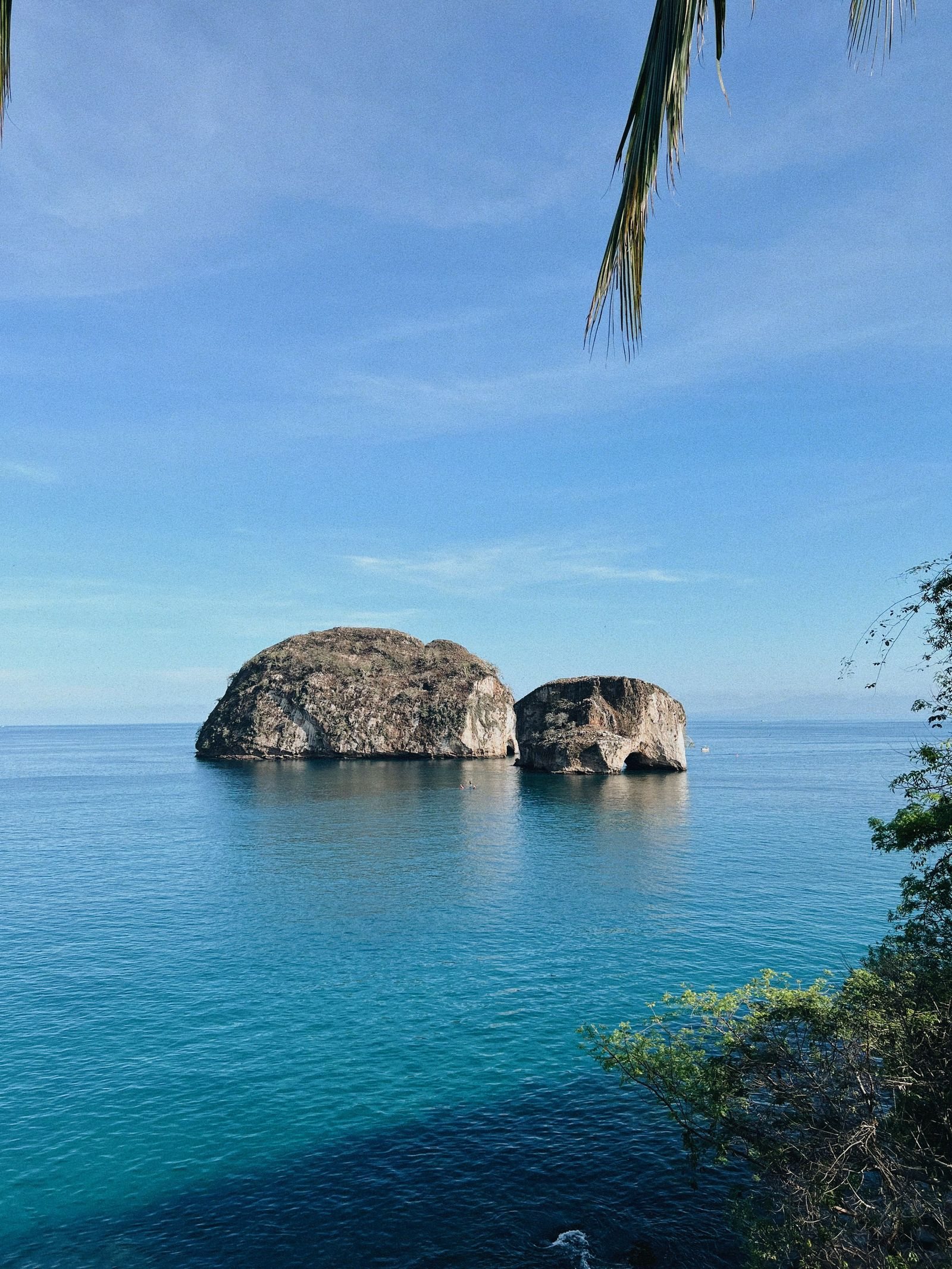 Los Arcos rock formations in Banderas Bay, Puerto Vallarta.
7. Watch the Sunset
The sun sets over Banderas Bay almost all year round. The Malecón and the downtown beaches are favorite viewing spots.
8. Whale Watching (Seasonal)
In winter, humpback whales travel to Banderas Bay from their North Pacific feeding grounds, mainly Alaska, to mate and give birth. For the 2025–2026 season, Mexico's environment ministry (Semarnat) set the official viewing period from December 8 to March 23, and January and February tend to be the busiest months. Whale watching is regulated by Mexican standard NOM-131: authorized operators only, at a set distance. Riviera doesn't offer this trip; learn how to choose one in our whale watching in Puerto Vallarta guide.
9. Discover Huichol Art
The Wixárika (Huichol) people live in the mountains where Jalisco, Nayarit, Durango and Zacatecas meet, and their beadwork and yarn paintings pressed into wax are among Mexico's most recognizable folk art. Downtown and the Romantic Zone have Huichol art galleries, some with artists working on site. Learn how to spot an authentic piece in our Huichol art guide.
10. Visit the Vallarta Botanical Garden
About 15 miles (24 km) south, in the municipality of Cabo Corrientes, the Vallarta Botanical Garden was founded in 2004 on former cattle pasture. It is known for its Mexican orchids, jungle trails and the Los Horcones River. In 2022 it received the American Public Garden Association's Garden of Excellence award. Details in our Vallarta Botanical Garden guide.
Festivals and Living Culture: Vallarta's Calendar
If you can, time your trip around one of these dates:
- May: every May 31 the city marks the founding of the municipality, with festivities around that date. Vallarta Pride also takes place in May, centered on the Romantic Zone; Vallarta is one of Mexico's best-known LGBTQ+ destinations.
- November 2: Day of the Dead, with altars and celebrations around town.
- December 1–12: the Guadalupe festivities, Vallarta's biggest celebration. Pilgrimages wind through downtown to the church, and the fiesta peaks on December 12, which is also the city's founding anniversary.
- December: posadas close out the year.
City Tours
If you want to explore downtown with someone who knows its stories, our City Tours run every day, last about 7 hours and are offered in English and Spanish:
- Vallarta City Tour: guided walking tour of downtown, a stop at a jewelry shop, free time for shopping, a tequila distillery visit and tasting, and a stop at a Mexican restaurant (lunch optional).
- Vallarta City Tour Plus: the same tour with an authentic Mexican lunch included.
Day Trips from Puerto Vallarta
Some of the best of Vallarta is just outside it:
- San Sebastián del Oeste: a historic mining town in the Jalisco mountains, founded in 1605 at about 4,850 feet (1,480 m), a Pueblo Mágico since 2011, with coffee farms and cool mountain air. Its mines created the demand for salt that gave birth to Las Peñas. → San Sebastián tour (Mon, Wed, Fri)
- Sayulita: the surf-and-bohemian town of the Riviera Nayarit, a Pueblo Mágico since 2015.
- San Pancho: a wide beach, a quiet vibe and an artsy community, minutes from Sayulita. → Sayulita & San Pancho tour (Tue, Thu, Sat)
More ideas on your own: the Marietas Islands, a national park off Punta de Mita (visiting rules change, so confirm them with CONANP or an authorized operator), and the Riviera Nayarit beach towns.
Sample Itinerary: 4 Days in Puerto Vallarta
- Day 1, downtown: a City Tour to get your bearings; in the afternoon, Isla Cuale, the Romantic Zone and sunset on the Malecón.
- Day 2, the mountains: a day trip to San Sebastián del Oeste (Monday, Wednesday or Friday).
- Day 3, the south shore: Mismaloya, Los Arcos and Boca de Tomatlán, or the Botanical Garden.
- Day 4, Nayarit: Sayulita and San Pancho (Tuesday, Thursday or Saturday).
Only have half a day? Walk the Malecón from north to south, step into the church, cross to Isla Cuale and end with sunset at Playa Los Muertos.
Travel Tips
- Best time to go: November to April brings little rain and whale season, but also bigger crowds and higher prices. The rainy season means green mountains and fewer people.
- Carry cash for markets, tips and small businesses.
- Wear comfortable shoes: downtown streets are cobblestone and hilly.
- Sun protection: biodegradable sunscreen, sunglasses and a hat; at midday, find shade on Isla Cuale.
- Getting around: downtown and the Romantic Zone are walkable; for the south shore there are local buses from the Romantic Zone, taxis and ride-hailing apps.
- Budget: street food and markets are inexpensive; oceanfront restaurants and boat trips raise your spending quickly.
- Respect: ask before photographing artisans and vendors, and buy Huichol art directly from the artists when you can.
FAQ
What is Puerto Vallarta best known for? Its Malecón, its crown-topped church, beautiful sunsets over Banderas Bay and easy day trips to Magic Towns like San Sebastián del Oeste and Sayulita.
How many days do you need in Puerto Vallarta? Three or four days let you see the city, enjoy the beach and take one or two day trips.
When is the best time to visit Puerto Vallarta? November through April, the dry season; February, March and April are the clearest months. From mid-June to mid-October it rains often, mostly in the afternoons.
When can you see whales in Puerto Vallarta? In winter. In 2025–2026 the official season ran from December 8 to March 23; check Semarnat's current notice before booking.
Why is it called Puerto Vallarta? It honors Ignacio L. Vallarta, a jurist and former governor of Jalisco. The name was adopted in 1918, when Las Peñas became a municipality.
Are Puerto Vallarta and Nuevo Vallarta the same place? No. Puerto Vallarta is in Jalisco; Nuevo Vallarta is a resort area across the Ameca River, in Nayarit. Both run on Central Time.
What tour should I take on my first visit? The Vallarta City Tour Plus to discover the city with lunch included, plus a day trip to San Sebastián or Sayulita & San Pancho.
Photos: Soly Moses / Pexels License via Pexels · Cintyafloars / CC BY-SA 4.0 via Wikimedia Commons · Hana Brannigan / Pexels License via Pexels




