
Puerto Vallarta food is mostly about the sea. Fish and shrimp cooked over open fire on the beach sit right next to dishes from inland Jalisco, like birria and tortas ahogadas, plus a handful of drinks you won't find back home, one of which sailed here from the Philippines centuries ago. Here's where Vallarta's food comes from, what to eat and drink, and how to plan a full day of eating your way through town.
A Short History of Puerto Vallarta Food
Salt, silver and fishermen
Puerto Vallarta was founded on December 12, 1851, as Las Peñas de Santa María de Guadalupe. Its founder, Guadalupe Sánchez Torres, was a salt trader: the silver mines up in the Sierra Madre (San Sebastián, Mascota, Cuale) needed huge amounts of salt to refine their ore, and the little port supplied it. Our Puerto Vallarta history guide tells the full story.
When mining faded, the area turned to farming. An American fruit company, Montgomery Fruit, arrived in 1925 and pulled out after Mexico's 1935 agrarian reform. The town turned to the sea instead, and for a time shark fishing was a major livelihood, with the meat and fins shipped abroad. You can still hear that past in place names: Playa Camarones ("Shrimp Beach") got its name from the shrimp fishermen who landed their boats there.
For decades, Vallarta could only be reached by sea or, later, by plane. So its cooking grew out of what the bay provided, cooked over wood right on the sand.
What came across the Pacific
From 1565 to 1815, the Manila galleons linked the Philippines with New Spain. Their main port was Acapulco, but they also called at places like Banderas Bay. Along that route came the coconut palm and the Filipino practice of tapping it for sap to make tuba, the drink still sold on the Malecón today.
From fishing village to food destination
Everything changed in the 1960s. In 1963, John Huston filmed The Night of the Iguana at Mismaloya and put Vallarta on the world's radar (read the story here). In 1968 funds went to the coastal highway and the bridge over the Ameca River, and the airport opened in 1970. Tourism brought cuisines from all over the world, but the fishermen's and street cooks' food is still what tells you where you are.
Timeline: Vallarta food through the centuries
- 1565–1815: The Manila galleons connect Asia and New Spain; the coconut palm and tuba take root on Mexico's Pacific coast.
- 1619: A Spanish captain complains to King Philip III that Filipino tuba is eating into sales of Spanish wine.
- 1621: Chronicler Domingo Lázaro de Arregui describes a distilled agave "wine" in the region, an early ancestor of raicilla.
- 1851: Las Peñas is founded as a salt port for the mountain mines.
- 1963–1970: A Hollywood film, a highway and an airport open Vallarta to international travelers.
- 1974: Tequila becomes Mexico's first spirit with a Denomination of Origin.
- 2010: UNESCO adds traditional Mexican cuisine to its list of the Intangible Cultural Heritage of Humanity.
- 2019: Raicilla earns its own Denomination of Origin, covering Puerto Vallarta and Bahía de Banderas.
Seafood: The Heart of Puerto Vallarta Food
1. Pescado embarazado
The name translates as "pregnant fish," but it's a pun on pescado en vara asado, or "fish roasted on a stick." The fish is brushed with a chile adobo (usually guajillo, garlic and achiote), skewered on wooden sticks and planted in the sand beside an open fire to cook slowly. It started as the way local fishermen cooked their catch right on the beach, and it's about as Vallarta as food gets.
The fish varies by cook: some use whole mojarra or tilapia, others use pieces of shark or marlin. Beach vendors walk the sand selling it ready to eat. If you want to watch it being made, guides point to the fishing villages of the South Bay, like Boca de Tomatlán, Yelapa and Quimixto. Dig deeper in our guide to pescado embarazado, fish on a stick.
2. Camarones embarazados
The shrimp version: skewered shrimp, slathered in a spicy, garlicky adobo and grilled over charcoal. Look for vendors on the busier beaches.
3. Pescado zarandeado
A whole fish split open, rubbed with red adobo and grilled inside a hinged wire basket (the zaranda) over wood or charcoal. Its origin is credited to the island of Mexcaltitán in Nayarit, and the name comes from zarandear, "to shake," after the basket. Cooks usually use red snapper or snook, and it's served family-style with tortillas, rice and salsas. Boca de Tomates, near the airport, is one of the best-known areas for it. Read the full story in our pescado zarandeado guide.
4. Aguachile
Raw shrimp "cooked" in lime juice with ground chiles, cucumber and red onion, served the moment it's made. It has its roots in Sinaloa but is just as common in Nayarit and Jalisco. There are green and red versions, and some are very spicy, so ask before you order.
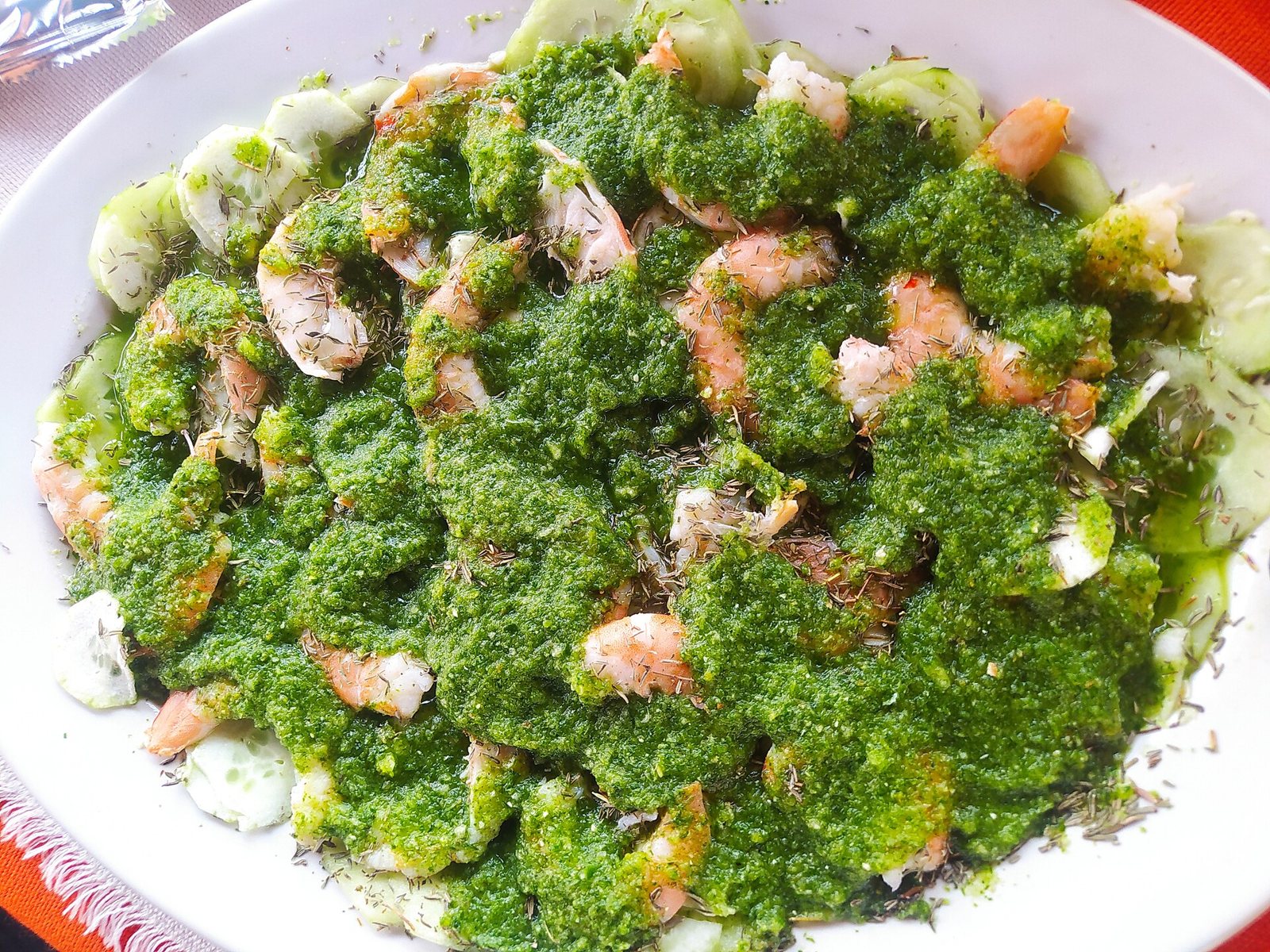 Green shrimp aguachile with cucumber (photographed in Michoacán; the dish is just as popular on the Jalisco and Nayarit coast).
5. Vallarta-style ceviche
Vallarta's ceviche has its own style: fresh fish chopped very fine or ground, cured in lime juice and mixed with tomato, onion, cilantro and often grated carrot. You eat it piled on crispy tostadas with hot sauce. For more, see our Puerto Vallarta seafood guide.
6. Marlin burritas and tacos
Smoked marlin is a coastal favorite, and it makes sense: Banderas Bay is so rich in sailfish that it hosts international fishing tournaments. Marlin burritas are flour tortillas filled with smoked marlin, cheese, lettuce, tomato and onion, toasted on the griddle. You'll also see smoked marlin in tacos and quesadillas, and some spots make versions with shrimp, octopus or crab.
The salsa ritual
Tacos almost always come with two salsas, one mild and one hot, plus lime. At salsa bars you'll find smoky red chile de árbol, green tomatillo, creamy avocado and salsa macha, a rich mix of peanuts and dried chiles.
Jalisco Flavors in Vallarta
7. Birria
Birria is meat marinated in an adobo of dried chiles, vinegar, garlic and herbs, then slow-cooked for hours. In Jalisco, "birria" is the regional name for a barbacoa traditionally cooked in an earth oven, and goat was the classic meat. The town of Cocula is the origin most often cited, though there's no documented birthplace.
In Vallarta, beef birria is the most common. It's served as tacos, soft or crispy, with a cup of consommé for dipping, plus onion, cilantro and lime. It's a breakfast food, and many stands sell out by midday. More in our birria in Puerto Vallarta guide.
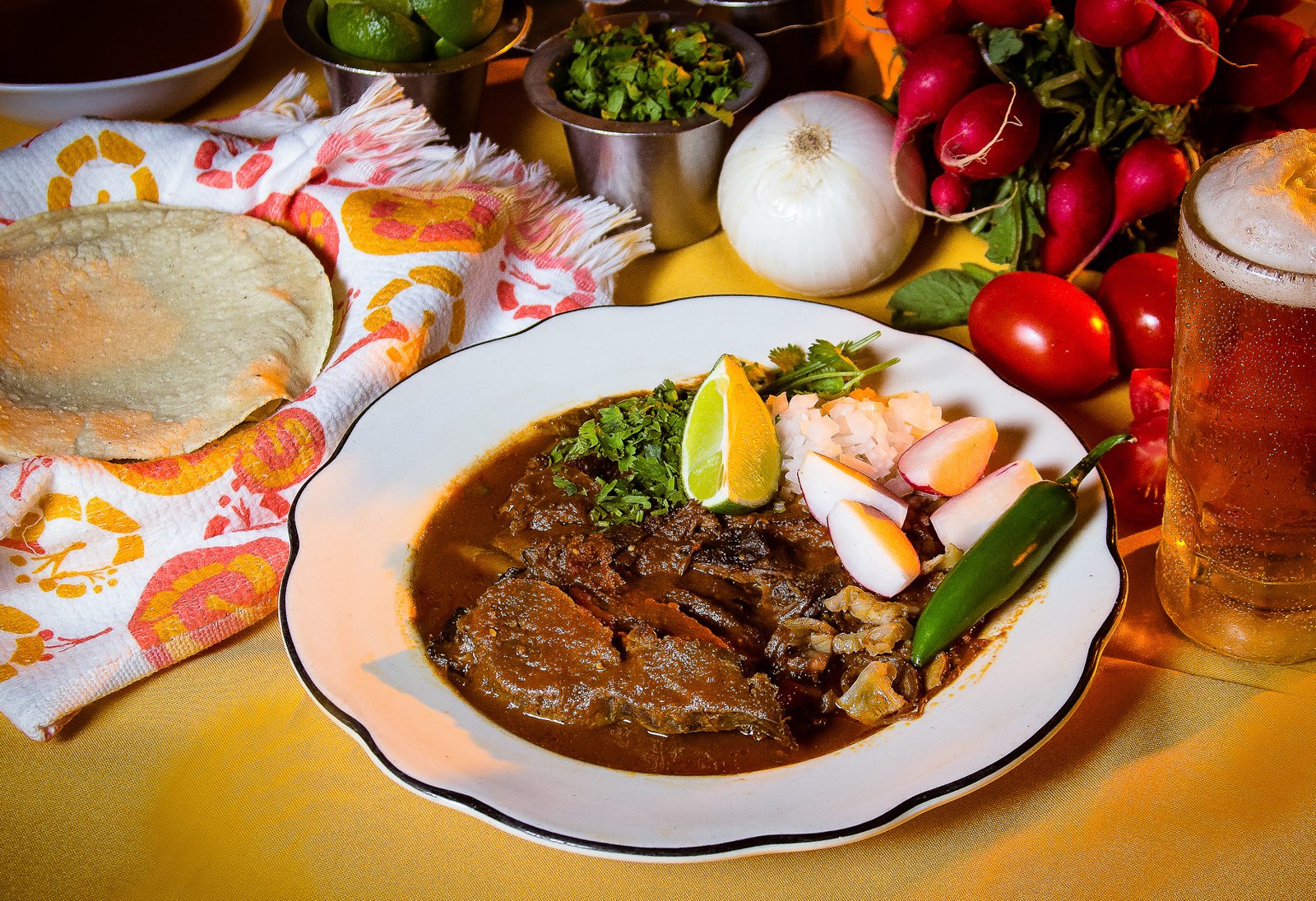 Birria in La Barca, Jalisco. In Vallarta, birria is an everyday breakfast.
8. Tortas ahogadas
The "drowned sandwich" comes from Guadalajara. The most widely told story credits Luis de la Torre, known as "El Güero," who started selling them sometime between 1920 and 1930. The key is the birote salado, a crusty, slightly sour roll sturdy enough to soak up sauce without falling apart. It's stuffed with carnitas and drowned in a thin tomato sauce plus a fiery one made with chile de árbol from Yahualica. Ask for it media ahogada (half-drowned) if you're cautious about heat.
Pozole and carne en su jugo
Pozole is a pre-Hispanic soup of cacahuazintle hominy simmered until the kernels "burst," with pork and broth; Jalisco's version is red. Carne en su jugo ("meat in its juices") is chopped beef cooked in its own broth with whole beans and bacon, a dish born in Acatic, Jalisco.
9. Malecón snacks and carnitas
Carnitas tacos, pork slow-cooked in its own fat, are the classic Saturday-morning plan, washed down with an agua fresca. Around sunset, the Malecón and Old Town fill with carts selling elotes and esquites (corn with mayo, cheese and chile), papaelotes (loaded baked potatoes), tostilocos, candied nuts in paper cones and churros. Our Puerto Vallarta street food guide tells you what to order where.
Traditional Sweets and Desserts
- Pie de Yelapa: the homemade pie of Yelapa, a village on the south side of the bay. Coconut is the star, but you'll also find pecan, banana, lime and cheese.
- Cocadas: chewy coconut candies, sometimes with pineapple or raisins, sold on beaches, in shops and at roadside stands north of town.
- Nieves de garrafa: fruit sorbets churned by hand in wooden barrels, in flavors like mango, guava, tamarind and hibiscus.
- Pan de elote: moist sweet corn bread, served warm with cream.
- Jericalla: Guadalajara's custard. According to the most popular version, 19th-century nuns at the Hospicio Cabañas created it for orphaned children, and the name comes from Jérica, the Spanish hometown of one of them.
Traditional Drinks in Puerto Vallarta
10. Tuba
Tuba is coconut palm sap, lightly fermented. The word comes from the Visayan languages of the Philippines and appears in writing as early as 1525, in Antonio Pigafetta's account of Magellan's voyage. It arrived on the Manila galleons and settled along the coast of Colima, Jalisco, Michoacán and Guerrero. It caught on so fast that in 1619 a Spanish captain complained to the king that it was hurting Spanish wine sales. Tuberos cut the palm's flower cluster and collect the dripping sap every morning.
On the Malecón, vendors carry it in gourds or wooden barrels and pour it over ice with diced apple and peanuts or walnuts. The street version has little or no alcohol. Learn more in our guide to tuba, tejuino and traditional drinks.
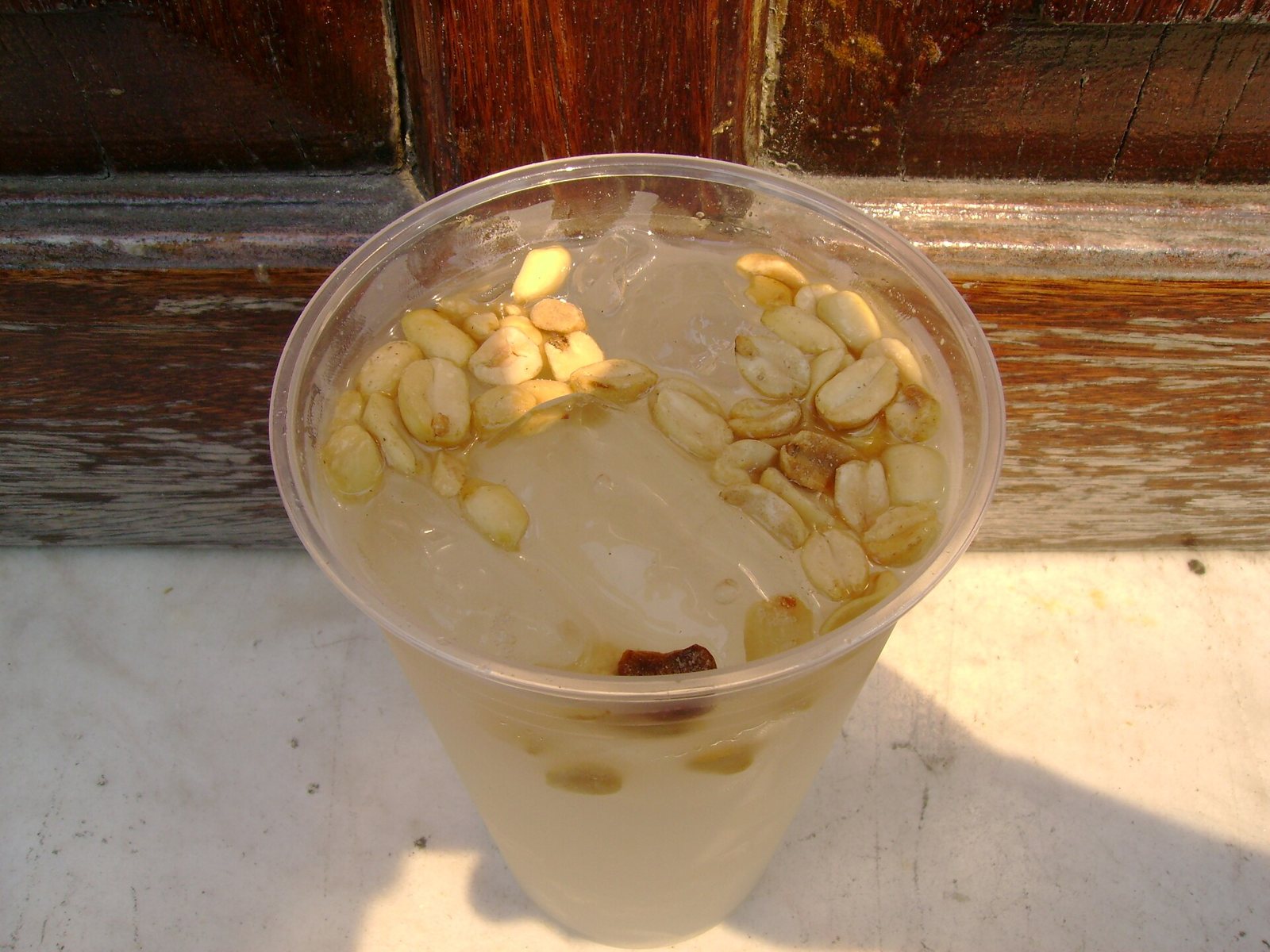 Tuba over ice with peanuts (photographed in Manzanillo, Colima). In Vallarta it is sold on the Malecón.
11. Tejuino
A sweet-and-sour drink made from fermented corn dough and piloncillo (unrefined cane sugar), with pre-Hispanic roots and typical of western Mexico. It's served cold with lime and salt and, Jalisco-style, a scoop of lime sorbet on top. You'll find it at carts in plazas and neighborhoods. It's only lightly fermented; the strong, ceremonial corn beer is a different drink called tesgüino.
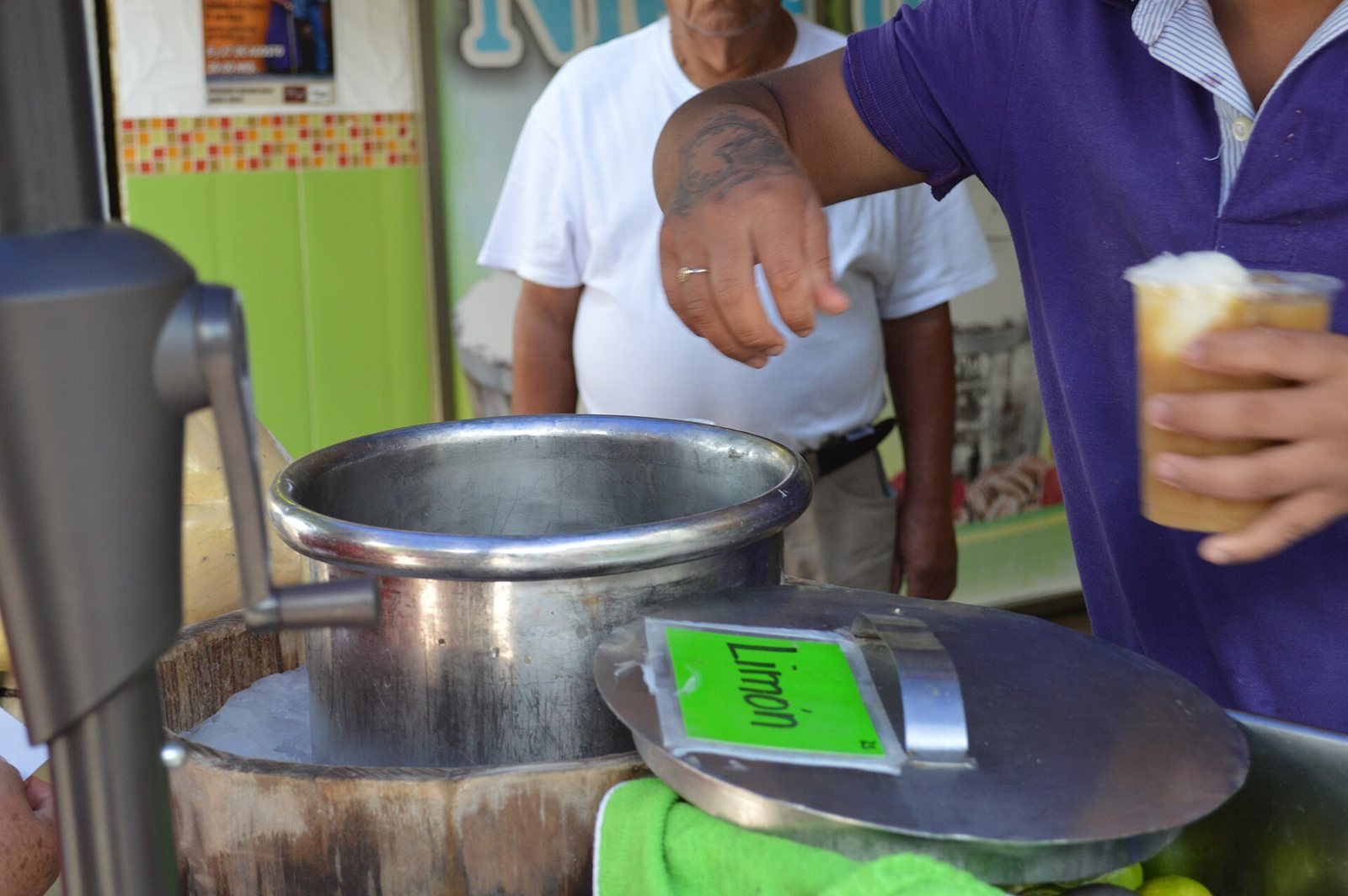 Tejuino with lime sorbet at a street stand in Tlaquepaque, Jalisco.
12. Raicilla
Jalisco's artisanal agave spirit from the mountains and coast around Vallarta, protected by a Denomination of Origin since 2019 that covers 16 Jalisco municipalities (Puerto Vallarta among them) plus Bahía de Banderas in Nayarit. Back in 1621, a chronicler living in Tepic described a local agave "wine" clearer than water and stronger than brandy. Expect floral, fruity or herbal notes. Learn more in our guide to raicilla, the Mexican agave spirit. The legal drinking age in Mexico is 18.
Tequila
Tequila is made in central Jalisco, not on the coast, but it's on every Vallarta table. Blue agave has been used to make it since the 16th century. In 1974 it became Mexico's first spirit with a Denomination of Origin, and in 2006 UNESCO named the Agave Landscape around Tequila, Magdalena, El Arenal and Amatitán a World Heritage Site.
Pajaretas and other drinks
Pajaretas are a ranch-country morning drink: fresh cow's milk mixed with chocolate, coffee, sugar and usually a shot of aguardiente. They're only served early, at small family dairy ranches in the hills northwest of town. During the day, cool off with fresh coconut water, aguas frescas and mango with lime and chile.
A Food Lover's Day in Puerto Vallarta
- Morning: birria or carnitas for breakfast. The Mercado Municipal Río Cuale downtown has traditional food and fresh juices, and the Aramara market, across from the cruise terminal, is the place for fresh fish and seafood. See our Puerto Vallarta markets guide.
- Midday: seafood. Ceviche, aguachile or a zarandeado to share. With half a day free, head to Boca de Tomatlán, Yelapa or Quimixto to see fish on a stick.
- Afternoon: stroll the Malecón with a cold tuba and wait for sunset.
- Evening: snacks in the main plaza of El Pitillal, or tamales and crispy tacos at stands on Calle Honduras and around Lázaro Cárdenas Park in the Romantic Zone. Finish with churros or a scoop of nieve de garrafa.
When to go: seasons and festivals
The rainy season runs from mid-June to mid-October, with August the wettest month; February through April are the clearest months. From December 1 to 12, the Virgin of Guadalupe festivities fill downtown with processions, music and food stalls. For Day of the Dead, the Malecón is decorated with altars and giant catrinas.
Taste Regional Food on the Vallarta Plus City Tour
Want to see Vallarta and taste its food on the same day? The Vallarta Plus City Tour by Riviera Tours & Transfers runs daily, lasts about 7 hours and includes:
- Guided walk through downtown Puerto Vallarta
- Visit to a traditional jewelry shop
- Free time for shopping
- Distillery tour and tequila tasting
- Lunch included at a regional cuisine restaurant
The menu is set by the restaurant, so we can't promise any specific dish from this list, but you'll get a real taste of the local cooking.
Check dates and book the Vallarta Plus City Tour →
Planning the rest of your trip? See our list of things to do in Puerto Vallarta and our Romantic Zone guide.
Tips for Eating in Puerto Vallarta
- Carry pesos in cash. Most street vendors don't take cards, and small bills help.
- Go early for birria. It's breakfast food, and stands often run out.
- Follow the locals. A busy stand usually means fresh food and quick turnover.
- Ask about the heat before ordering aguachile or reaching for the salsas.
- Ask the price first for pescado zarandeado, since it's usually charged by size or weight.
- Play it safe: choose food that's freshly cooked and served hot, fruit you peel yourself, and sealed bottled water.
- Budget: street and market food is the cheapest way to eat well; beachfront seafood costs more.
Frequently Asked Questions
What food is Puerto Vallarta known for? Seafood cooked over fire. Pescado embarazado (fish roasted on a stick) is the dish most tied to the city, along with pescado zarandeado, Vallarta-style ceviche and smoked marlin burritas.
Why is it called "pregnant fish"? It's a pun: pescado embarazado sounds like pescado en vara asado, "fish roasted on a stick."
Does tuba contain alcohol? The tuba fresca sold on the street has little or no alcohol. Sap that is fermented longer can be alcoholic.
What does the Philippines have to do with Vallarta food? The Manila galleons (1565–1815) brought the coconut palm and tuba to Mexico's Pacific coast, where tuba is still sold today.
Where can I find the most authentic local food? In the markets, at street stands downtown and in the Romantic Zone, in El Pitillal's plaza and in the fishing villages of the South Bay.
Is raicilla the same as tequila? No. Both are Jalisco agave spirits, but tequila uses only blue agave, while raicilla is made from other wild or cultivated agaves from the mountains and coast.
Does the Vallarta Plus City Tour include food? Yes, lunch at a regional cuisine restaurant is included. The menu depends on the restaurant. See tour details.
Photos: Wotancito / CC BY-SA 4.0 via Wikimedia Commons · Pequeño mar / CC BY-SA 4.0 via Wikimedia Commons · Carloscurielfotografo / CC BY-SA 3.0 via Wikimedia Commons · Yaomautzin Ohtokani Olvera Lara / CC BY-SA 4.0 via Wikimedia Commons · AlejandroLinaresGarcia / CC BY-SA 4.0 via Wikimedia Commons




