
Markets are one of the easiest ways to get a feel for everyday life in Puerto Vallarta. You can pick up a handmade souvenir, grab a home-style Mexican meal and see how locals shop. And every market here comes with a story: a town founded by a salt trader, an architect who escaped Nazi-era Austria as a boy, and a river island created by a cyclone a century ago. Here's where to go, what's behind each place, and how to make the most of it.
A Port Built on Trade
Long before souvenirs, commerce was this town's reason to exist. Puerto Vallarta was founded on December 12, 1851, as Las Peñas de Santa María de Guadalupe. Its founder, Guadalupe Sánchez Torres, made his living supplying salt to the silver mines up in the Sierra Madre, in San Sebastián, Mascota and Cuale. The salt arrived by sea and was hauled into the mountains by mule.
The settlement grew along the Cuale River. In 1885 it opened to domestic shipping and got a customs office, and in 1918 it became a municipality named Puerto Vallarta, after the jurist Ignacio L. Vallarta. Until highways reached the coast, the only way in was by sea and, later, by air. For the full story, read our history of Puerto Vallarta.
From Aztec Tianguis to Today's Markets
Mexico's market culture is ancient. The word tianguis, still used for open-air markets, comes from the Nahuatl tianquiztli, "market." In the 1400s, towns across central Mexico held regular market days in their plazas, where people bartered and used cacao beans as currency. The biggest market of all was at Tlatelolco, where, according to Hernán Cortés, some 60,000 people gathered every day to buy and sell. In Vallarta you'll see both sides of that heritage: a permanent municipal market and seasonal markets held one day a week.
Mercado Municipal Río Cuale: Puerto Vallarta's Flea Market
The Mercado Municipal Río Cuale sits downtown on Agustín Rodríguez Street, right where the city meets the Cuale River. On its own banners it calls itself the City Market and the Municipal Flea Market, and for many visitors it's simply "the market" in Puerto Vallarta.
The market's exact birth year depends on who you ask. Most sources say 1957, but in 2019 the market itself celebrated its 80th anniversary, which would date it to the late 1930s. Everyone agrees the current building went up in the late 1970s. It started out selling fruit, meat, poultry, fish, flowers and fabric, and as tourism grew it filled up with crafts and souvenirs.
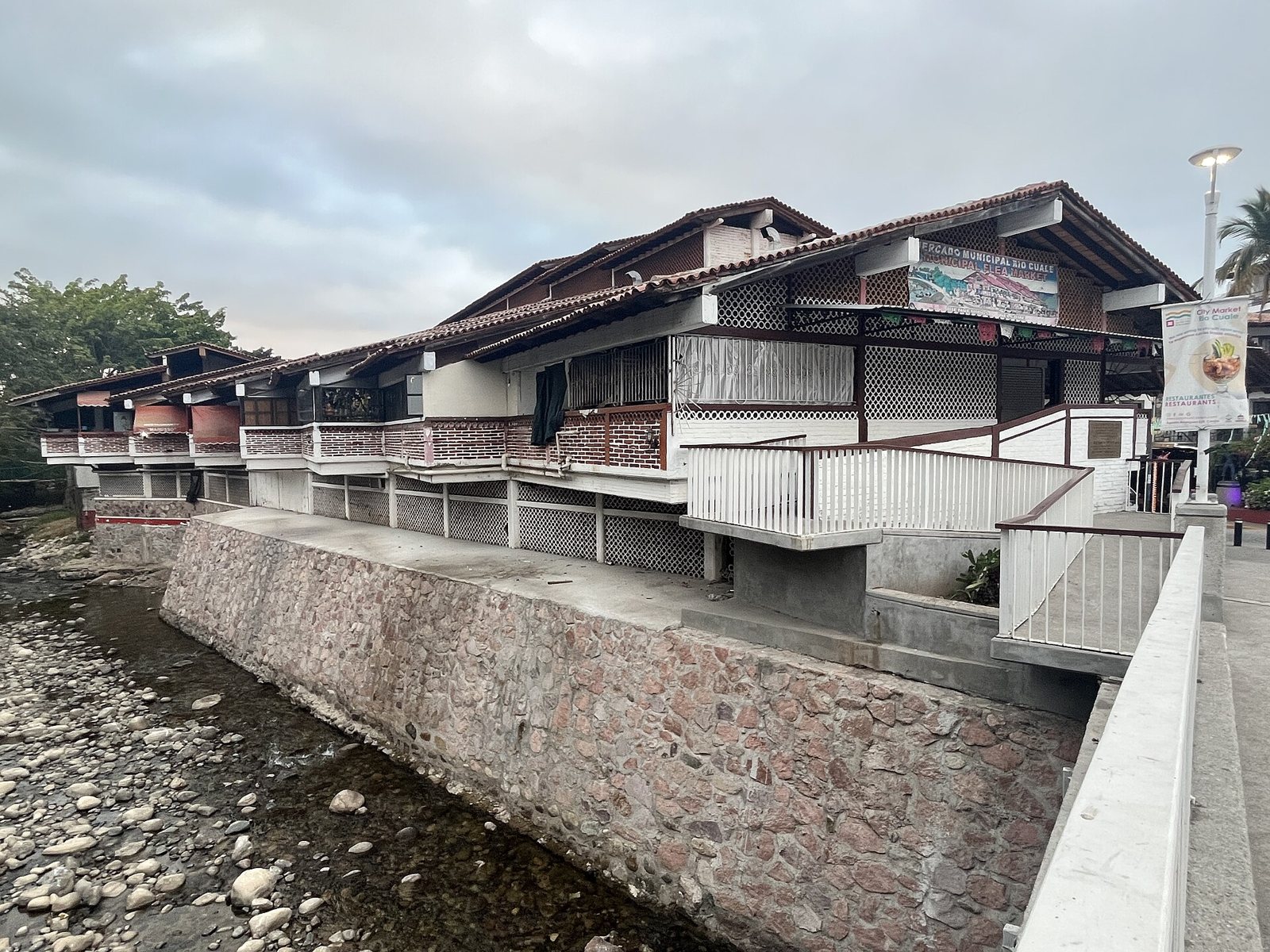 The market sits right on the banks of the Cuale River.
Alejandro Zohn, the Architect Behind the Building
The building you see today was designed by architect Alejandro Zohn and built between 1977 and 1979, as a bronze plaque near the entrance notes. Zohn was born in Vienna in 1930. His family left Austria after the Nazi annexation, reached Mexico in February 1939 and settled in Tlaquepaque, next to Guadalajara. He studied engineering and architecture at the University of Guadalajara.
By then he had already designed one of Mexico's landmark markets: Guadalajara's Mercado Libertad (San Juan de Dios), built between 1953 and 1958, with roughly 4,000 stalls and later declared a national artistic monument. Zohn also drew up Puerto Vallarta's general urban plan in 1973. He died in Guadalajara in 2000, the same year he received the Jalisco Prize.
Mexico's national federation of architects' associations recently declared the Cuale market part of the city's architectural heritage and added it to the buildings monitored by its Architectural Observatory.
What You'll Find at the Río Cuale Market
- Handicrafts and souvenirs to take home.
- Jewelry, from simple pieces to more elaborate ones.
- Leather goods and footwear.
- Traditional Mexican clothing.
- Food: the market advertises restaurants on the second floor, serving traditional Mexican dishes and fresh juices at local prices.
Take your time. Many stalls carry similar items, so walk the whole market, upstairs and down, before you buy.
Storms, a Comeback and a Renovation Planned for 2026
Life on the riverbank has its risks. When Hurricane Nora hit in late August 2021, the Cuale overflowed and damaged the market and its surroundings, and many vendors lost merchandise. In 2022 the market launched a new logo, website and social media to win back shoppers, and that October the city celebrated its economic comeback.
In late 2025, Mayor Luis Munguía announced a full rehabilitation of the market during 2026: new wiring, replacement of wooden beams and damaged roof tiles, plus updated restrooms and fresh paint, while keeping the original architecture. The same announcement covered work at other public markets in the city, including the Emiliano Zapata and 5 de Diciembre markets. No exact dates were published, so check before you go in case some sections are closed.
Puerto Vallarta Markets Timeline
- 1851: Las Peñas is founded as a salt port supplying the mountain mines.
- 1918: Las Peñas becomes the municipality of Puerto Vallarta.
- 1925: A cyclone shifts the Cuale River and creates today's island.
- Late 1930s or 1957: The municipal market begins on the Cuale (sources differ).
- 1977–1979: The current Río Cuale market building is constructed.
- 2009: Neighbors launch the Sunday market in La Cruz de Huanacaxtle.
- 2021: Hurricane Nora damages the market and riverbanks.
- 2025: Isla Cuale turns 100, and the market's 2026 rehabilitation is announced.
Isla Cuale's Souvenir Stalls
Steps from the market is Isla Cuale, a narrow island in the middle of the river with art galleries, restaurants and souvenir stalls. Footbridges link it to downtown and to the Romantic Zone, so it's easy to pair with the market on the same walk.
The island has a history of its own. It formed in 1925, when a cyclone changed the river's course and split it into two channels. It was first called Isla de Santa Clara, then Isla de los Niños (Children's Island), because local kids played there. After a flood in 1975 the ground was reinforced, and on October 28, 2025, the city unveiled a plaque for its centennial. Today it's home to the Vallarta Institute of Culture, with workshops and festivals; a statue of director John Huston (installed in 1988), whose film The Night of the Iguana put Vallarta on the map; and INAH's Museo del Cuale, an archaeology museum (listed as temporarily closed, so check before you go).
The island's stalls sell crafts, clothing and jewelry, and some of what you'll see is made by Wixárika (Huichol) artisans from the Sierra Madre Occidental. Along the banks, keep an eye out for iguanas and birds. For more on the area, see our guides to the Puerto Vallarta Malecón and Old Town and The Night of the Iguana.
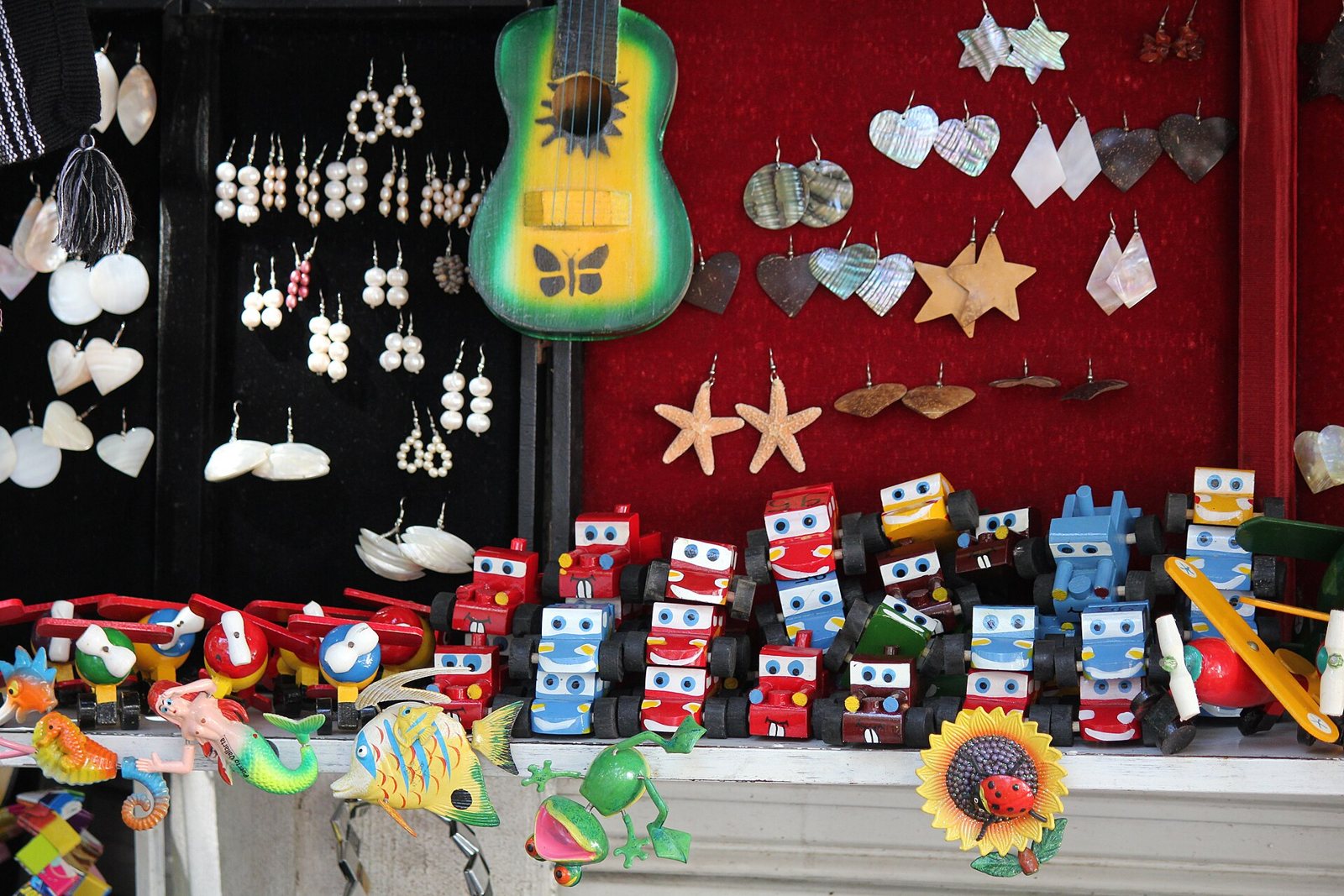 Shell earrings, wooden toys and souvenirs at a market stall in Puerto Vallarta.
How to Recognize Western Mexico's Crafts
A few traditions worth knowing before you shop:
- Wixárika (Huichol) art. Beadwork is made by pressing beads one by one into a wax base, and yarn paintings (nierika) have ritual roots. The key motifs are the deer, corn and peyote. In 2025, the Wixárika pilgrimage route to Wirikuta was added to UNESCO's World Heritage List. Ask about the artist or home community; our Huichol art guide goes deeper.
- Tonalá pottery. In this pottery town next to Guadalajara, the most common styles are bruñido, bandera, petatillo and canelo. Its street market sets up Thursdays and Sundays and can draw thousands of vendors.
- Tlaquepaque glass and clay. The town where Zohn grew up became a Pueblo Mágico in 2018 and is famous for pottery and hand-blown glass.
- Silver. Mexico is the world's largest silver producer, and Taxco became a silver-crafting center after American William Spratling discovered the town in 1929 and opened his workshop there. If you're buying silver, ask to see the purity stamp.
The Saturday Farmers Market in the Romantic Zone (Emiliano Zapata)
Cross the river heading south and you're in Colonia Emiliano Zapata, the heart of the Romantic Zone, which many guides also call Old Town. On Saturday mornings in high season (roughly November through May), Lázaro Cárdenas Park hosts the Olas Altas Farmers Market.
It's a smaller, more laid-back market than the one by the river. Expect:
- Local produce, bread and preserves.
- Handmade crafts and artisanal goods.
- Street-style food such as tamales and churros.
- Live music on many Saturdays.
While you're there, look around the park: there's a statue of President Lázaro Cárdenas, the sculpture Ándale Bernardo, and tile-covered benches from the Tile Park (Parque de los Azulejos) project by artist Natasha Moraga. In the same neighborhood stands the Iglesia de la Santa Cruz, whose feast day is May 3.
Seasons and hours shift from year to year, so check the market's social media before heading over. If you're staying nearby, our Puerto Vallarta Romantic Zone guide has plenty of ideas for the rest of the day.
The La Cruz de Huanacaxtle Sunday Market
Visiting on a Sunday in season? Head north around the bay to La Cruz de Huanacaxtle, in Nayarit, for the Mercado Huanacaxtle, better known as the La Cruz Market, which sets up along the marina.
It began in 2009 as a neighborhood project meant to let artisans sell without middlemen, and now draws around 170 vendors selling crafts, clothing, baked goods, organic produce and food, usually with live music. It runs from about November through April, on Sunday mornings until around 2 p.m. Opening dates change each year, so confirm on the market's official social media.
La Cruz itself is young: it was founded in the 1930s, and its name comes from a cross carved from huanacaxtle (parota or guanacaste) wood. This coastal tree can grow 20 to 35 meters (65 to 115 feet) tall and produces ear-shaped seed pods. Each May the town celebrates the Fiesta de la Santa Cruz, which peaks on May 3. Read more in our Riviera Nayarit beach towns guide and our list of restaurants in Bucerías and Punta Mita.
Fish and Seafood Markets
For a truly local scene, Puerto Vallarta also has fish markets. The city's largest fish market is in the Lázaro Cárdenas neighborhood, and in the Aramara area, across from the cruise ship terminal, there's a busy fish and seafood market with stands where you can eat on the spot.
Fishing has long been part of the port's economy; Playa Camarones, for instance, is named after the shrimp fishermen who worked it. These aren't craft markets, but they're great if you're curious about the local food. To know what to order, see our Puerto Vallarta food guide and Puerto Vallarta seafood guide.
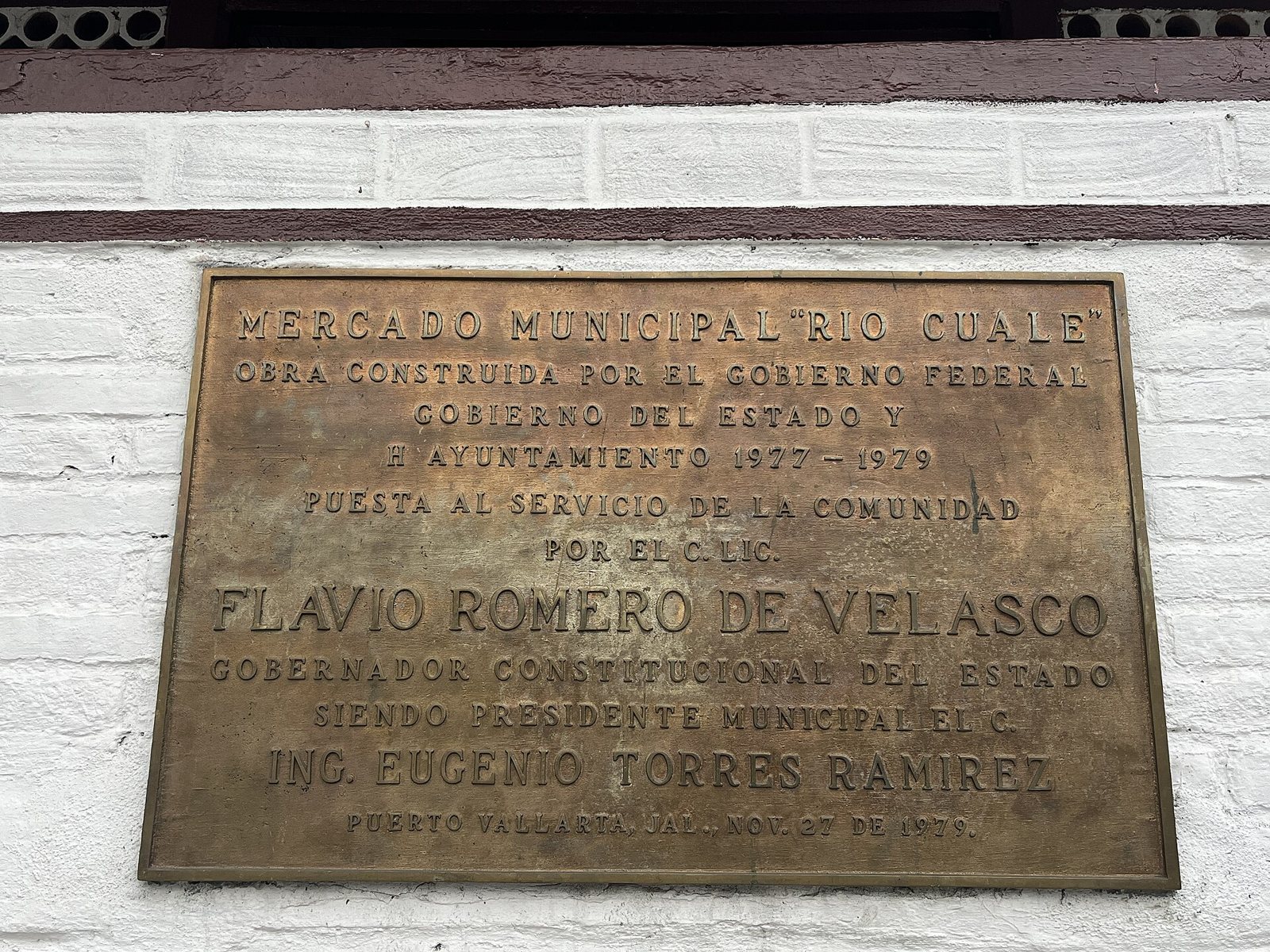 The plaque on the current market building, built 1977–1979.
A Suggested Puerto Vallarta Market Itinerary
Half a day downtown (any day):
- Start early at the Río Cuale market, before the heat builds. Browse the ground floor, then head upstairs.
- Cross a footbridge to Isla Cuale and stroll the island to the John Huston statue.
- Continue into the Romantic Zone; on a Saturday in season, end at Lázaro Cárdenas Park.
A Sunday in season: spend the morning at the La Cruz de Huanacaxtle market, walk the marina and stay for lunch in town. La Cruz is on the north side of the bay, about 25 km (15 miles) from Puerto Vallarta.
Best Time to Visit Puerto Vallarta's Markets
International high season runs from late November through March, which lines up with the weekend markets. The rainy season runs from mid-June to mid-October, with most rain in July through September, when average highs reach about 32 °C (90 °F) and the seasonal markets are closed. The Río Cuale market, on the other hand, is open year-round (barring closures during the 2026 work).
What to bring: small bills in pesos, a reusable bag, water, a hat and sunscreen. If you buy pottery or glass, ask for it to be wrapped well.
Explore Downtown on the Riviera Tours & Transfers Vallarta City Tour
Prefer to see downtown with a local guide? Our Vallarta City Tour runs every day, lasts about 7 hours and is offered in English and Spanish. It includes:
- A guided walk through downtown Puerto Vallarta
- A stop at a traditional jewelry shop
- Free time for shopping
- A tequila stop
- A visit to a regional cuisine restaurant (meal not included)
Want lunch included, plus a distillery tour and tequila tasting? Choose the Vallarta Plus City Tour.
Check dates and book the Vallarta City Tour →
Tips for Shopping at Puerto Vallarta's Markets
- Bring cash in small bills, in case a stall doesn't take cards.
- Ask where pieces come from, whether it's silver, leather, textiles or Huichol art. Vendors are usually happy to explain.
- If you bargain, keep it friendly. For many families the stall is their livelihood, and a fair price matters more than a few pesos.
- Ask before taking photos of vendors, artisans at work or their pieces.
- Go early to the weekend markets: it's cooler and the selection is better.
- Confirm hours and seasons directly with each market, especially in summer and during the Río Cuale market renovation.
Frequently Asked Questions
Where is the flea market in Puerto Vallarta? The Mercado Municipal Río Cuale is downtown on Agustín Rodríguez Street, on the banks of the Cuale River, a few blocks from the Malecón.
Can you eat at the Río Cuale market? Yes. The market has a restaurant area on the second floor serving traditional Mexican food and fresh juices.
Who designed the Río Cuale market? Architect Alejandro Zohn, who was born in Vienna and trained in Guadalajara, where he also designed the Mercado Libertad. The building went up between 1977 and 1979.
Is the Río Cuale market open during the 2026 renovation? The city didn't publish exact dates for the work. Check the market's official social media before you go in case some areas are closed.
Is there a farmers market in Puerto Vallarta? Yes, in high season: on Saturdays in Lázaro Cárdenas Park in the Romantic Zone, and on Sundays at the La Cruz de Huanacaxtle marina, north of the city. Check dates on their social media before you go.
How can I tell if Huichol art is authentic? Ask about the artist or home community and look for handwork: in beadwork, each bead is set by hand into wax. Our Huichol art guide has more tips.
Does the City Tour stop at the market? The tour includes free time for shopping downtown. Ask your guide whether there's enough time to visit the Río Cuale market.
Photos: Another Believer / CC BY-SA 4.0 via Wikimedia Commons · Another Believer / CC BY-SA 4.0 via Wikimedia Commons · terri_bateman / CC BY 2.0 via Wikimedia Commons · Another Believer / CC BY-SA 4.0 via Wikimedia Commons




