
Picture a whole fish split open like a book, brushed with a brick-red chile marinade and slowly charring over hot coals while the cook flips it again and again inside a hinged grill basket. That's pescado zarandeado, one of the signature dishes of Mexico's Pacific coast and, for many visitors, the ultimate beach lunch in Puerto Vallarta and the Riviera Nayarit. Here's where it comes from, how it's made, how to grill it at home, and where to find it on your trip.
What Is Pescado Zarandeado?
Pescado zarandeado is a whole fish, butterflied lengthwise, marinated and grilled over coals inside a hinged double grate called a zaranda. The basket clamps the fish so it can be flipped in one piece without the tender flesh falling apart.
The name comes from the Spanish verb zarandear, meaning to shake or toss vigorously. The most common explanation is that it refers to the constant turning of the basket over the fire, which helps the fish cook evenly and soak up the smoke.
Where Pescado Zarandeado Comes From
Most sources trace the dish to Mexcaltitán, a tiny car-free island in a lagoon in northern Nayarit, in the municipality of Santiago Ixcuintla. You can only reach it by boat. It's nicknamed "the Mexican Venice," and local tradition links it to Aztlán, the legendary homeland the Mexica (Aztecs) are said to have left on their journey to central Mexico.
Food writers credit the technique to the Totorame, an Indigenous fishing people who lived along the coast of what is now Nayarit and Sinaloa, and give it pre-Hispanic roots. That's why both states claim the dish today. The fairest way to put it: zarandeado is a coastal tradition shared by Nayarit and Sinaloa, and Mexcaltitán is the place most often named as its birthplace.
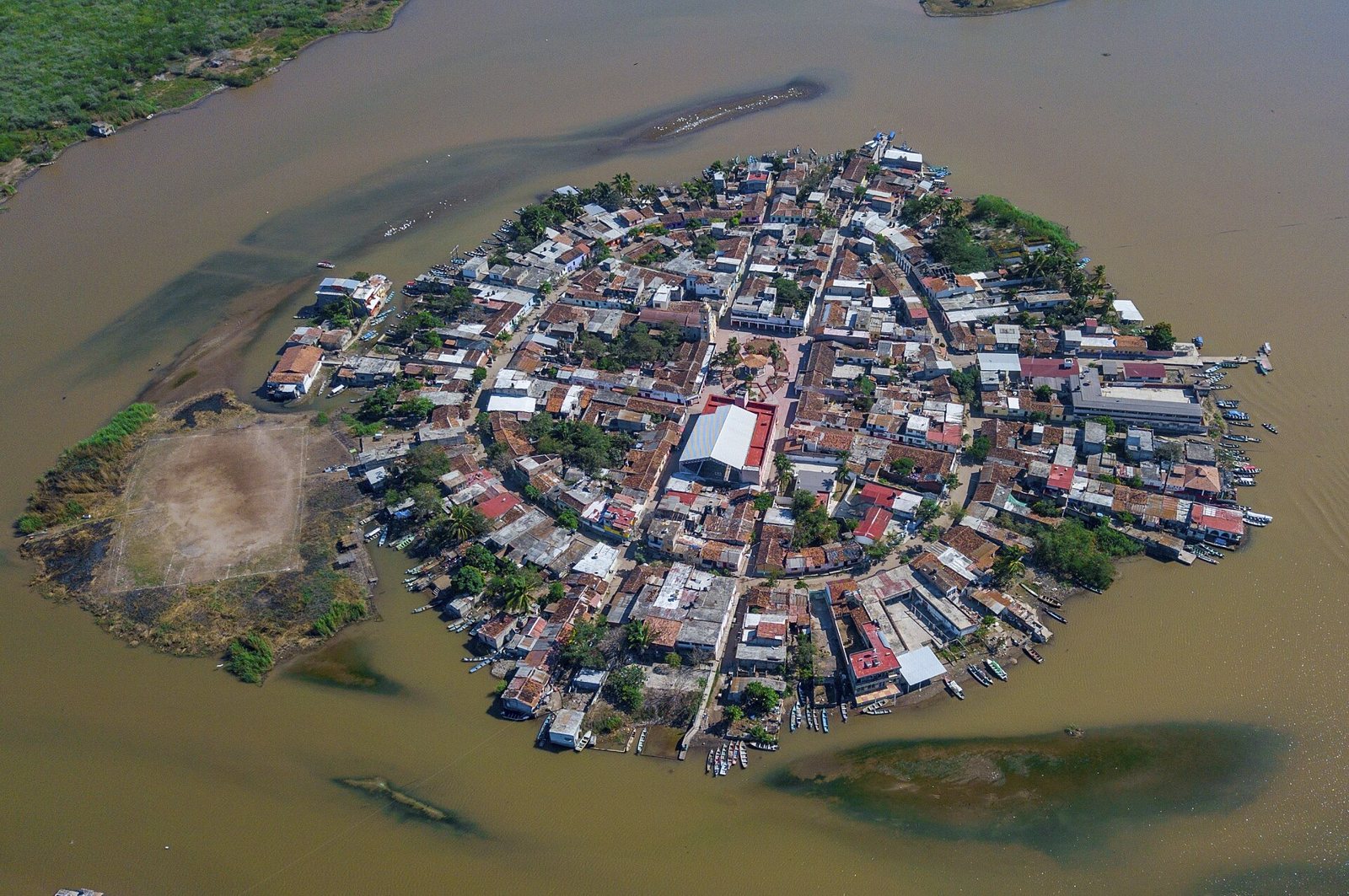 Mexcaltitán island in northern Nayarit, often named as the birthplace of pescado zarandeado.
The Totorame: The Fishing People Behind the Dish
Archaeologists use the term Totorame region for northern Nayarit and southern Sinaloa, the territory this people held when the Spanish arrived. They farmed and fished the estuaries, lagoons and open sea, the exact landscape that gave rise to fish grilled over coals.
Their best-known center is Chametla, on the Baluarte River in Sinaloa. Researchers from Mexico's national institute of anthropology (INAH) describe a settlement of more than 100 hectares (about 250 acres) with pyramid platforms and a ballcourt, which overturns the old idea that this coast was home only to simple villages. Archaeologist Isabel Kelly, of the University of California, dug there in the 1930s and published her findings in 1938. The fine decorated pottery of this coast is known as Aztatlán ware, a name coined by geographers Carl Sauer and Donald Brand.
That world was shattered in 1530, when conquistador Nuño de Guzmán pushed violently through the coastal provinces of Sentispac and Aztatlán in Nayarit and on to Chametla. His campaign created the colonial province of New Galicia. Coastal communities were devastated, but the way of fishing and cooking beside the estuaries survived among fishing families, and that's the tradition on your plate today.
Mexcaltitán Today: The Island Where It All Began
Mexcaltitán is a roughly oval island only about 400 meters (a quarter mile) across, ringed by lagoons and mangroves. Most residents make their living from shrimp fishing, and from roughly July to October the rains flood the streets so people get around by raft. That's where the "Mexican Venice" nickname comes from.
- A Pueblo Mágico with ups and downs. It earned Mexico's "Magic Town" designation in 2001, lost it in 2009 over infrastructure and upkeep problems, and won it back in 2020 after restoration work.
- The Museo del Origen. Housed in an early-1800s building, this small museum displays archaeological pieces from the region. Its name nods to the tradition that the island was Aztlán, the place the Mexica left on the migration that ended with the founding of Tenochtitlan. It's an unproven theory, but a proud part of local identity.
- Other island flavors. Besides zarandeado, look for shrimp tamales and shrimp fritters.
The Feast of Saints Peter and Paul
On June 29, the images of the island's patron saints go out by boat early in the morning to bless the waters and ask for a good shrimp season. Then the whole town splits into two teams, one per saint, and races big canoes around the island, poling them along the bottom like the trajineras of Xochimilco. According to the organizers, Saint Peter always wins; local lore says the one year Saint Paul won, the fishing was terrible.
Getting to Mexcaltitán
Drive to Santiago Ixcuintla and on to the La Batanga boat landing, where launches cross to the island in about 15 minutes. From Puerto Vallarta, the drive to the landing takes roughly four to five hours, so plan at least one night in the area. Check boat schedules before you go.
Pescado Zarandeado Timeline
- Around 100 BC: the first farming and fishing communities appear on the lower Baluarte River, forerunners of the Totorame (per the INAH/Sinaloa book Chametla ancestral).
- 1530: Nuño de Guzmán marches up the Nayarit coast to Chametla; New Galicia begins.
- 1938: Isabel Kelly publishes her Chametla excavations.
- 1995: Marismas Nacionales is named a Ramsar wetland of international importance.
- 2001: Mexcaltitán is first named a Pueblo Mágico.
- May 12, 2010: the Marismas Nacionales Nayarit Biosphere Reserve is decreed.
- 2020: Mexcaltitán regains its Pueblo Mágico status.
How It's Cooked: The Basket, the Coals and the Smoke
Traditionally, fishermen used mangrove wood both to build the grill baskets and to fuel the fire, which gave the fish its distinctive smoky flavor. Mexico's mangroves are now listed as a threatened species under federal law, so today most cooks use metal baskets over charcoal or other types of wood.
Marismas Nacionales: The Mangroves That Made Zarandeado Possible
Mexcaltitán sits inside Marismas Nacionales, a vast system of lagoons, estuaries and salt marshes straddling Nayarit and Sinaloa. Its Ramsar listing (1995) describes it as the largest mangrove area on Mexico's Pacific coast, with about 20% of all the country's mangroves. In 2010, the Nayarit side was declared a Biosphere Reserve covering more than 133,000 hectares (roughly 330,000 acres).
Those mangroves are shrimp habitat and gave fishermen wood and fuel for centuries. Today they face pressure from shrimp farms and altered water flows, and Mexico's protected-areas agency (CONANP) works on restoring them. That's why modern zarandeado is cooked over charcoal in a metal basket.
Which Fish Is Used: Snapper and Snook
The most common fish are red snapper (huachinango), pargo (another type of snapper) and snook (robalo). Pargo is often called the traditional choice, red snapper is what you'll see most on restaurant menus, and snook has more delicate flesh that can dry out if you're not careful.
For the curious:
- Pacific red snapper (Lutjanus peru): one of Mexico's five most commercially important species. According to Mexico's 2023 National Fisheries Chart, five states, including Nayarit and Sinaloa, land more than 70% of the Pacific catch. Researchers at CICIMAR-IPN warn that warming seas and overfishing threaten its habitat.
- Spotted rose snapper (Lutjanus guttatus, pargo lunarejo): ranges from the Gulf of California to Peru and can reach about 80 cm (31 inches). On some stretches of coast it's also called huachinango or pargo flamenco, so the name on the menu doesn't always match the species.
The Marinade: Nayarit Style vs. Sinaloa Style
There's no single recipe, and every family guards its own. Broadly speaking:
- Nayarit style: simpler, built on ground dried chiles (such as guajillo), garlic, achiote, lime or orange juice, salt and pepper. Many sources consider it closer to the original.
- Sinaloa style: richer and creamier, often with mustard, mayonnaise and butter, sometimes topped with tomato, onion and peppers.
Modern versions may also add Worcestershire or soy sauce to the marinade.
Achiote: A Color With Ancient Roots
The brick-red tint of Nayarit-style zarandeado comes from achiote, or annatto (Bixa orellana), a shrub native to tropical America whose name comes from the Nahuatl achiotl. Indigenous peoples used it as a seasoning, a food coloring and even body paint. The color lives in the waxy coating of its seeds, rich in pigments called bixin and norbixin.
Zarandeado vs. Pescado Embarazado
Around Vallarta you'll spot another red, fire-grilled fish: pescado embarazado, skewered on wooden sticks beside a beach fire and usually made with mojarra or tilapia. It's a grab-and-go beach snack; zarandeado is a sit-down dish for sharing. Learn more in our guide to pescado embarazado, Vallarta's fish on a stick.
How to Eat It
Pescado zarandeado arrives whole, in the middle of the table, and it's meant to be shared. Everyone flakes off pieces with a fork and builds their own tacos with warm tortillas, hot salsa, onion, cucumber and lime. White rice and a simple salad are common sides.
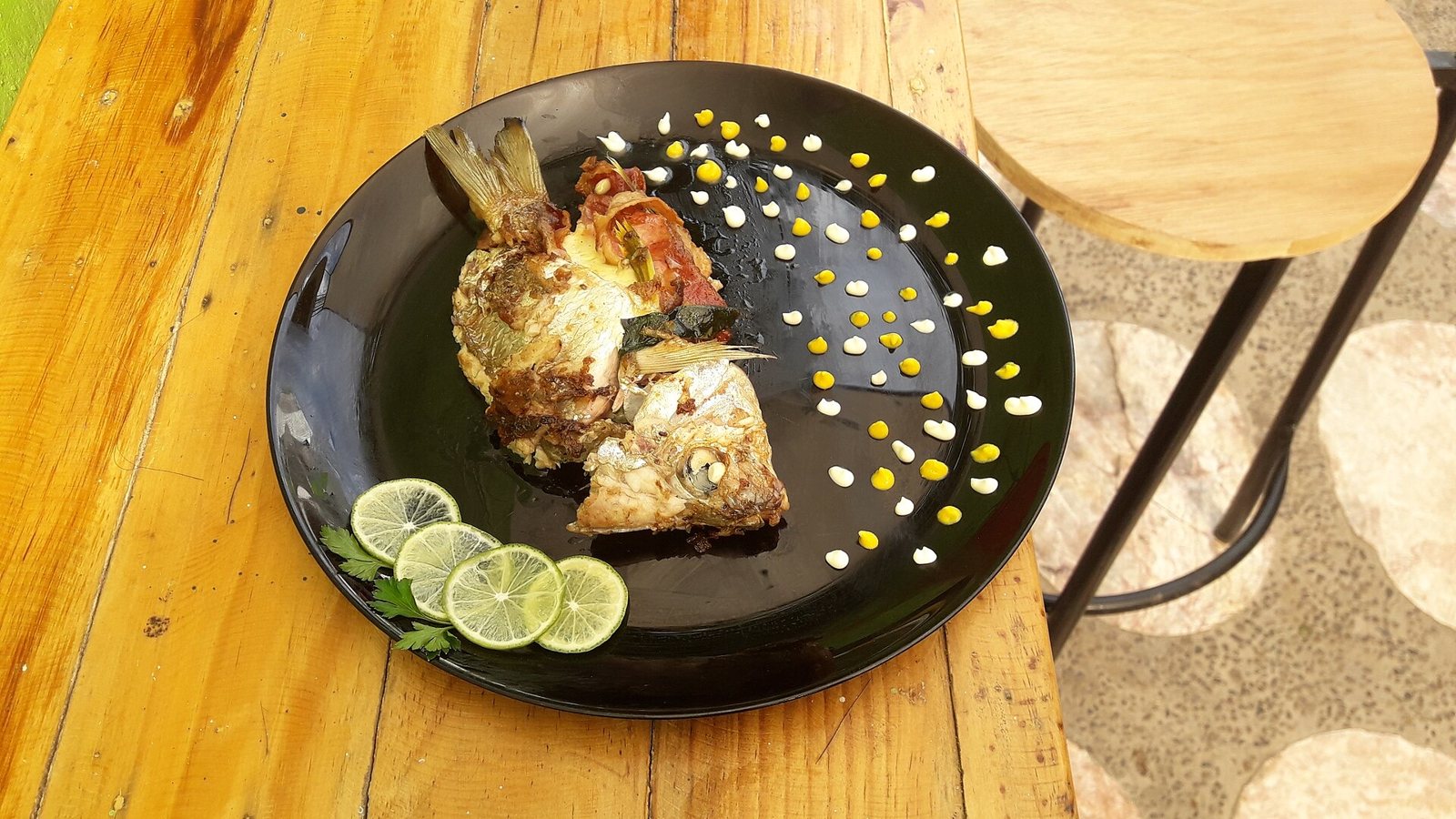 The fish is served whole and eaten by hand or in tacos, with lime and salsa.
Easy Pescado Zarandeado Recipe for Home
Think of this as a general method rather than an exact recipe. Adjust amounts to the size of your fish and your taste.
You'll need:
- 1 whole fish (red snapper or snook work well), cleaned and butterflied. Ask your fishmonger to do it.
- A few rehydrated guajillo chiles, some garlic cloves and a little achiote paste.
- Lime or orange juice, salt and pepper.
- Optional: a spoonful of mayonnaise or mustard if you like the Sinaloa style.
- A hinged fish grill basket and charcoal or hardwood.
Steps:
- Make the marinade. Blend the chiles, garlic, achiote and citrus juice into a thick paste. Season with salt and pepper.
- Marinate. Spread the paste over the flesh side and let it rest in the fridge for a while.
- Light the grill. Wait for even, glowing coals with no big flames.
- Grill in the basket. Place the fish in the basket, start flesh side down and flip it several times. Cooking time depends on the size of the fish and the heat of the coals.
- Check for doneness. It's ready when the flesh turns opaque and flakes easily with a fork.
No grill? Some cooks bake it wrapped in foil and finish it over direct heat, though you'll lose some of that smoky flavor.
Where to Eat Pescado Zarandeado in Puerto Vallarta and the Riviera Nayarit
We won't point you to a specific restaurant (they come and go), but these are areas where it's easy to find:
- Boca de Tomates, near the Puerto Vallarta airport, is one of the best-known spots, with beachside palapa eateries.
- Seafood restaurants in Puerto Vallarta: many have it on the menu, each with its own marinade.
- Riviera Nayarit beach towns such as Rincón de Guayabitos, Chacala and San Blas, which local tourism guides highlight for this dish. Around San Blas you may also see it called tatemado.
- Mexcaltitán, if you want to go to the source. It's far from Vallarta, so plan it as a separate trip.
Staying north of the bay? Our Nuevo Vallarta guide can help you plan. For more coastal towns, see our Riviera Nayarit beach towns guide, and for more seafood, our Puerto Vallarta seafood guide and Puerto Vallarta food guide.
Boca de Tomates: What to Know
It sits next to the airport, near the mouth of the Ameca River, which forms the border between Jalisco and Nayarit. There are mangroves for birdwatching, a sea turtle release camp and family palapa eateries that sometimes have live music on weekends. Heads-up: Puerto Vallarta's tourism office advises against swimming here because of strong waves, and crocodiles live in the nearby estuaries.
Sample Itineraries for a Zarandeado Trip
Half day. Head to Boca de Tomates mid-morning, order your fish as soon as you arrive (it's grilled to order) and watch for birds in the mangroves while you wait.
Full day. Explore downtown and the Malecón in the morning, then settle in for a long seafood lunch.
Trip to the birthplace (2+ days). Drive to northern Nayarit, overnight in the area and cross to Mexcaltitán early. Go on June 29 if you can; between July and October, expect rain.
What to bring: some cash, a hat, sunscreen and bug spray for the mangroves.
Taste Vallarta's Regional Food on the Vallarta Plus City Tour
If you're curious about regional food, Riviera Tours & Transfers' Vallarta Plus City Tour is an easy way to get a taste of it. It runs every day, lasts about 7 hours and includes:
- Guided walking tour of downtown Puerto Vallarta
- Visit to a traditional jewelry shop
- Free time for shopping
- Distillery tour and tequila tasting
- Lunch included at a regional cuisine restaurant
The restaurant sets its own menu, so we can't promise pescado zarandeado will be on it that day. What you do get is a real taste of the region's food and culture, plus the local knowledge to go hunting for your own zarandeado later.
See dates and book the Vallarta Plus City Tour →
Planning the rest of your trip? Check out our list of things to do in Puerto Vallarta and our guide to raicilla, Mexico's other agave spirit.
Tips for Ordering Pescado Zarandeado
- Ask about size and price before they start cooking, so there are no surprises.
- Be patient. It's grilled to order and takes a while, so order before you head into the water.
- Share it. A medium fish usually feeds several people.
- Watch for bones, especially if you're eating with kids.
- Ask about the heat. If you don't like spicy food, ask for less chile in the marinade.
- Ask what fish it is and whether it's today's catch.
- Respect the mangroves: don't leave trash and keep your distance from wildlife.
FAQ
Where is pescado zarandeado from? Most sources trace it to Mexcaltitán, Nayarit, with roots in the coast's pre-Hispanic fishing communities. Sinaloa also claims it.
What kind of fish is used for zarandeado? Usually red snapper, pargo or snook, cooked whole and butterflied.
What does "zarandeado" mean? It comes from zarandear, "to shake," and from the zaranda, the hinged basket the fish is grilled in and flipped over the coals.
Does the Vallarta Plus City Tour serve pescado zarandeado? The tour includes lunch at a regional cuisine restaurant, but the menu can vary and zarandeado isn't guaranteed. To try it, head to one of the beach areas listed above.
Who were the Totorame? A pre-Hispanic farming and fishing people of northern Nayarit and southern Sinaloa, credited with the zarandeado grilling technique.
What's the difference between Nayarit-style and Sinaloa-style zarandeado? Nayarit style uses dried chiles, garlic, achiote and citrus; Sinaloa style tends to be creamier, with mustard, mayonnaise and butter.
Can you swim at Boca de Tomates? It's not recommended because of strong waves and the nearby Ameca River mouth, and crocodiles live in the estuaries.
Can I visit Mexcaltitán as a day trip from Puerto Vallarta? It's possible but exhausting: four to five hours each way by car to the boat landing. Better to spend a night in the area.
Photos: El Nuevo Doge / CC0 via Wikimedia Commons · El Nuevo Doge / CC0 via Wikimedia Commons · Luis Méndez Covarrubias / CC BY-SA 4.0 via Wikimedia Commons




