
Today San Sebastián del Oeste is a sleepy mountain town of cobblestones, whitewashed adobe and red tile roofs. It's hard to picture it as a busy colonial mining center, yet for roughly three centuries its silver and gold helped fuel the economy of western Mexico. Knowing that history makes a visit far more interesting, and it also explains how Puerto Vallarta got its start.
This guide goes deeper than the usual day-trip blurb: who lived here before the Spanish, how silver was actually refined, the people and festivals that shaped the town, its forests, and a timeline you can keep handy.
Before the Silver: The Tecos, the Conquistadors and a Royal Mining District
Long before Europeans arrived, this part of the Sierra Madre was home to the Teco people, according to the historical summary published by Jalisco's state statistics and geography institute (IIEG). The area was conquered in 1524 by an expedition led by Captain Francisco Cortés de San Buenaventura.
In 1530, Nuño de Guzmán passed through with his army. The IIEG notes that local people received him peacefully, and that he used this as a pretext to claim the lands Cortés de San Buenaventura had already conquered.
Mining followed quickly. The IIEG dates the discovery of mines in the region to around 1542, when a colonial district called the Real de Minas de San Sebastián was created under the jurisdiction of Hostotipac. It covered several mining camps, including Los Reyes, Jolapa, Santiago and San Nicolás, and during the colonial era the area became one of the main mining centers of New Spain.
How It Began: The Silver Strike of 1605
Spanish prospectors had been working the region for decades, but the date that marks the town's birth is 1605. According to the file Mexico submitted to UNESCO, the San Sebastián mines were discovered in January of that year, and the town grew up around them.
The local veins produced mainly silver and gold, plus some lead. The church came early: the original construction of the parish church of San Sebastián dates to 1608, just three years after the town was founded, and the parish archive holds records going back to 1615, according to the archive guide published by the Mexican nonprofit ADABI.
Why "del Oeste"? The town is named for its patron saint, Saint Sebastian, whose feast day is January 20. "Del Oeste" ("of the West") was added to set it apart from San Sebastián del Sur, another town in Jalisco. The full name is surprisingly recent. In colonial times the place was the Real de San Sebastián; by the mid-1800s it was simply San Sebastián; and for much of the 20th century the municipality was known as San Sebastián Ex Décimo Cantón. The current name became official by decree on October 22, 1983, at the town council's request.
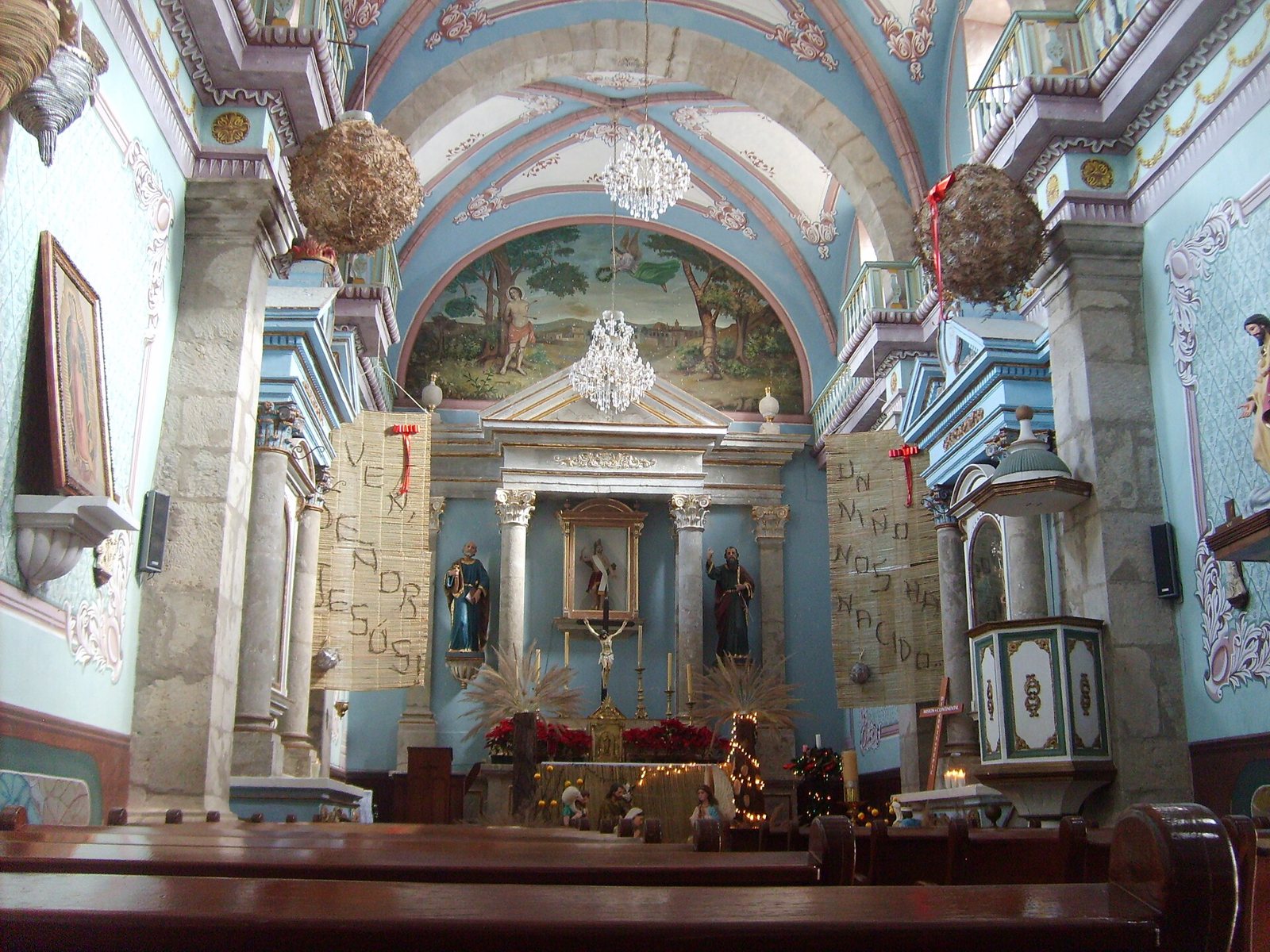 Inside the San Sebastián parish church in San Sebastián del Oeste.
How Silver Was Refined: Mines, Haciendas and Salt
Digging out ore was only half the job. It then had to be processed to separate the silver from the rock, which is what haciendas de beneficio (reduction haciendas) were for: estates with mills, courtyards, ovens and smelters.
Across much of New Spain, the standard technique was the patio process, developed by Bartolomé de Medina in Pachuca in 1554. Crushed ore was mixed with water, mercury, common salt and a copper compound called magistral, then spread out in large courtyards and churned for weeks until the silver bonded with the mercury and could be recovered.
We don't know exactly which method each San Sebastián hacienda used, but the sources agree on one thing: the mountain mines needed salt, and there was none in the sierra. That small detail would turn out to be key to the founding of Puerto Vallarta. The millstone and ovens still standing at Hacienda Jalisco (see the cover photo) are a reminder of this industrial side of the story.
The Mining Boom in San Sebastián del Oeste
The 18th century was the golden age. By 1785, according to the UNESCO file, the town had about ten reduction haciendas and close to 30 mines. Several foundries stood along the creeks, since water was essential for working the metal.
That wealth is still written into the town's layout. The main plaza dates to 1774, according to Milenio and Mexico News Daily. The square known as the Portal del Hueso ("Bone Arcade") takes its name, México Desconocido explains, from the butcher shops that once operated there. The town also preserves a garitón, an old watchtower, next to what was once a tienda de raya, the company store where mine workers bought their supplies.
Plastered adobe walls, archways and wood-and-tile roofs from the 17th to 19th centuries remain in good condition. In 1812, San Sebastián was officially granted the rank of city.
Mining carried on into the 1800s. The Santa Gertrudis mine, about 4 km (2.5 miles) from town, supplied silver to Hacienda Jalisco, a 19th-century estate that now houses a museum. México Desconocido describes it as one of the first places in Mexico to generate electricity, and Mexico News Daily mentions its long-gone hydroelectric plant.
The 1800s: Town Councils, Cantons and a Miners' Strike
After independence, the IIEG records these milestones:
- By 1825, the Real de San Sebastián had its own town council and belonged to the Mascota department within the Sixth Canton of Autlán.
- In 1843, Manuel López Cotilla listed it simply as San Sebastián in his geographic and statistical survey of the Department of Jalisco.
- In 1870, the Tenth Canton was created with its seat in Mascota, and San Sebastián was placed within it, which is where the "Ex Décimo Cantón" name comes from.
The first municipal president on record, Ignacio Aguirre Peña, took office in 1867. The church also had to be rebuilt: according to Mexico News Daily, it was first raised by Augustinian friars in the 17th century and reconstructed after a strong earthquake in 1868.
The municipal history summarized on Spanish-language Wikipedia records a lesser-known episode. In 1888, while Ramón Corona was governor of Jalisco, miners went on strike under the leadership of Felipe Preciado and Francisco Ochoa. They won their demands, but the New York-based mining company rejected the deal and shut the mines down. The same source says the ore was shipped out through Las Peñas, today's Puerto Vallarta.
San Sebastián and the Birth of Puerto Vallarta
The mountain town's story is closely linked to the coast. Refining silver required salt, and the small settlement founded at the mouth of the Cuale River on December 12, 1851, Las Peñas de Santa María de Guadalupe, made its living supplying it to the mines in the sierra. Salt arrived by sea and was hauled up the mountains by mule.
For a time, Vallarta even answered to San Sebastián: in 1888 the Las Peñas commissary was annexed to the municipality of San Sebastián, and only in 1918 did it become its own municipality under the name Puerto Vallarta. For the coastal side of the story, read our Puerto Vallarta history, our guide to the Puerto Vallarta Malecón and Old Town and our road trip from San Sebastián del Oeste to the coast.
How Many People Lived Here?
You'll often read that San Sebastián once had more than 20,000 residents. The figure shows up in several travel guides and reference sources, but it's unclear whether it refers to the town alone or to the whole mining district around it.
Census counts for the town tell a more modest story, but they show the decline clearly: 2,305 residents in 1900, 1,342 in 1910, 706 in 1940 and 632 in the 2020 census, when the entire municipality had just over 5,000.
Why the Town Declined
Prosperity faded in the early 20th century. After the Mexican Revolution of 1910 and the closure of most mines, much of the population left in search of work. Mexico News Daily adds that many foreign-owned mining companies pulled out and that the mines were shut down by 1921.
Ironically, that decline is what preserved San Sebastián: with few people, little money and poor roads, no one tore down the old mansions. That's why the town still looks so much like it did in its mining days.
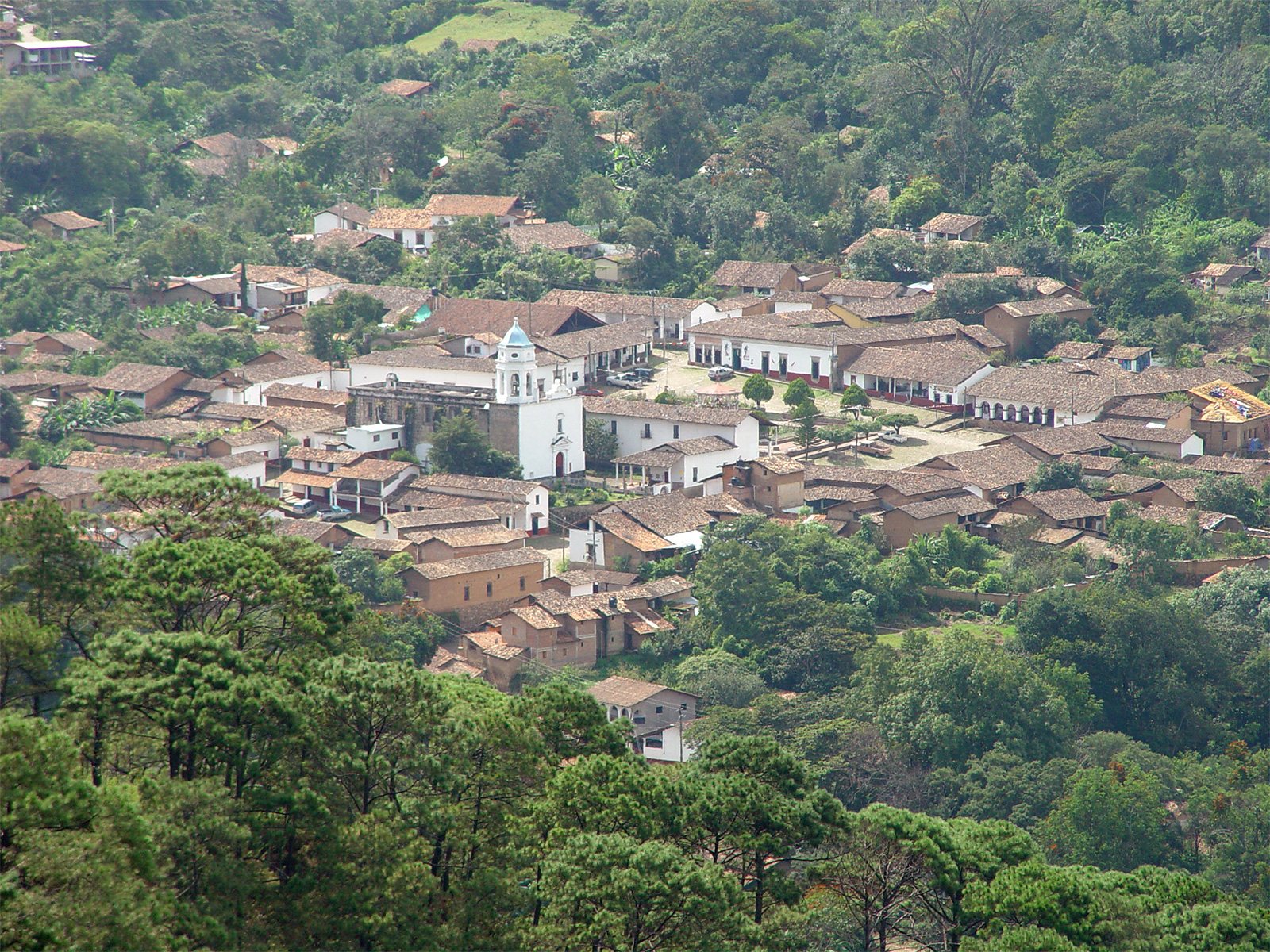 San Sebastián del Oeste from above: tile roofs tucked into the mountain forest.
A Native Son: General Amado Aguirre
The town's best-known native is Amado Aguirre Santiago (1863–1949), son of Ignacio Aguirre Peña, the first municipal president. He earned a degree in mining engineering in Guadalajara and was working for a mining company in 1910. The Revolution launched him into national politics: he was a delegate to the Constitutional Congress of 1917, a senator for Jalisco, Secretary of Communications and Public Works under President Álvaro Obregón, director of the national Military College, and governor of the territories of Quintana Roo and southern Baja California.
A mining engineer from the sierra who helped draft the constitution Mexico still lives under.
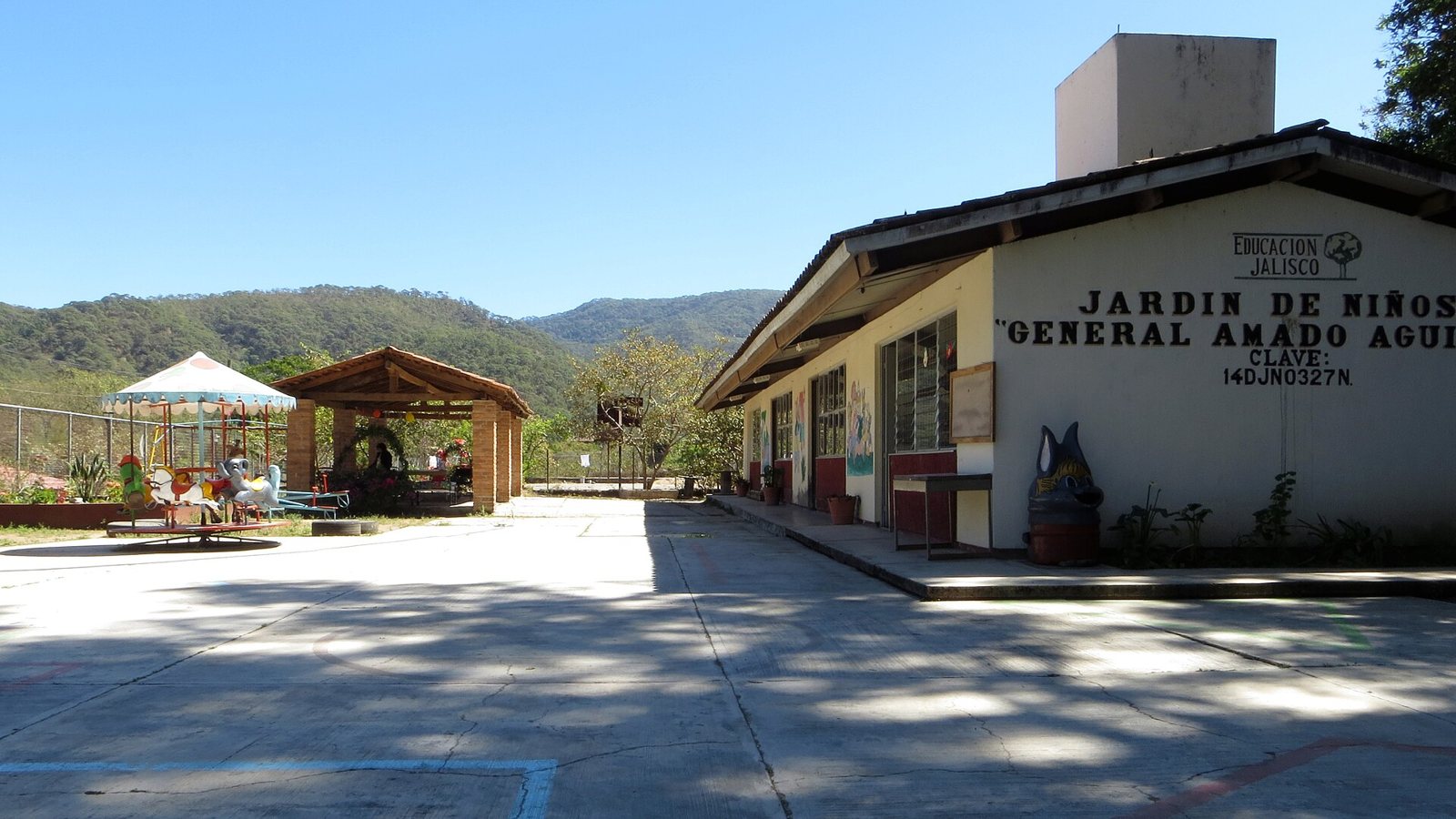 A kindergarten in San Sebastián is named after General Amado Aguirre, a native son of the town.
The 20th Century: Hollywood in the Mountains and Pueblo Mágico Status
According to Mexico News Daily, Hacienda Jalisco was once owned by American artist Bud Acord and hosted stars such as John Huston, Elizabeth Taylor, Richard Burton and Peter O'Toole, the same Hollywood circle that put Vallarta on the map with The Night of the Iguana.
In 2001, the "Historic Town of San Sebastián del Oeste" was added to Mexico's UNESCO Tentative List, the step before a possible World Heritage nomination. In 2011 it was named a Pueblo Mágico ("Magic Town"), a federal tourism designation for towns with special historic and cultural value.
Is There Still Mining in San Sebastián del Oeste?
Yes, though not in town. Elsewhere in the municipality, near Santiago de los Pinos, a Canadian company developed the Terronera mine, which the mining press reports reached commercial production on October 1, 2025. In August 2026 the company announced a temporary suspension after a blockade by members of a neighboring ejido (communal landholding). The mining story of the sierra is still being written.
Living Culture: Festivals, Crafts and Mountain Cooking
Religious festivals still set the local calendar:
- January 20: Feast of Saint Sebastian, the patron saint.
- August 15: Our Lady of the Assumption.
- September 15–16: Independence Day celebrations.
- October 7: Our Lady of the Rosary. In nearby Real Alto, whose church dates from the 17th and 18th centuries, her image is among the most venerated in the area.
- December 12: Our Lady of Guadalupe, celebrated in Los Reyes, a village in the municipality.
Traditional crafts include saddles and leatherwork, carved wood and textiles. Local cooking features pozole, birria, enchiladas and tamales; for dessert, fruit rolls and fruit cajetas; and on cool evenings, atole, ponche (warm fruit punch) and high-altitude coffee. To dig deeper, read our posts on San Sebastián del Oeste coffee and food and raicilla, Jalisco's mountain agave spirit.
Nature and Climate in the Sierra
San Sebastián sits in the Sierra Madre Occidental, surrounded by pine and oak forest. Wetter slopes hold cloud forest with Jalisco fir, magnolia and tree ferns, and the municipality is home to white-tailed deer, peccaries, coyotes, parrots and hummingbirds.
According to the IIEG, about 70% of the municipality lies within a federal protected natural area, the Cuenca Alimentadora del Distrito Nacional de Riego 043. The highest point is Cerro de La Bufa, at 2,411 meters (about 7,900 feet), where on clear days you can see all the way to Banderas Bay. Our Cerro de La Bufa guide explains how to get up there.
The town sits at about 1,480 meters (roughly 4,850 feet), so mornings are cool and fog is common. Rain falls mostly from June to October.
San Sebastián del Oeste Timeline
- Before 1524: The region is home to the Teco people.
- 1524: Conquest of the area by Francisco Cortés de San Buenaventura.
- 1542: Mines discovered in the region; the Real de Minas de San Sebastián is created.
- 1605: San Sebastián mines discovered and the town founded.
- 1608: Original construction of the parish church.
- 1785: About ten reduction haciendas and close to 30 mines.
- 1812: San Sebastián granted the rank of city.
- 1851: Las Peñas (today's Puerto Vallarta) founded on the coast as a salt supplier.
- 1888: Las Peñas annexed to the municipality of San Sebastián.
- 1910–1921: Revolution, departure of mining companies and closure of the mines.
- 1983: The municipality officially adopts the name San Sebastián del Oeste.
- 2011: Named a Pueblo Mágico.
- 2025: The Terronera mine, in the municipality, begins commercial production.
A Suggested History Walk
Half day: the main plaza, the church of San Sebastián, the Portal del Hueso and the side streets with their adobe walls, archways and the old watchtower. Finish with a cup of local coffee.
Full day: add Hacienda Jalisco (check ahead whether it's open to visitors) or a walk toward the Santa Gertrudis mine, about 4 km away. Alternatively, spend the day on Cerro de La Bufa, which requires a 4x4 and a hike.
Be a good guest: this is a small town where people go about their daily lives. Say hello, ask before photographing people, and keep quiet inside the church during Mass.
See San Sebastián's History with Riviera Tours & Transfers
Our San Sebastián del Oeste tour runs Monday, Wednesday and Friday. It's a full-day tour offered in English and Spanish, and it includes:
- Round-trip transportation
- Certified tour guide
- Visit to an artisanal tequila gallery
- Organic coffee factory tour
- Lunch and aguas frescas at a traditional Mexican restaurant
- Guided walking tour of downtown San Sebastián
- Free time to explore on your own
- Bottled water during the tour
The tour does not go up Cerro de La Bufa, and Hacienda Jalisco is not part of the published itinerary. To plan your trip, read our San Sebastián del Oeste travel guide and our post on San Sebastián del Oeste haciendas and rural tourism.
See dates and book the San Sebastián del Oeste tour →
Tips for Your Visit
- Bring cash. Many businesses in town only accept cash.
- Wear comfortable shoes. The streets are cobblestone and hilly.
- Pack a light jacket. The town sits at about 1,480 meters (roughly 4,850 feet), and mornings are cool.
- June to October: bring a rain jacket.
- Don't count on your phone. Cell signal in the mountains is limited.
- Accessibility: because of the cobblestones and slopes, the tour is not recommended for wheelchair users.
FAQ
When was San Sebastián del Oeste founded? In 1605, after its silver mines were discovered, although the IIEG dates the first mining finds in the region to around 1542.
Why is San Sebastián del Oeste called a mining town? It was built around silver and gold mines. By 1785 it had close to 30 mines and about ten ore-processing haciendas. After the 1910 Revolution the mines closed and the town emptied out.
Why is it called "del Oeste"? To distinguish it from San Sebastián del Sur, also in Jalisco. The name became official in 1983.
What does San Sebastián have to do with Puerto Vallarta? Las Peñas, the village that became Puerto Vallarta, supplied salt to the mountain mines, and from 1888 to 1918 it was part of the municipality of San Sebastián.
Are there still active mines? Not in town. Elsewhere in the municipality, the modern Terronera mine began production in 2025, though it reported a temporary suspension in August 2026.
When are San Sebastián's festivals? The main one is January 20, the feast of Saint Sebastian. There are also celebrations on August 15 and October 7.
What's the best time to visit? November through May, when there's less rain. From June to October the forest is at its greenest, but rain is frequent.
Photos: Melikamp / CC BY-SA 3.0 via Wikimedia Commons · JelloSheriffBob / CC BY-SA 3.0 via Wikimedia Commons · Intersofia / CC BY-SA 3.0 via Wikimedia Commons · Melikamp / CC BY-SA 3.0 via Wikimedia Commons




