
Most visitors to San Sebastián del Oeste spend their time around the main square, and that is a fine way to see the town. But step a little beyond the cobblestones and you find the countryside that grew up around the old mines: haciendas built in the mining era, coffee growing in the shade of the forest, fruit orchards and dirt roads winding through pine and oak. If you are curious about rural Mexico, this mountain Pueblo Mágico, a little over an hour from Puerto Vallarta, is one of the easiest places to get a taste of it.
Below you will find where the haciendas came from, why the local coffee grows under trees, which festivals shape the year and how to plan a day trip or a weekend.
What "Rural Tourism" Means in Mexico
Mexico's Tourism Secretariat (SECTUR) groups three styles of travel under the label alternative tourism: ecotourism (getting to know nature), adventure tourism (taking on challenges the terrain sets) and rural tourism, which is about spending time with people in the countryside and seeing how they live and work. Agritourism fits inside that last one: walking an orchard or following a crop from the field to your cup.
San Sebastián del Oeste packs all three into a small area: mountain roads and lookouts, but above all families who still grow coffee and fruit in a town with four centuries of history.
Why San Sebastián del Oeste Is Great for Rural Tourism
San Sebastián del Oeste was founded in 1605 as a mining town and named a Pueblo Mágico ("Magic Town") in 2011. It sits at roughly 1,480 meters (about 4,850 feet) in the Sierra Madre Occidental, surrounded by pine and oak forest. When mining faded, life here turned quieter and more agricultural, and that blend of mining history and ranch life is what draws travelers looking for something different from the beach.
The numbers tell the story. The municipality, part of Jalisco's Sierra Occidental region, covers about 1,117 km² (430 square miles) and had 5,086 residents in the 2020 census; the town itself had just 632. According to Jalisco's statistics institute (IIEG), about 80% of the municipality is mountainous and forest covers roughly 45% of the land.
For the full story of the mines, read our post on San Sebastián del Oeste's mining history. If this is your first visit, start with our San Sebastián del Oeste travel guide.
Timeline: From Silver Camp to Country Town
- 1530. Spanish forces under Nuño de Guzmán reach a region home to the people sources call the Tecos.
- 1542. First mineral finds recorded in the area.
- 1605. The mining town is formally founded (UNESCO dates the discovery of its mines to January 20 of that year).
- 1608. The first parish church of San Sebastián is built.
- 1774. The main plaza you see today is laid out.
- 1785. Close to 30 mines and about 10 ore-processing haciendas operate in the area.
- 1812. San Sebastián is granted the title of city.
- 1800s. Hacienda Jalisco is built.
- 1868. An earthquake damages the parish church, which is later rebuilt.
- 1910–1921. After the Revolution, the foreign mining companies leave; by 1921 the mines are closed.
- 2001. The town is added to UNESCO's Tentative List for World Heritage.
- 2011. Named a Pueblo Mágico.
What Was an Ore-Processing Hacienda?
When you read that San Sebastián once had "10 haciendas," don't picture cattle ranches. In colonial mining, a hacienda de beneficio was where ore from the mine was turned into metal. The rock was crushed in mills driven by water or by mules and horses, which is why these haciendas were built beside creeks: water supplied power and was used to mix and wash the ore.
The most common method was the patio process, credited to Bartolomé de Medina in Pachuca in the mid-1500s. Crushed ore was wetted into a mud, spread over a paved patio and mixed with salt, mercury and a copper compound; horses trampled it for weeks until the silver bonded with the mercury and could be recovered. The salt matters for the regional story: the mountains had none, so it came up from the coast. The little settlement that supplied salt to the mines, Las Peñas, founded in 1851, became Puerto Vallarta, as we explain in our Puerto Vallarta history.
Hacienda Jalisco: San Sebastián's Most Famous Hacienda
Hacienda Jalisco is probably the best-known rural building in San Sebastián. It dates to the 1800s and was tied to the mining industry: sources agree it was used to store and process the precious metals coming out of nearby mines. It stands on the outskirts of town, next to the small airstrip, roughly a 20-minute walk from the center; the walk crosses the airstrip and a bridge before reaching the gates.
What makes it memorable:
- A small mining museum. Inside, a museum space displays documents, maps and objects from the region's mining past.
- Silver from Santa Gertrudis. According to México Desconocido, the Santa Gertrudis mine, about 4 km away, supplied silver to Hacienda Jalisco in the 19th century.
- Candlelight instead of power lines. The hacienda once had its own hydroelectric plant and is said to have been among the first places in Mexico to generate electricity. Today it is lit by oil lamps, candles and fireplaces.
- A Hollywood guest list. Mexico News Daily reports that the hacienda was once owned by Hollywood artist Bud Acord and that stars such as John Huston, Elizabeth Taylor, Richard Burton and Peter O'Toole stayed here, names that will ring a bell if you know the story of The Night of the Iguana in Puerto Vallarta.
A note on legend versus record: some guides say the hacienda was built to guard mine treasure before it was shipped to Spain. If it dates to the 1800s, as other sources say, much of its life came after Mexican independence in 1821, so treat that line as local lore rather than documented fact.
Heads up: sources disagree on whether the hacienda is currently open to visitors, and some report it as closed. Opening hours and entry fees are not reliably published. Check before you go rather than showing up unannounced.
Hacienda Esperanza de la Galera and the Fruit Orchards
Orchards are another side of rural San Sebastián. Travel guides describe Hacienda Esperanza de la Galera as a fruit orchard that has welcomed visitors, with trees bearing guavas, limes, bananas, oranges and peaches, plus faisanes, a fruit México Desconocido compares to a mulberry.
Along the roads leaving town, for example on the way up to Cerro de La Bufa, you will also pass orchards among ash and pine trees, a reminder that many families here still live off the land. Head down toward Los Reyes instead and the trail runs past banana and avocado trees, a sign of how quickly the climate turns tropical as you lose altitude.
As with Hacienda Jalisco, there is no official, up-to-date information on hours or access. These are private properties, so ask locally before visiting and respect fences, crops and animals.
Shade-Grown Coffee in the Sierra
Coffee is not native to the Americas. It reached New Spain in the 18th century from the Caribbean, via Veracruz, and spread to other regions in the 1800s. In Jalisco, high-altitude coffee is concentrated in the Sierra Occidental, South Coast and South regions, and San Sebastián del Oeste is listed among the state's coffee-producing municipalities.
What makes it special is how it is grown: in agroforestry systems, under shade. Instead of clearing forest for sun-grown rows, coffee shrubs grow beneath native and fruit trees. The North American Commission for Environmental Cooperation has documented that shade coffee keeps more plant, bird and insect life than sun coffee or cattle pasture.
The high-altitude coffee is one of the most popular things visitors take home. Some farms in the area show you the process: walking among the coffee plants, watching the beans roast and tasting blends such as espresso, Americano or coffee with chocolate and cinnamon. Several focus on organic coffee.
The town has held a spring festival devoted to coffee and raicilla; sources disagree on whether it falls during Holy Week or in May, so confirm this year's date. For more on what to eat and drink in town, see our guide to San Sebastián del Oeste coffee and food.
Nature: Cloud Forest, Fog and One-of-a-Kind Plants
The landscape is rugged: steep peaks, deep ravines and narrow valleys carved by rivers such as the Ameca and the Los Reyes. Pine and oak cover the higher slopes, while moist canyons hold patches of cloud forest (bosque mesófilo de montaña), one of Mexico's richest and most fragile ecosystems.
A 2021 study in Acta Botanica Mexicana recorded 407 species of vascular plants in the municipality. Of those, 94 are endemic to western Mexico, 31 are known only from Jalisco and 6 have been found nowhere but San Sebastián del Oeste. Most appear on at least one national or international risk list, so stay on the trails and leave plants and mushrooms where they are.
For the municipality as a whole, the IIEG reports an average annual temperature of about 19.5 °C (67 °F) and roughly 1,189 mm (47 inches) of rain a year. Because the town sits higher than much of the municipality, mornings there feel noticeably cooler.
Hiking, Horseback Riding and Back Roads
With extra time, the countryside around San Sebastián is made for exploring on foot:
- Santa Gertrudis Mine. About 4 km (2.5 miles) from town, reachable on foot or by ATV, up to the old tunnel entrance. It was one of the most productive mines of the 1800s.
- Cerro de La Bufa. About 9 km (5.5 miles) from town, with a summit around 2,400 meters (about 7,900 feet) and views toward Banderas Bay on clear days. A 4x4 takes you to the base, and the last stretch is a hike. Read more in our Cerro de La Bufa lookout guide.
- Real Alto. A hamlet near La Bufa on the same dirt road. Its church was built between the 17th and 18th centuries and holds an image of the Virgin of the Rosary that is deeply venerated in nearby villages.
- The road to Los Reyes. A rough route of about 16 km (10 miles) following a creek, with hanging bridges and remains of old mines. Nearby are a cave with basalt columns known as La Escondida, a waterfall and the ruins of Hacienda La Victoria.
What about horseback riding? It fits the ranch-country setting, but we could not find reliable, current information on who offers rides. If it is on your wish list, ask around once you arrive.
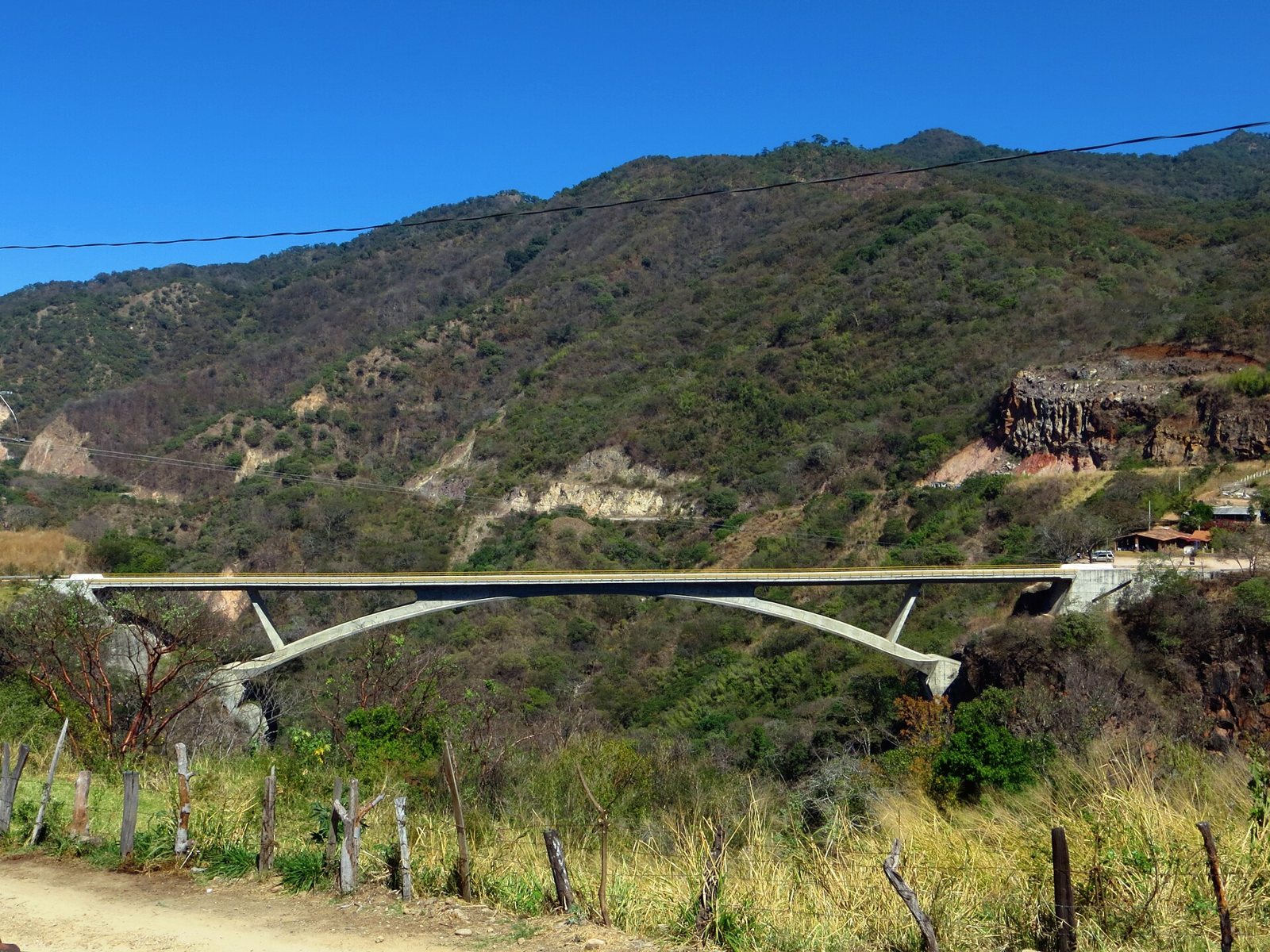 El Progreso bridge near San Sebastián del Oeste, set among the mountains.
Living Traditions: Festivals, Crafts and Flavors
Rural travel is about people as much as scenery, and the local calendar is built around religious and civic festivals:
- January 20, San Sebastián. The patron saint's festival, with a traditional fair and charreadas (Mexican rodeo); the busiest celebration of the year.
- August 15. Feast of the Assumption, with processions.
- September 15–16. Independence celebrations, with a Noche Mexicana and a parade.
- October 7. Our Lady of the Rosary.
- December 12. Our Lady of Guadalupe is honored in Los Reyes.
- Christmas. Pastorelas (shepherds' plays) and nativity scenes under the arcades.
Traditional crafts include carved wood, saddles, leatherwork and textiles, all echoes of a life built around horses and ranches. There is also silverwork, though local silversmiths now bring raw silver in from central Mexico: mining here stopped a century ago.
On the table you will find birria, pozole, tamales and tostadas, with atole or coffee, and fruit cajetas and fruit rolls for dessert, sold near the main plaza.
Weather and the Best Time to Visit
Thanks to the altitude, San Sebastián is much cooler than the coast, especially in the morning, when fog often settles over town. The rainy season runs roughly from June to October: everything turns green, but dirt roads get muddy. Winter is cool and comfortable for walking, so pack a jacket. Visit in January and you may catch the patron saint's festival.
Suggested Itineraries: One Day or a Weekend
Day trip from Vallarta. Start early: it is about 60 to 70 km (40 to 45 miles) via Federal Highway 200 and State Highway 544, with a narrow, winding final stretch. See the plaza and church, visit a coffee farm, have lunch in town and, if Hacienda Jalisco is receiving visitors, walk out to it in the afternoon. Head back before dark.
Weekend. On day two, drive up La Bufa early (the fog usually clears in the morning), stop in Real Alto and spend the afternoon at Santa Gertrudis or, with the right vehicle, on the road to Los Reyes.
To stretch the trip, see our San Sebastián del Oeste to the coast route or our guide to Mascota and Talpa.
Staying Overnight in the Countryside
A day trip covers the town center and a coffee farm, but rural tourism is best enjoyed slowly. In and around town you will find old homes turned into guesthouses, cabins in the woods and eco-lodging. Spending the night lets you see the misty sunrise, head up to La Bufa early or walk a trail without rushing. Options change often, so check recent reviews before booking.
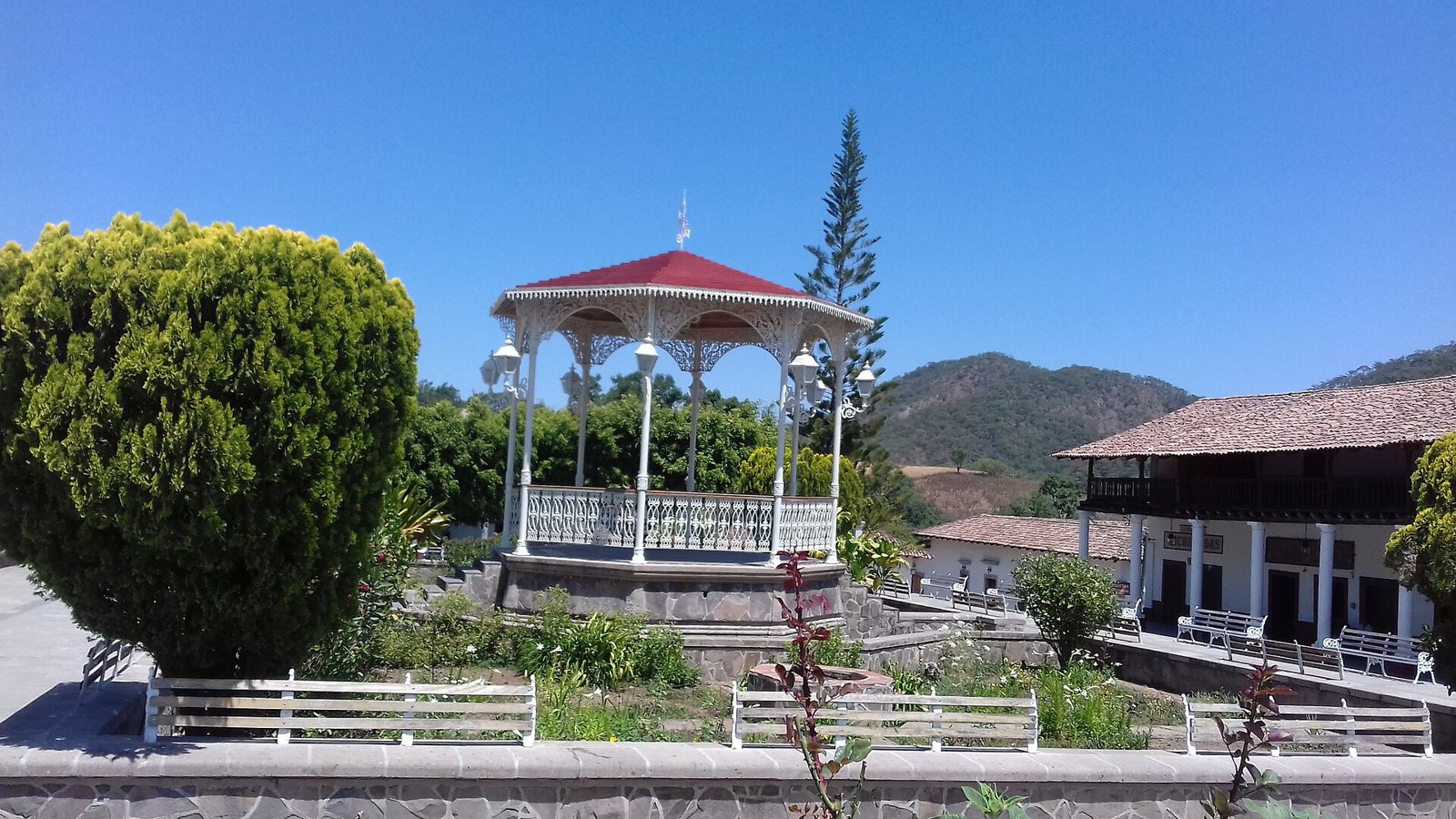 The main plaza of San Sebastián del Oeste, with its bandstand and the hills around town.
Riviera Tours & Transfers' San Sebastián del Oeste Tour
If you would rather not drive the mountain road, our San Sebastián del Oeste tour runs Monday, Wednesday and Friday. It is a full-day tour in English and Spanish. It does not visit the haciendas or orchards described above, but it does give you a taste of the town's rural side with an organic coffee factory tour. It includes:
- Round-trip transportation
- Certified tour guide
- Visit to an artisanal tequila gallery
- Organic coffee factory tour
- Lunch and aguas frescas at a traditional Mexican restaurant
- Guided walking tour of downtown San Sebastián
- Free time to explore on your own
- Bottled water during the tour
See dates and book the San Sebastián del Oeste tour →
Tips for Visiting Rural San Sebastián
- Bring cash. Many businesses in town only accept cash.
- What to pack. Comfortable layers, walking shoes, a light jacket, sunscreen and a rain shell in the wet season.
- Respect private property. Haciendas, orchards and farms belong to someone: ask permission, don't pick fruit without approval and confirm hours and access ahead of time.
- Buy local. Coffee, cajetas and crafts made in town put money directly into mountain families' pockets.
- Greet people and ask first before photographing anyone or the inside of their home.
- Don't count on your phone. Signal in the mountains is limited, so download offline maps before you leave.
- In the rainy season, avoid dirt roads unless you have a suitable vehicle.
- Budget. Costs are usually modest; bring extra cash if you plan to rent an ATV or a 4x4 ride up La Bufa.
FAQ
Can you visit Hacienda Jalisco? It has operated as a hotel and museum, but its current opening status is unclear and some sources list it as closed. Confirm before you go.
Does the Riviera tour stop at Hacienda Jalisco or the orchards? No. The tour includes an organic coffee factory, the artisanal tequila gallery, lunch and a guided walk through town. To see the haciendas, consider staying overnight and visiting on your own.
When is the best time for a countryside visit? Winter, outside the rainy season, is cool and pleasant for walking. From June to October it rains more: the scenery is greener, but the dirt roads are harder going.
What was a "hacienda de beneficio"? A site where ore was crushed and processed to extract silver. The San Sebastián area had about 10 of them in 1785.
Why is San Sebastián coffee shade-grown? It is planted beneath native and fruit trees, a system that keeps the forest standing and protects wildlife.
When is the San Sebastián festival? January 20, with a traditional fair and charreadas. It is the town's biggest celebration.
Can you do it as a day trip from Puerto Vallarta? Yes, it is about 60 to 70 km each way; for the haciendas or La Bufa, stay overnight.
Photos: Melikamp / CC BY-SA 3.0 via Wikimedia Commons · Melikamp / CC BY-SA 3.0 via Wikimedia Commons · Esme193227 / CC BY-SA 4.0 via Wikimedia Commons




