
Trade the beach for the mountains for a day. Up in the Sierra Madre, a little over an hour from Puerto Vallarta, San Sebastián del Oeste is a quiet town of cobblestone streets, whitewashed adobe houses and tile roofs, where the air smells like coffee and pine. It is one of the most rewarding day trips from Vallarta, and it feels like a different Mexico.
That calm hides more than four centuries of history: silver, mule trains hauling salt up from the coast, an earthquake and a revolution that emptied the town. This guide covers that story, plus what to see, what to eat, when to go and how to get there.
A Mining Town Frozen in Time
San Sebastián del Oeste was founded in 1605 as a silver and gold mining town during the Spanish colonial period. At its height, dozens of mines and foundries operated in the surrounding hills. When mining declined, the town was left largely untouched, which is exactly why it is so charming today.
The town sits at roughly 1,480 meters (about 4,850 feet) above sea level, so it is noticeably cooler than the coast, especially in the morning and during winter. In 2011 it was named a Pueblo Mágico ("Magic Town"), a designation Mexico gives to towns with special historic and cultural value. It is a small place today: the 2020 census counted 632 people in town and just over 5,000 in the whole municipality.
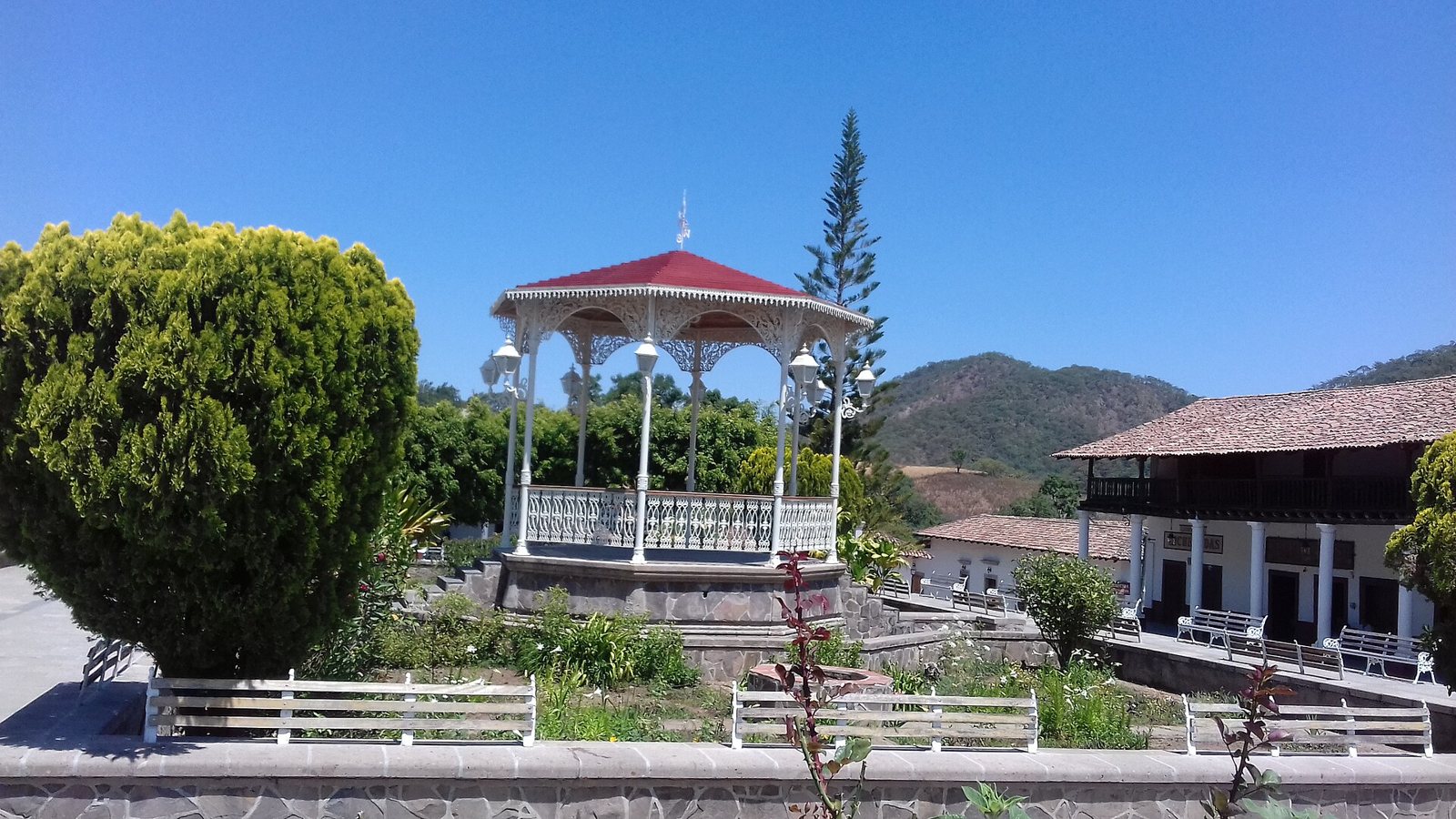 The gazebo in the main plaza, the heart of town.
San Sebastián del Oeste History: From Silver Camp to Magic Town
Before the silver
Before the Spanish arrived, this part of the sierra was home to people colonial sources call the Tecos. Jalisco's state statistics and geography institute (IIEG) dates the Spanish conquest of the area to 1524 and records that in 1530 the army of Nuño de Guzmán, the conquistador of Nueva Galicia, passed through.
The Royal Mines of San Sebastián
Ore was found early. The IIEG places mines in the area as far back as 1542, when the district of the Real de Minas de San Sebastián was organized, covering several neighboring mining camps such as Los Reyes, Jolapa and Santiago. In colonial times the town was simply called Real de San Sebastián ("real" was the term for a royal mining settlement).
The date usually given for the founding of the town itself is 1605. According to the dossier Mexico submitted to UNESCO, San Sebastián's mines were discovered on January 20 of that year, and the settlement grew around them. A fun coincidence: January 20 is the feast day of Saint Sebastian, the town's patron saint, still celebrated every year on that date.
The boom years
The 18th century was the richest era. By 1785, the same dossier says, the area had nearly 30 mines and about ten haciendas de beneficio, the works where ore was crushed and refined. Foundries were built along the creeks because processing metal required water. In 1812 the town was granted city status.
That wealth is still written in stone and adobe: much of the plaza, arcades, arches and tile roofs you see today date from the 17th to 19th centuries. That is why, in 2001, Mexico placed the "Historic Town of San Sebastián del Oeste" on its UNESCO Tentative List, the step before a possible World Heritage nomination.
The salt road that linked the mountains to the sea
Refining silver required salt, and there was none in the mountains. That is where the coast comes in. On December 12, 1851, a small settlement called Las Peñas de Santa María de Guadalupe was founded at the mouth of the Cuale River to supply salt to the sierra mines. Salt arrived by sea and was carried uphill by mule.
The ties ran deep: in 1888 Las Peñas was annexed to the municipality of San Sebastián, and it was not until 1918 that it became its own municipality under the name Puerto Vallarta. In other words, for three decades today's Vallarta was governed from this mountain mining town. For the coastal side of the story, read our Puerto Vallarta history guide.
Earthquake, revolution and decline
The main church had to be rebuilt after a strong earthquake in 1868, according to Mexico News Daily. The real blow came in the 20th century: after the Revolution of 1910, the mining companies pulled out, and by 1921 the mines had closed. People left to find work elsewhere.
You will often read that the town once had more than 20,000 residents, but the 1900 census counted 2,305 people in town; the figure most likely covers the wider mining district. What is certain is that decline preserved the town: with few people and poor roads, no one tore down the old mansions.
Why "del Oeste"?
In colonial times it was Real de San Sebastián; in the 19th century, simply San Sebastián; and for much of the 20th century the municipality was officially called "San Sebastián Ex Décimo Cantón," a leftover from Jalisco's old system of cantons. The current name is fairly recent: it was adopted by decree on October 22, 1983, at the town council's request. "Del Oeste" ("of the West") distinguishes it from San Sebastián del Sur, another town in Jalisco.
For a deeper dive, see our article on San Sebastián del Oeste's mining history.
San Sebastián del Oeste timeline
- 1524: Spanish conquest of the area, then home to the Tecos.
- 1542: mines and the Real de Minas de San Sebastián district are recorded.
- January 20, 1605: discovery of the mines that gave rise to the town.
- 1608: original construction date of the parish church.
- 1785: nearly 30 mines and about 10 ore-processing haciendas.
- 1812: granted city status.
- 1851: Las Peñas, today Puerto Vallarta, is founded to supply the mines with salt.
- 1868: an earthquake forces the church to be rebuilt.
- 1888–1918: Las Peñas is part of the municipality of San Sebastián.
- 1910–1921: Revolution, departure of the mining companies and closure of the mines.
- 1983: the municipality officially becomes San Sebastián del Oeste.
- 2001: added to Mexico's UNESCO Tentative List.
- 2011: named a Pueblo Mágico.
- 2019: the municipality is included in the Raicilla Denomination of Origin.
What to See in San Sebastián del Oeste: Landmarks with a Story
The main plaza. Every visit starts here. It is dated to 1774 and has a gazebo, flower beds, a stone fountain and shaded benches. On clear days you can see the peak of Cerro de La Bufa to the southeast.
Portal de Hueso. One of the arcades downtown, its name ("Bone Arcade") comes, according to México Desconocido, from the butcher shops that once operated there. It is a nice reminder of everyday life in the old mining town.
The parish church of San Sebastián. Its original construction is dated to 1608 and credited to Augustinian friars. After the 1868 earthquake it was rebuilt, and today it shows neoclassical lines with Baroque decoration, a painted vaulted ceiling and chandeliers. The image of the patron saint is inside. It is an active church, so keep quiet and skip photos during Mass.
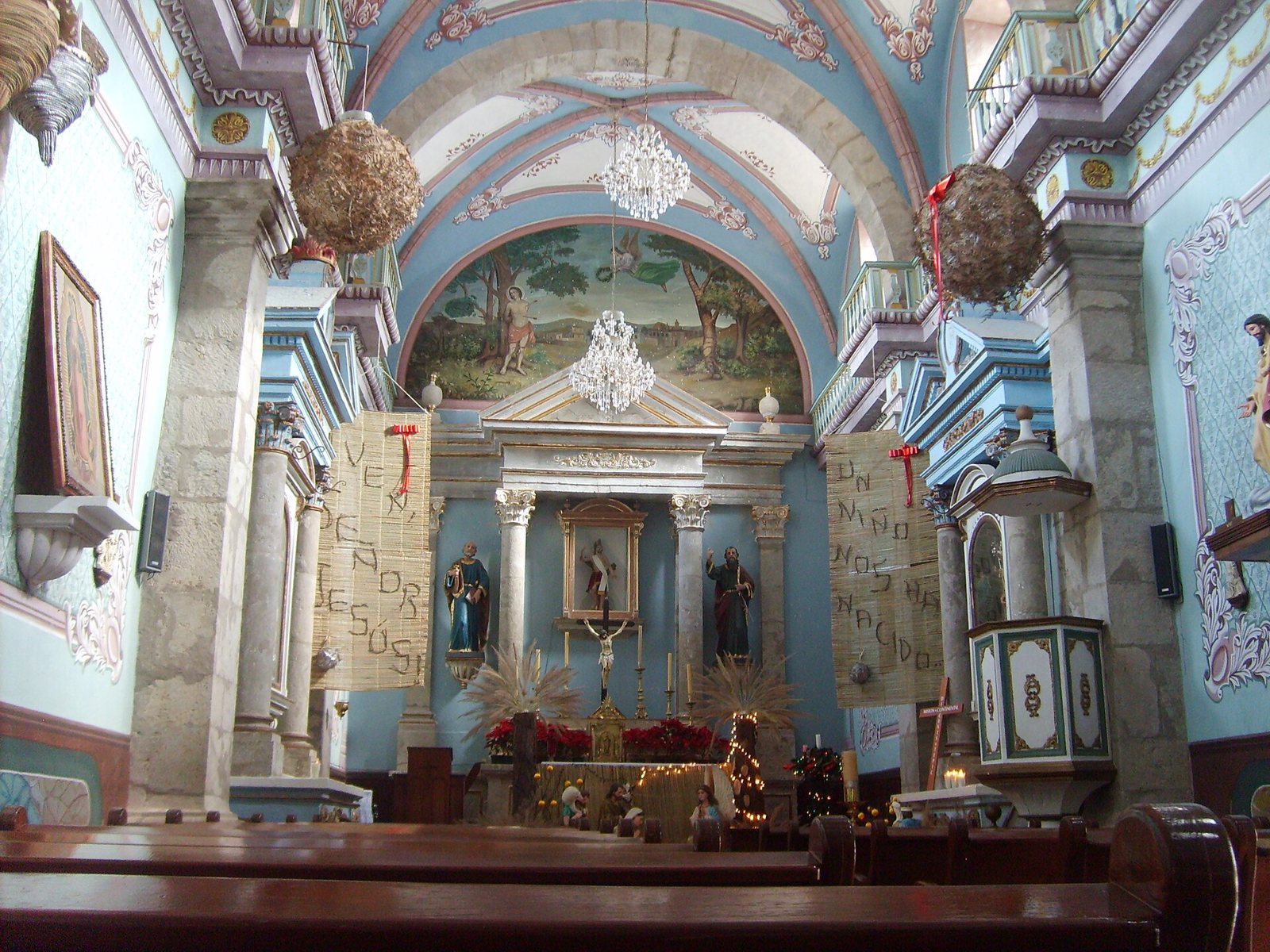 Inside the San Sebastián parish church in San Sebastián del Oeste.
Hacienda Jalisco. About a 20-minute walk from the center, this 19th-century complex was built by mining companies. According to Mexico News Daily it had its own hydroelectric plant, and México Desconocido calls it one of the first places in Mexico to generate electricity. Mexico News Daily also says guests have included John Huston, Elizabeth Taylor, Richard Burton and Peter O'Toole, several of them tied to the filming of The Night of the Iguana. It has operated as a museum; check whether it is open before you go.
Real Alto and Los Reyes. The outskirts hold small villages with their own history. Real Alto, near La Bufa, has a 17th–18th-century church with a much-venerated image of the Virgin of the Rosary. Los Reyes, about 16 km away on a rough road, was another mining camp and still has old mine ruins, walls and chimneys, plus a waterfall and a hanging bridge. Both need extra time and a suitable vehicle.
Things to Do in San Sebastián del Oeste
- Walk the historic center. The main square, the bandstand and the parish church are the heart of town. Take it slow and peek into the old mansions and porticos.
- Learn about tequila. Local artisan galleries explain how Mexico's most famous spirit is made.
- Visit a coffee farm. High-altitude coffee is grown in the area, and some farms show the process from bean to cup. More in our guide to San Sebastián del Oeste coffee and food.
- Eat traditional Jalisco food. Local restaurants serve home-style Mexican cooking with mountain views and fresh aguas frescas.
- Hike to an old mine. The Santa Gertrudis mine, about 4 km from town, was one of the most productive in the 19th century and supplied ore to Hacienda Jalisco.
- Drive up to Cerro de La Bufa. If you have extra time, this lookout at about 2,400 meters offers some of the best views in the region. It is reached by dirt road, usually in a 4x4. Our Cerro de La Bufa guide has the details.
- Explore the countryside. Haciendas, orchards and trails are covered in our article on San Sebastián del Oeste haciendas and rural tourism.
Nature: Forests, Mist and Seasons
San Sebastián is surrounded by pine-oak forest, and in the dampest ravines you will find montane cloud forest, one of Mexico's richest and most fragile ecosystems. A study published in Acta Botanica Mexicana (2021) recorded 407 vascular plant species in the municipality: 94 are endemic to western Mexico, 31 grow only in Jalisco and 6 are found only in this municipality.
According to the IIEG, almost 80% of the municipality is mountainous and forest is its dominant land cover. For the whole municipality, which runs from low valleys to more than 2,500 meters, it reports an average of 19.5 °C (about 67 °F) and roughly 1,189 mm (47 inches) of rain a year. Up in town, mornings tend to be cool and misty, and rain falls mostly from about June to October.
Living Culture: Festivals, Food and Crafts
Festivals. The biggest is the feast of Saint Sebastian on January 20, with a traditional fair and charreadas (Mexican rodeo); México Desconocido calls it the most anticipated event of the year. Other dates on the religious calendar are August 15 (Virgin of the Assumption), October 7 (Virgin of the Rosary) and December 12, when the Virgin of Guadalupe is honored in the village of Los Reyes. The town has also held a spring coffee and raicilla festival; dates vary, so confirm with the local tourism office.
Food. Mountain cooking here is hearty: birria, Jalisco-style red pozole, enchiladas, tostadas and tamales, including tamales colados. For dessert there are fruit cajetas (fruit pastes) and fruit rolls, and on cold mornings, atole and coffee. Birria is most closely tied to the town of Cocula; read about its origins in our birria guide.
Raicilla. San Sebastián del Oeste is one of the municipalities included in the Raicilla Denomination of Origin, published in 2019. Mountain raicilla is made from wild local agaves, and a local way to drink it is chocorraíz, mixed with chocolate. Learn more in our raicilla guide. Alcohol sales in Mexico are for adults 18 and over only.
Crafts. Look for carved wood, saddles, leatherwork and textiles, plus fruit liqueurs and cajetas sold near the plaza.
How to Get There from Puerto Vallarta
San Sebastián is about 60–70 km (roughly 37–45 miles) from Puerto Vallarta. Head north on Federal Highway 200 and, at Las Juntas, take State Highway 544, which climbs into the sierra toward Mascota; the turnoff to town comes later. Depending on traffic and weather, the drive takes between about 1 hour 15 minutes and 2 hours on a winding mountain road. Landslides can happen in the rainy season, so check road conditions before you leave.
You have two options:
- Drive yourself. Doable, but leave early, take the curves slowly and keep in mind that cell signal in the mountains is limited.
- Join a guided tour. You are picked up, you don't have to worry about the road, and you travel with someone who knows the town's history.
The same highway leads to two more Magic Towns: see our guide to Mascota and Talpa de Allende and our San Sebastián del Oeste to the coast road trip.
Suggested One-Day Itinerary
If you go on your own, this is a comfortable pace:
- Morning: leave early; walk the plaza while mist still hangs on the hills, step into the church and wander the arcades.
- Late morning: a coffee farm and a tequila or local-products gallery.
- Midday: a slow mountain-style lunch.
- Afternoon: walk to Hacienda Jalisco or relax in the plaza; head back before dark.
If you stay overnight, spend the next morning at Cerro de La Bufa or Real Alto, which require a 4x4 or a local guide.
Riviera Tours & Transfers' San Sebastián del Oeste Tour
Our San Sebastián del Oeste tour runs Monday, Wednesday and Friday. It is a full-day tour offered in English and Spanish, and it includes:
- Round-trip transportation
- Certified tour guide
- Visit to an artisanal tequila gallery
- Organic coffee factory tour
- Lunch and aguas frescas at a traditional Mexican restaurant
- Guided walking tour of downtown San Sebastián
- Free time to explore on your own
- Bottled water during the tour
The tour does not go up Cerro de La Bufa or to Real Alto; those require extra time on your own.
See dates and book the San Sebastián del Oeste tour →
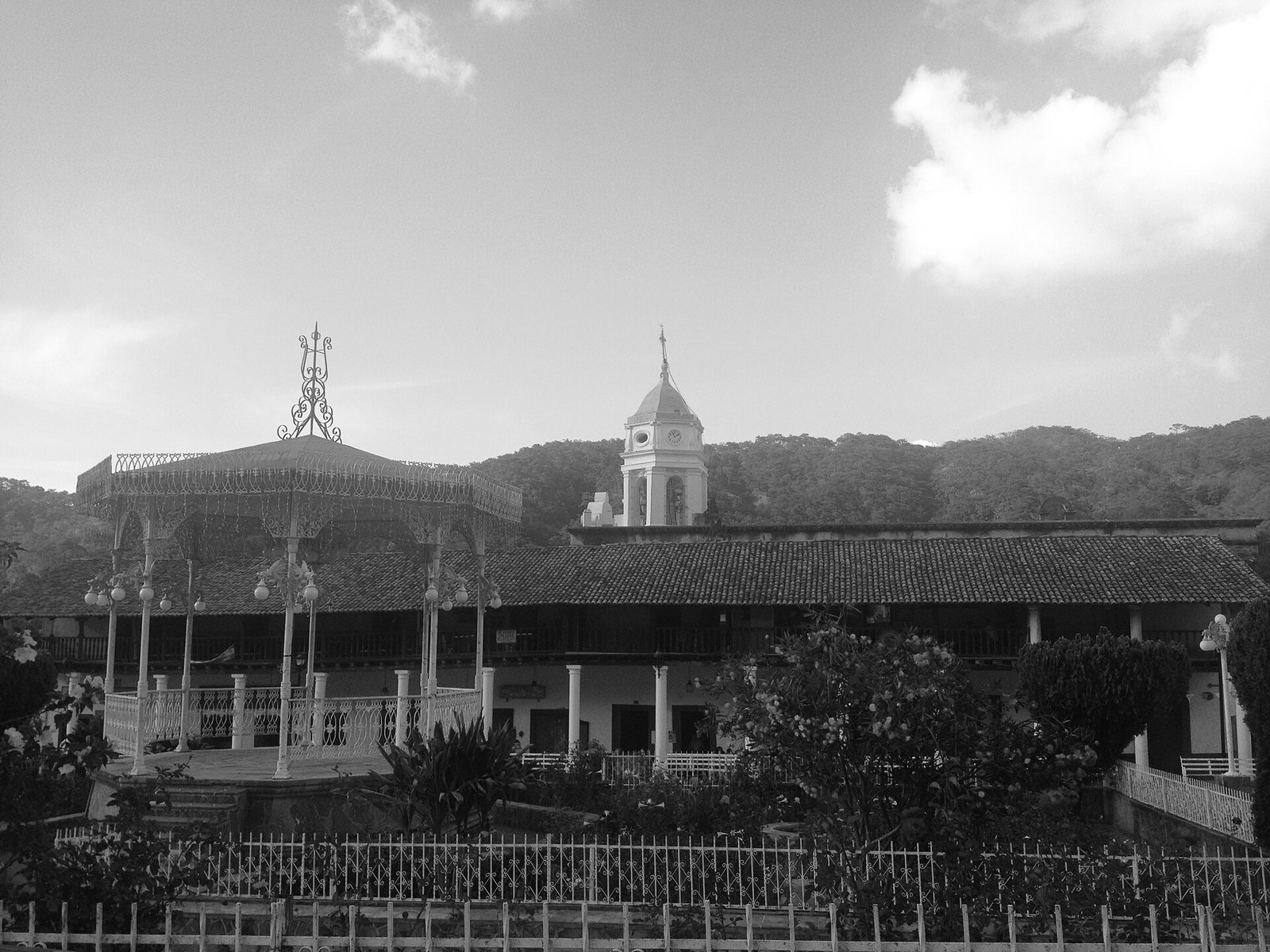 The plaza, its arcades and the church tower, in black and white.
Best Time to Visit San Sebastián del Oeste
- November to May: dry season. November to February is cooler and ideal for walking; bring a jacket. The patron saint festival falls around January 20.
- June to October: rainy season. The forest is at its greenest, but expect more mist, possible landslides and rough dirt roads.
Tips for Your Visit
- Bring cash. Many businesses in town only accept cash.
- Wear comfortable shoes. Streets are cobblestone and hilly.
- Pack a light jacket, especially from November to February.
- Don't count on your phone. Reception is limited; download offline maps before you go.
- Accessibility: because of the cobblestones and slopes, the tour is not recommended for wheelchair users.
- Budget: a moderate-cost outing (transportation or a tour, lunch and a souvenir); bring extra cash if you plan to buy coffee or crafts.
- Be a respectful visitor. Many old mansions are private homes: ask before photographing interiors or people, and leave no trash.
FAQ
How much time do I need in San Sebastián del Oeste? A full day covers the town center, a coffee farm, lunch and some free time. If you want to hike or go up to La Bufa, consider staying overnight.
Is it worth the trip from Puerto Vallarta? Yes, if you want to see a different side of the region: mining history, mountain weather and traditional food, far from the beach.
When was San Sebastián del Oeste founded? The town dates to 1605, when its mines were discovered, although mining in the area is recorded as early as 1542.
How is San Sebastián connected to Puerto Vallarta? Las Peñas, the village that became Vallarta, was founded in 1851 to supply salt to the mountain mines, and from 1888 to 1918 it was part of the municipality of San Sebastián.
When is the San Sebastián del Oeste festival? The patron saint festival is on January 20, with a fair and charreadas. Check each year's program with the municipality.
Does the tour include Cerro de La Bufa? No. The tour covers the town, the tequila gallery and a coffee factory, with lunch included. La Bufa requires extra time on your own.
Which days does the tour run? Monday, Wednesday and Friday. Check availability here.
Photos: Mechitas / CC BY-SA 3.0 via Wikimedia Commons · Esme193227 / CC BY-SA 4.0 via Wikimedia Commons · JelloSheriffBob / CC BY-SA 3.0 via Wikimedia Commons · Aldair546 / CC BY-SA 4.0 via Wikimedia Commons




