
Head south out of Puerto Vallarta, past the last beach coves, and the highway climbs into jungle-covered hills. About 40 minutes later you reach one of the most rewarding half-day trips in the area: the Vallarta Botanical Garden. Think orchids, cacti, giant palms, a clear mountain river you can swim in and trails through native forest. If you need a break from the beach, this is the place.
There's also a great story behind the greenhouses: a traveler from Georgia who came for six months and stayed to plant a garden on worn-out pastureland. Here's that story, what to look for once you're there and how to plan your day.
About the Vallarta Botanical Garden
The garden was founded in 2004 and opened to the public in 2005. Its founders, Bob Price, his mother Betty Price and local co-founder Jesús Reyes, started on degraded cattle pasture and turned it into a garden of Mexican and exotic plants and a reserve protecting forest in the Los Horcones River basin.
Its stated mission is to conserve and celebrate the plant biodiversity of western Mexico. It runs as a nonprofit and, according to the garden, receives no government funding; admission, memberships and donations keep it going.
Today it maintains about 20 acres (8 ha) of public gardens and trails and manages roughly 297 acres (120 ha) of forest in the basin, 79 acres (32 ha) of which carry official protected status.
The garden has earned international recognition. In 2022 it received the American Public Garden Association's Garden of Excellence Award, the first garden outside the United States to get it, and it has placed several times in USA Today 10Best readers' polls of the best botanical gardens in North America.
The History of the Vallarta Botanical Garden
Six Months That Turned into a Life's Work
Robert "Bob" Price grew up in Savannah, Georgia. As he told Mexico News Daily, he arrived in Puerto Vallarta in 2004 planning to stay about six months. Then a man selling orchids took him to a piece of land in the mountains, and that was that. Price noticed the coast had no botanical garden, decided to build one and taught himself much of what he needed to get started.
The land was far from pristine jungle. According to the garden, it had been used for grazing and agave farming. What you see today is largely the result of nearly two decades of restoration.
From Garden to Conservation Hub
The project quickly grew beyond a place to stroll: it surveyed the basin's wild orchids, opened a lab to propagate native plants and began buying forestland with donor support to protect it. It has also added hundreds of records to the herbarium at the University of Guadalajara's coastal campus (Centro Universitario de la Costa), some documented there for the first time, and works with communities in El Tuito and El Cuale to learn how to propagate the region's rare species.
Timeline
- 2004: Bob Price, Betty Price and Jesús Reyes found the garden on former pasture.
- 2005: Opens to the public.
- 2008: An orchid survey of the basin with the University of Guadalajara records 50 native species.
- 2010: Opens its micropropagation lab and registers with Mexico's environment ministry as a Wildlife Conservation Management Unit (UMA).
- 2013: Named one of the Top 10 North American Gardens Worth Travelling For (again in 2015 and 2019).
- 2017: The International Peace Garden of Mexico is dedicated.
- 2018: The lab is upgraded for in vitro orchid culture.
- 2019: The first military macaw born at the garden is released into the wild, and community opposition stops an illegal hydroelectric project on the river.
- 2021: The Los Angelitos art installation goes up in the garden's chapel.
- 2022: APGA Garden of Excellence Award.
- 2023: Jalisco certifies 79 acres (32 ha) as protected land; an international grant funds propagation of four western Mexican Encyclia orchids.
- 2024: Two greenhouses are built to propagate native plants.
- 2025: Reaches Level 2 accreditation with ArbNet, the global arboretum network.
Where Is the Vallarta Botanical Garden?
Despite the name, the garden sits in the municipality of Cabo Corrientes, at kilometer 24 of the Puerto Vallarta – Barra de Navidad highway (Federal Highway 200), the road that runs south from the city toward El Tuito. That puts it roughly 15 miles (24 km) south of Puerto Vallarta and around 1,300 feet (400 m) above sea level, so mornings tend to feel a bit cooler than on the coast.
Cabo Corrientes is a rugged, thinly populated municipality, more than half of it mountainous, with El Tuito as its seat. It became a municipality in 1944 and takes its name from the Cabo Corrientes headland on the Pacific. Traditional crafts here include leatherwork, huarache sandals and pottery.
On the way you pass the south shore of the bay, including Mismaloya and Boca de Tomatlán. If you want to add some beach time, see our Mismaloya Beach guide or our roundup of Puerto Vallarta's south shore beaches.
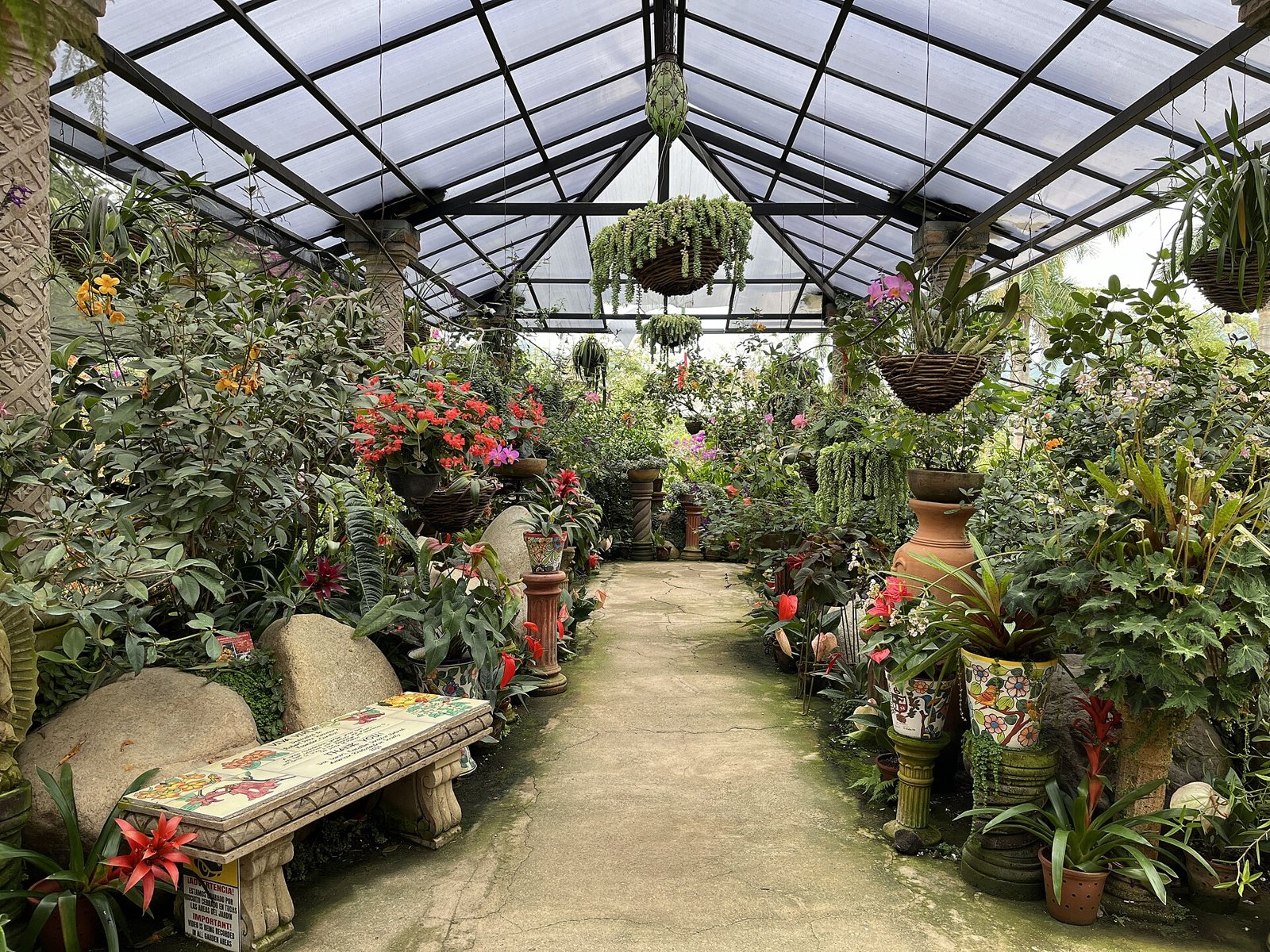 A greenhouse filled with orchids and tropical plants at the Vallarta Botanical Garden.
What to See at the Vallarta Botanical Garden
The living collections include more than 1,200 species and hybrids. Many plants are labeled with both scientific and common names, which makes a slow wander surprisingly educational.
Orchids
Orchids are the garden's signature. Conserving and propagating Mexican orchids is at the core of its mission, and many of the plants on display were grown in its own lab. The garden says its collection tops 130 species from nearly 70 genera, about three-quarters of them native to Mexico. You'll find them in the Orchid & Native Plants Conservatory and growing on trees along the paths.
Look for vanilla (Vanilla planifolia), itself an orchid and one of the garden's emblem species. It's native to Mesoamerica: the Totonac people grew it and paid it as tribute to the Aztecs, who called it tlilxochitl, "black flower." Grown abroad, it refused to set fruit without its native bee pollinators, until in 1841 Edmond Albius, a 12-year-old enslaved boy on Réunion Island, worked out the hand-pollination method still used today.
Oaks and Magnolias: The Science Collections
Two native-tree collections put the garden on Mexico's botanical map. The oak collection holds more than 100 trees of at least 12 native species, including Quercus tuitensis, named for nearby El Tuito. Mexico has more oak species than any other country: over 160, 109 of them found nowhere else.
The magnolia collection, accredited by the American Public Garden Association, holds about 130 trees of 10 Mexican species, among them the rare Magnolia vallartensis, which the garden is learning to propagate for reforestation.
Cacti, Agaves, Palms and Plant Houses
You'll also find bromeliads, 22 agave species, cacti, 30 palm species (a collection that grew through an agreement with the Culiacán Botanical Garden) and houses devoted to cacti, begonias, vireya rhododendrons and tropical plants.
Another emblem species is the papelillo or gumbo-limbo (Bursera simaruba), known for reddish bark that peels away in layers. Its green inner bark photosynthesizes during the dry season. Fun fact: locals in Sayulita reportedly call it the "gringo tree."
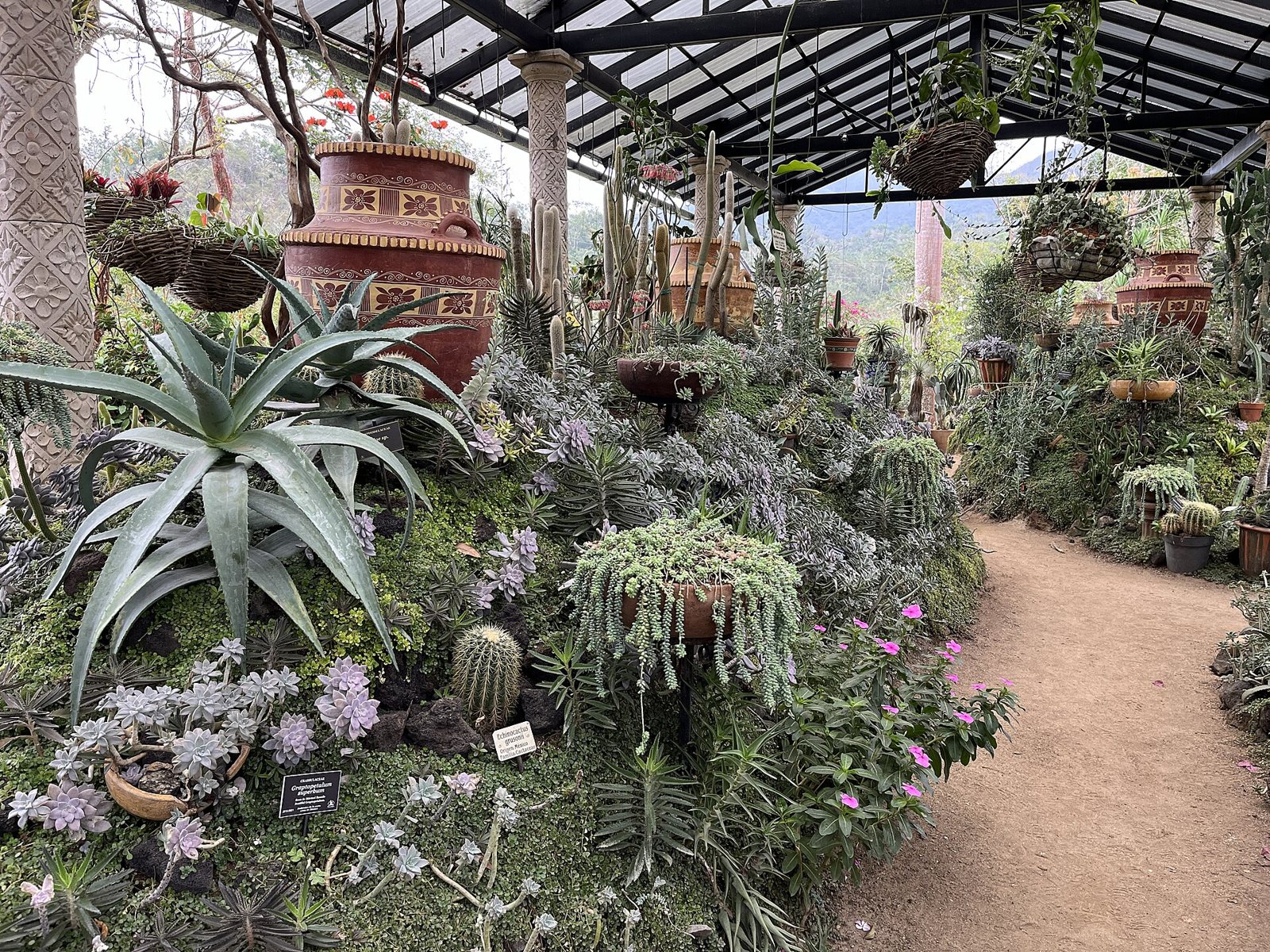 Cacti, agaves and succulents in one of the garden's covered areas.
Art, a Chapel and a Peace Garden
On the hillside stands Our Lady of the Garden, an open-air, interfaith chapel inspired by Mission San Juan Capistrano. Since 2021 it has housed Los Angelitos by David Allen Burns and Austin Young (Fallen Fruit), which uses photos of plants and birds printed on fabric alongside historic hummingbird lithographs by Rafael Montes de Oca and John Gould.
On the way up is the International Peace Garden of Mexico, with hand-painted tiles by Canadian artist Cheryl Wheeler and terraced seating that forms a natural amphitheater. Scattered through the grounds are hand-carved cantera stone sculptures with Indigenous imagery by artisan Alejandro Mondragón of Escolásticas, Querétaro.
Jungle Trails
Past the manicured areas, 8 trails lead into native forest. The best known is the Jaguar Trail, with some steep stretches; others lead to jungle lookouts and a swinging bridge, and a 2019 account also mentions a tree fern grotto and a giant strangler fig. Wear closed-toe shoes.
The Los Horcones River
The Río Los Horcones runs through the property. It rises in the Sierra El Cuale above 7,500 feet (2,300 m), cuts through a granite-walled canyon and meets the Pacific at Boca de Tomatlán, passing from pine-oak forest up high to tropical dry forest below.
For much of the year you can swim in its pools at your own risk, as the garden itself notes. After heavy rain the current can rise, so check with staff before getting in.
Along the river the garden has documented little-known plants such as the aquatic Marathrum rubrum and a vine new to science, named Polystemma horconesense after the river.
Nature: The Dry Forest and Its Wildlife
The garden sits in tropical dry forest. Its defining trait is that many trees drop their leaves in the dry season to save water and leaf out again when the rains arrive. In Cabo Corrientes the average annual temperature is about 76 °F (24.6 °C), with roughly 64 inches (1,600 mm) of rain a year, most of it in summer. That's why the scenery changes by season: in July and August, the height of the rains, the garden is at its greenest.
According to the garden, the Los Horcones basin is one of Mexico's last largely untouched wild areas. Its camera traps have recorded ocelots and jaguars, and the area is also home to otters and military macaws. The garden has installed more than 15 artificial macaw nests and runs two sanctuaries: about 7 acres (3 ha) for the crested guan (Penelope purpurascens) and about 176 acres (71.4 ha) for the ocelot.
Birds and Hummingbirds
More than 265 bird species have been spotted at the garden, including the russet-crowned motmot, San Blas jay, painted bunting and yellow-winged cacique. Birding is best early in the morning or late in the day.
From May to October it's hummingbird season, with more than a dozen species recorded by the garden. A special one is the Mexican woodnymph (Eupherusa ridgwayi), found only in the mountains of Nayarit, Jalisco and Colima and listed as Vulnerable by the IUCN.
Garden birding rules: no playback apps, keep 20–30 feet (6–10 m) away, no flash, and no drones (drones and professional shoots need advance permission).
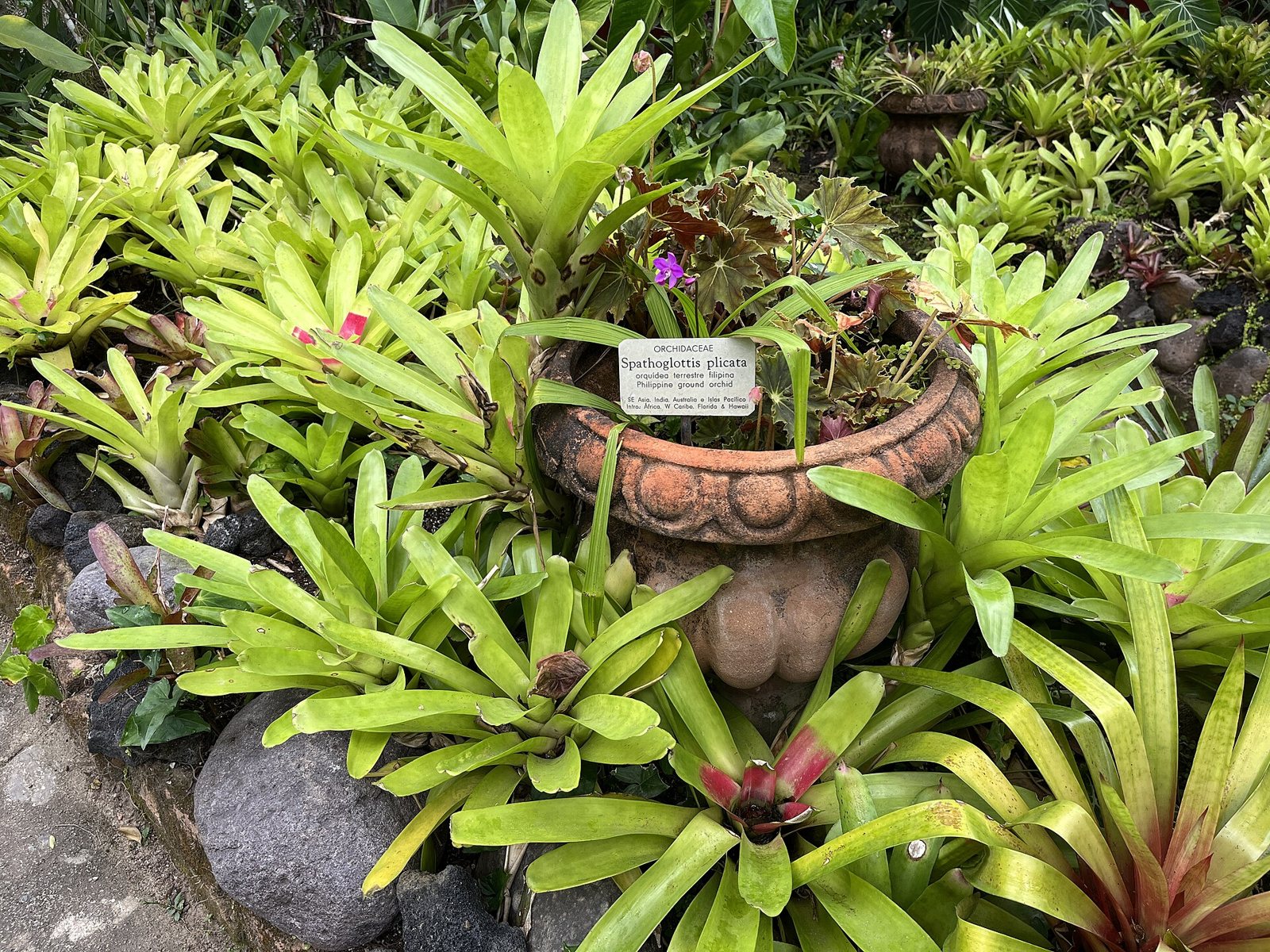 Bromeliads and a labeled ground orchid.
How to Get to the Vallarta Botanical Garden
- By public bus. The budget option. Catch the bus to El Tuito at the stop in the Romantic Zone. Buses run every half hour and the ride takes about 45 minutes. Ask the driver to let you off at the garden; the bus stops right at the front gate. Return buses run the same way.
- By taxi or Uber. Easy from anywhere in the area. Uber does not pick up at the garden, but staff can call you a taxi for the ride back. Agree on the fare first.
- By car. Drive south on Highway 200. There is free on-site parking. The road is winding, so take it easy.
- Garden shuttle. The garden runs a round-trip shuttle by advance reservation.
Staying downtown? Our Romantic Zone guide helps you get your bearings near where the southbound buses leave.
Suggested Itinerary
Half day (3–4 hours). Arrive at opening, when it's cooler and the birds are active. Start with the greenhouses and orchid conservatory, move on to the cactus, oak and magnolia collections, climb to the chapel and peace garden, then cool off in the river. The garden recommends at least 2–3 hours.
Full day. Add a jungle trail in the morning, eat at the garden's restaurant and spend the afternoon by the river and birding. On the way back, stop at Mismaloya or Boca de Tomatlán.
Budget. The bus is cheapest; a taxi or the garden shuttle costs more but saves time. Plan for admission, lunch and transportation, and check current rates with the garden.
Explore More of Vallarta with Riviera Tours & Transfers
Our tours do not visit the Botanical Garden, but if you want to get to know the city itself, the Vallarta City Tour runs every day, lasts about 7 hours and is offered in English and Spanish. It includes:
- A guided walk through downtown Puerto Vallarta
- A stop at a traditional jewelry shop
- Free time for shopping
- A tequila stop
- A visit to a regional-cuisine restaurant (meal not included)
Want lunch included? The Vallarta Plus City Tour adds a distillery tour, a tequila tasting and a meal at a regional-cuisine restaurant.
See dates and book the Vallarta City Tour →
For more ideas, check out our list of things to do in Puerto Vallarta and, for the backstory, our Puerto Vallarta history guide.
Tips for Your Visit
- Go early: cooler temperatures, more birds, better light.
- Check opening days. From April 1 through November 30 the garden is usually closed on Mondays; from December through March it opens daily. It also closes on Christmas Day and New Year's Day. Confirm on the official website before you go.
- Pack a swimsuit and towel if you want to swim in the river.
- Bring bug spray and sunscreen. You're in the jungle; repellent is also sold on site.
- Wear comfortable shoes and a hat, and carry water. Outside food and drinks aren't allowed, except water.
- Respect the forest: don't pick plants; poaching of orchids and birds is a real threat in the region.
- There's a restaurant on site, so you can stay for a meal with jungle views.
We recommend confirming hours and availability directly with the garden before your visit.
Frequently Asked Questions
Where is the Vallarta Botanical Garden located? At kilometer 24 of the Puerto Vallarta – Barra de Navidad highway (Highway 200), in Cabo Corrientes, Jalisco, about 15 miles (24 km) south of Puerto Vallarta.
How much time do I need? The garden recommends at least 2–3 hours. Half a day covers the collections, a trail and the river; plan most of the day if you eat there.
Can you swim in the river? Yes, for much of the year you can swim in the Los Horcones River at your own risk. Ask staff about conditions, especially during the rainy season.
Can I get there by public transportation? Yes. Take the El Tuito bus from the Romantic Zone; it runs every 30 minutes. Ask to be dropped off at the garden.
When is the best time to visit? May through October is hummingbird season, and July and August are the greenest months. From December through March the garden opens daily and it rains less.
Can I bring my dog? Yes, on a leash, under your control and with waste picked up. There's a per-pet fee.
Is it wheelchair accessible? Partly. Some areas are flat, restrooms are accessible and a basic wheelchair can be rented, but paving is uneven and the jungle trails are not accessible.
Photos: Another Believer / CC BY-SA 4.0 via Wikimedia Commons (4 photos)




