
Tucked into the southern corner of Banderas Bay is a village you can't drive to. To reach Yelapa you hop on a boat, cruise along the jungle coastline and step off onto a beach backed by palm-covered hills. That one fact shapes everything about the place: no traffic, no rush, and rainforest that runs almost to the waterline. If you're looking for a day trip from Puerto Vallarta that feels like a real escape, Yelapa is hard to beat.
Where Is Yelapa?
Yelapa belongs to the municipality of Cabo Corrientes, in the state of Jalisco, and sits in the southernmost cove of Banderas Bay, south of Puerto Vallarta. The village lies at the foot of the Sierra Madre Occidental, between Majahuitas beach to the east and Pizota to the west, right where a river comes down from the mountains into the bay.
What sets it apart is access: there's no road suitable for regular vehicles. Dirt tracks do wind down from the mountains, but they're not a realistic option in a normal car. Visitors, and much of what the village needs, arrive by water. Locals have chosen to keep it that way, and you feel the difference the moment your feet hit the sand.
It's also small. In Mexico's 2020 census, Yelapa held about 8% of Cabo Corrientes' 10,940 residents, a little under 900 people, making it the municipality's second-largest town after El Tuito, the municipal seat.
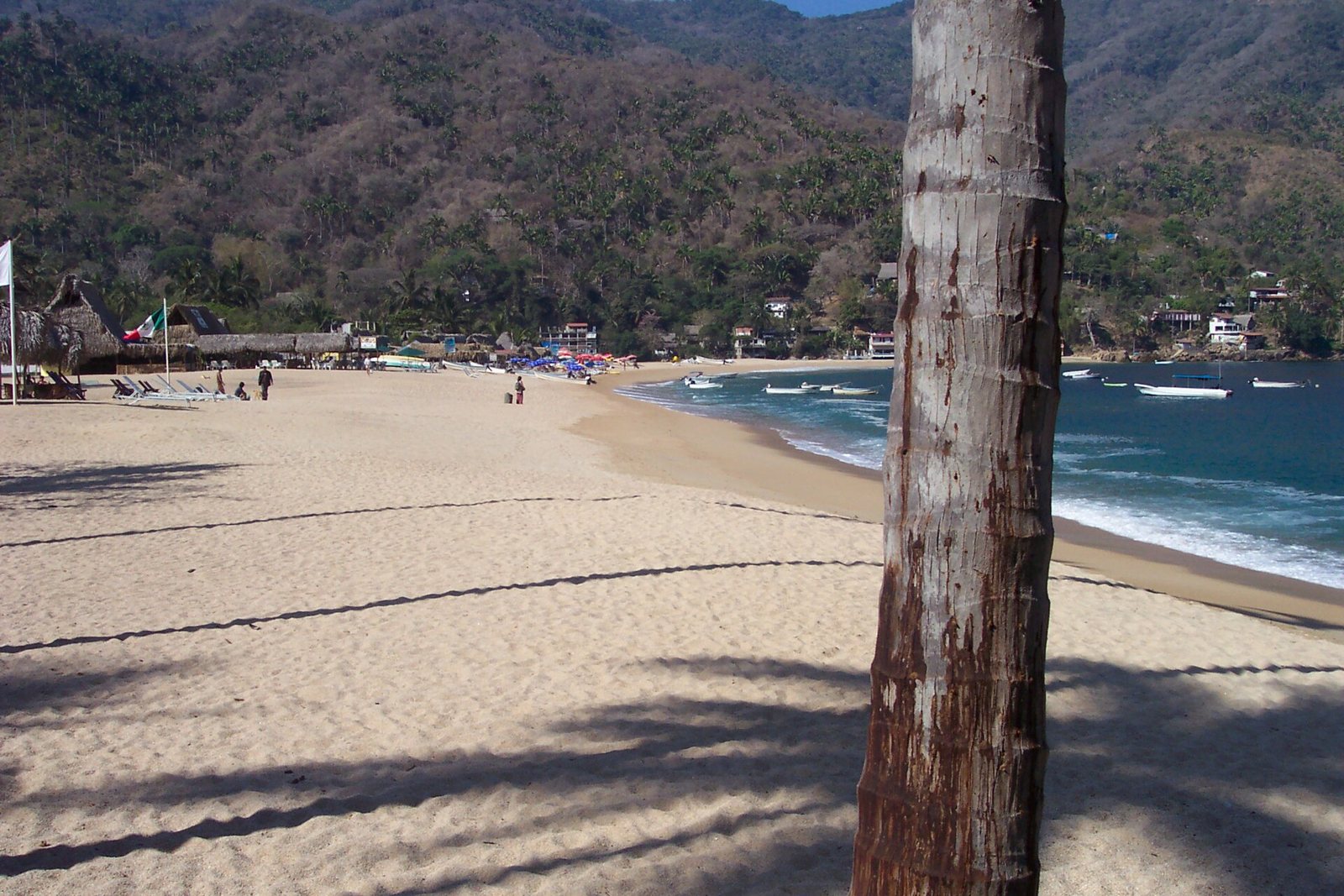 Yelapa's main beach, quiet and framed by hills.
What Does "Yelapa" Mean?
There's more than one answer. The most common explanation is an Indigenous phrase meaning roughly "where two rivers meet the sea," which gave the village its motto, "Where two rivers meet." Another source attributes the name to the Purépecha language and translates it as "the place where waters come together or pool." Old hands also call the village by a nickname: "Lapa."
Yelapa History: From Fishing Cove to Artists' Hideaway
Before the Spanish
Before the conquest, the Cabo Corrientes region was home to Nahua peoples, and sources on El Tuito also mention Huichol, Cora and Tecuexe groups in the area. In March 1525, troops led by Captain Francisco Cortés de San Buenaventura reached this coast. According to the traditional account, a large Indigenous force carrying banners met them and the encounter ended without a battle; that scene of flags is said to be the origin of the name "Valle de Banderas" and, by extension, Banderas Bay. Treat it as a traditional story rather than documented detail.
The 19th Century and a New Municipality
For much of the 1800s, this coast answered to distant administrative districts, first Autlán and later Mascota, and in 1872 Porfirio Díaz, later Mexico's longtime president, took refuge in the region. The municipality of Cabo Corrientes was formally created in 1944, with El Tuito as its seat.
Meanwhile, Yelapa remained a fishing settlement cut off by sea and mountains. When The Night of the Iguana was filmed at Mismaloya in 1963 and the world discovered Puerto Vallarta (the full story is in our Night of the Iguana guide), the coves of the south shore still had no road.
The 1960s: Travelers, Artists and a Woodstock Photographer
In the 1960s, Yelapa began drawing travelers in search of somewhere remote. One of them was American photographer and filmmaker Lisa Law, known for documenting the counterculture of that era and the 1969 Woodstock festival, who lived in Yelapa for a short time in 1966. Ever since, artists, writers and musicians have been drawn by the quiet, and a number of them stayed for good. The village keeps that bohemian feel today.
Even so, Yelapa never became a mass-market resort. A 2008 Sunset magazine piece, written by someone who went to grade school in the village, recalled that before there was a pier, visitors were brought ashore in dugout canoes, that donkeys did the job of delivery trucks, and that electricity had arrived only about six years earlier, in other words, in the early 2000s.
The Village Museum
On March 8, 2019, the Yelapa Museum of History, Art and Culture opened, billed as the first museum in the municipality of Cabo Corrientes. It's a nonprofit project driven by Lisa Law, Tatiana Rodríguez Anderson and Fernando García together with the municipal government. Exhibits include pre-Hispanic stone and clay pieces, objects from the Porfirio Díaz era, farm tools and a permanent photo exhibit by Law showing how Yelapa has changed. Check opening hours locally.
Yelapa Timeline
- Before 1525: Nahua peoples live in the Cabo Corrientes region.
- 1525: Francisco Cortés de San Buenaventura's troops arrive; the "Valle de Banderas" tradition is born.
- 1872: Porfirio Díaz takes refuge in the region.
- 1944: The municipality of Cabo Corrientes is created, with El Tuito as its seat.
- 1963: The Night of the Iguana is filmed at Mismaloya; Vallarta becomes famous, but the south shore stays roadless.
- 1966: Lisa Law lives in Yelapa for a time.
- Early 2000s: Electricity reaches the village.
- 2018: The International Astronomical Union names a crater on Mars "Yelapa."
- 2019: The Yelapa Museum of History, Art and Culture opens (March 8), and raicilla receives its Denomination of Origin, which includes Cabo Corrientes (June 28).
- 2020: The census counts a little under 900 residents in Yelapa.
Fun Fact: There's a Yelapa on Mars
On August 31, 2018, the International Astronomical Union approved the name Yelapa for a crater on Mars about 29 km (18 miles) across, in the Arabia Terra region near the Martian equator. The official U.S. Geological Survey gazetteer sums up the name's origin in three words: "Town in Mexico."
 Yes, there's a Yelapa on Mars (left), next to Izamal crater. Image from NASA's CTX camera.
Nature: Jungle, River and Bay
Yelapa sits where the mountains drop almost straight into the sea. Cabo Corrientes is mostly mountainous and forested, and off its coast Banderas Bay reaches its greatest depth, around 900 meters (roughly 3,000 feet).
The river that runs through the village, known as the Tuito River, feeds the waterfalls everyone comes to see. In the jungle and along the river you'll find parrots, iguanas, land crabs, frogs and plenty of birds; at night the soundtrack is crickets, cicadas, toads and bats, with fireflies in some seasons.
Out in the bay, humpback whales arrive roughly December through March to mate and give birth, and Mexico's environmental agency, Semarnat, sets the official whale-watching dates each season. You may spot them from the water taxi, though it's never guaranteed. More in our whale watching in Puerto Vallarta guide.
Weather by Season
- Dry season (November to early June): clear skies, especially February through April, generally calm seas and comfortable hiking. The waterfalls run lower.
- Rainy season (mid-June to mid-October): most of the rain falls July through September, and August is the wettest month. Expect a few hours of heavy rain in the late afternoon or evening. The jungle is at its greenest and the waterfalls at their fullest.
- Hurricanes: they're uncommon here because the Cabo Corrientes headland tends to weaken approaching storms, but during the season check Civil Protection advisories before heading out by boat.
Average highs hover around 86°F (30°C) and lows around 70°F (21°C), with high humidity year-round.
How to Get to Yelapa
The only practical way to get to Yelapa is by boat. There are two main departure points:
- From Los Muertos Pier (Puerto Vallarta). Water taxis to Yelapa leave from the pier at Playa Los Muertos in the Romantic Zone. The ride takes about 40 to 45 minutes and doubles as a scenic tour of the south shore.
- From Boca de Tomatlán. This small fishing village south of Mismaloya is the closest jumping-off point, about 20 to 25 minutes by boat. You can reach Boca by taxi or by local bus along the coastal highway: the orange-and-white buses marked "Boca" leave from the corner of Basilio Badillo and Constitución in the Romantic Zone and take about half an hour.
Private boat charters are also available if you'd rather set your own schedule. Water taxi times and fares change with the season, so check at the pier on the day you go and ask when the last boat back leaves.
Staying nearby? Our guide to Puerto Vallarta's Romantic Zone covers the neighborhood around the pier, and if you want a stop along the way, see our Mismaloya Beach guide or our roundup of Puerto Vallarta's south shore beaches, including Las Ánimas, Quimixto and Majahuitas.
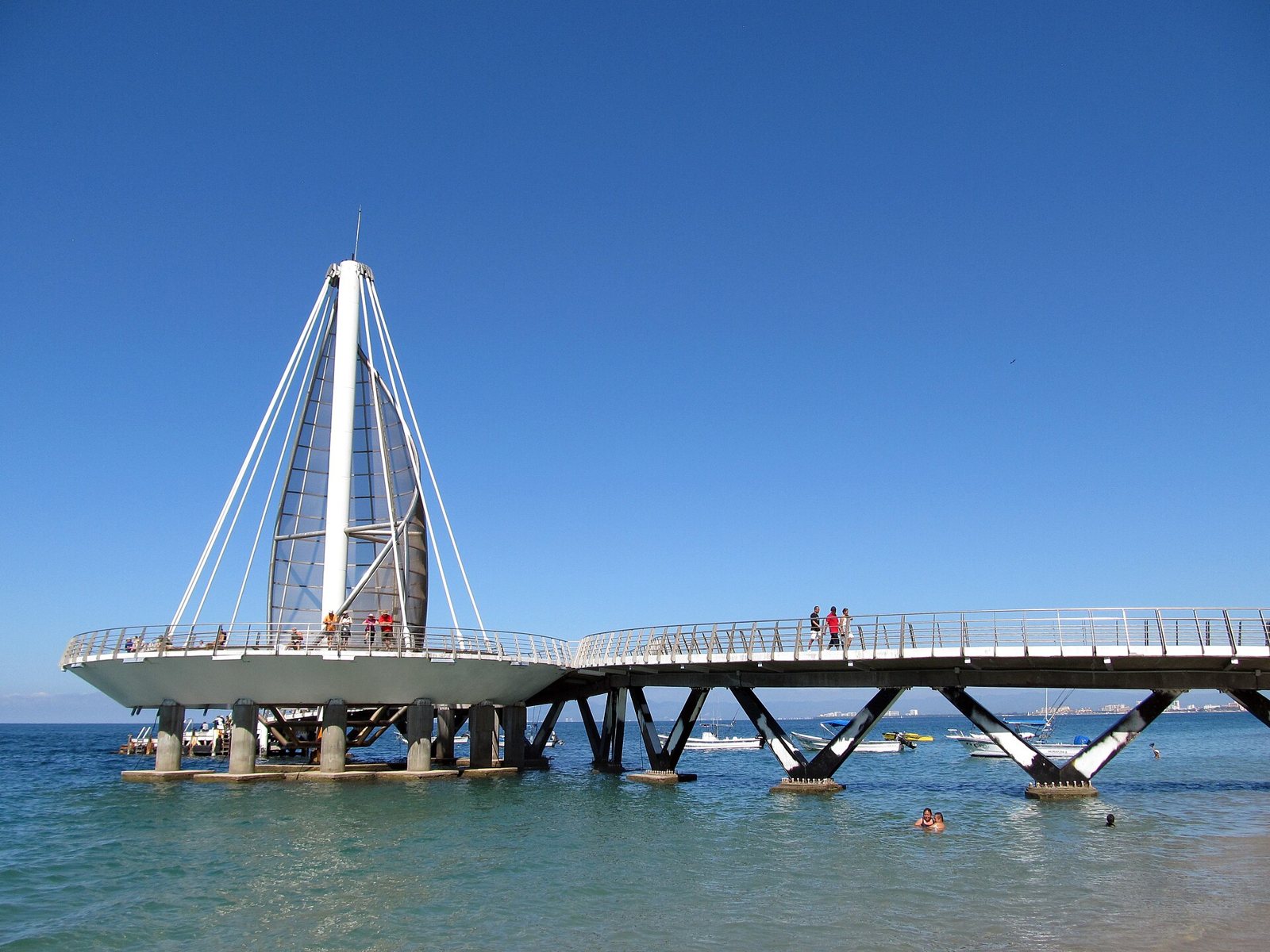 Los Muertos Pier in Puerto Vallarta, one of the departure points for water taxis to Yelapa.
Things to Do in Yelapa
Hike to the Yelapa Waterfall
The most popular waterfall is close to the village, along a trail that isn't steep; most kids can manage it. Your route depends on where you land: from the main beach you may need to wade across the river mouth (in the rainy season, use the bridge), while from the village pier you walk uphill through town. Wear shoes that can get wet.
The Big Waterfall Upriver
For something more adventurous, there's a bigger waterfall upriver. The hike takes roughly 90 minutes to two hours each way and crosses the river several times. The Sunset piece describes a wide, green swimming hole some call "the Cathedral," where locals once caught crawfish. Start early, bring water and consider hiring a local guide.
Spend the Day on the Beach
Yelapa's main beach has golden sand and generally calm water that's good for swimming. Snorkeling, kayaking, sportfishing and even scuba diving are popular in the bay, and rustic beachfront palapas serve fresh seafood, perfect for a long, lazy lunch. As at any beach, check sea conditions before swimming and follow local guidance.
Try Yelapa Pie
Ask anyone who's been, and they'll tell you about the pie. Local women sell it right on the beach, often balancing it on their heads, in flavors like coconut, chocolate, banana, corn, cheese, pecan and lemon meringue.
As Vallarta guides tell it, the tradition traces back to Socorro "Chacha" Vega, who ran a restaurant at a hotel beside the Cuale River in Puerto Vallarta, the same hotel that turns up in the Night of the Iguana story. Chacha shared her recipes with women in Yelapa so they could earn a living selling pie on the beach. Bring cash, and don't leave without at least one slice.
Raicilla and Coastal Flavors
Cabo Corrientes lies within the Denomination of Origin zone for raicilla, the agave spirit of coastal and mountain Jalisco, and El Tuito still has small distilleries that make it. You'll find it easily in Yelapa; sip slowly. Learn its backstory in our raicilla guide. The south shore's beaches are also known for fish grilled on sticks over a wood fire; see our guide to pescado embarazado, fish on a stick.
Suggested Yelapa Itinerary
Half day (from Boca de Tomatlán): - Early boat from Boca. - Walk to the nearby waterfall and take a dip. - Pie on the beach, then head back after lunch.
Full day (from Los Muertos Pier): - Morning: water taxi from Los Muertos and the hike to the big waterfall, ideally with a local guide. - Midday: back to the village for seafood by the water and a stop at the museum. - Afternoon: snorkeling or kayaking, a slice of pie, and the boat back before the last departure.
Stay the night: rooms, houses and small guesthouses are available; one night lets you see the village after the day boats leave.
Budget, in General Terms
Your main costs will be the round-trip boat, food and, if you hire one, a guide for the big waterfall. Beach palapas usually ask for a minimum food and drink purchase in exchange for shade and a lounger. Bring enough pesos in cash for the whole day.
Etiquette in a Village Without Roads
- It's a village, not a theme park. People live here; say hello, ask before photographing anyone and respect homes and private land.
- Pack out your trash. Everything that comes in by boat has to leave by boat.
- Protect the river. Skip non-biodegradable soap and sunscreen when you swim in the pools.
Does Riviera Tours & Transfers Offer a Yelapa Tour?
We don't currently offer a Yelapa tour. The easiest way to go is the water taxi from Los Muertos Pier or Boca de Tomatlán, as described above.
What you can do with us on another day of your trip is explore downtown Vallarta on our Vallarta City Tour. It runs every day, lasts about 7 hours, is offered in English and Spanish, and includes:
- Guided walk through downtown Puerto Vallarta
- Visit to a traditional jewelry shop
- Free time for shopping
- A tequila stop
- Visit to a regional-cuisine restaurant (meal not included)
If you'd like lunch included, plus a distillery tour and tequila tasting, check out the Vallarta Plus City Tour.
See dates and book the Vallarta City Tour →
For more ideas around the bay, see our guides to things to do in Puerto Vallarta and Puerto Vallarta history.
Tips for Visiting Yelapa
- Bring cash. It's a small, remote village; don't count on paying by card.
- Wear water-friendly shoes. Reaching the waterfall can mean crossing water.
- Lock in your ride back. Ask when the last boat leaves as soon as you arrive.
- Keep your gear dry. Use a dry bag for your phone and documents; boarding and landing can get splashy.
- Bring bug spray and water. The jungle has mosquitoes and the trail gets hot.
- Pick your season. July through September is the rainiest stretch, with showers usually in the late afternoon or evening, which is also when the waterfalls run strongest.
FAQ
Can you drive to Yelapa? Not in a regular vehicle. There are dirt tracks from the mountains, but they aren't practical; the way in is by boat from Los Muertos Pier or Boca de Tomatlán.
How long is the water taxi to Yelapa? About 40 to 45 minutes from Los Muertos Pier in Puerto Vallarta, and about 20 to 25 minutes from Boca de Tomatlán.
How far is the Yelapa waterfall? The most visited one is a short, easy walk from the village. A larger waterfall upriver takes roughly 90 minutes to two hours to hike.
Is a day trip to Yelapa enough? Yes. In one day you can see the waterfall, have lunch on the beach and try the pie. If you want the longer hike or just want to unplug, some visitors stay overnight.
When is the best time to visit Yelapa? November through May is generally dry with calm seas, and December through March adds whale season. If you want the waterfalls at full flow, go in the rainy season (July to September), but go early, since storms usually roll in later in the day.
Is Yelapa in Jalisco or Nayarit? Jalisco. It's in the municipality of Cabo Corrientes on the south side of the bay, and it runs on the same time zone as Puerto Vallarta.
What is Yelapa pie? Homemade pies sold on the beach by local women, in coconut, chocolate, banana, pecan, cheese, corn or lemon meringue. Tradition credits the recipes to Socorro "Chacha" Vega.
Photos: Vaquemami / CC BY 4.0 via Wikimedia Commons · RichardMills65 / CC BY-SA 3.0 via Wikimedia Commons · daryl_mitchell / CC BY-SA 2.0 via Wikimedia Commons · NASA/JPL/MSSS/The Murray Lab / Attribution via Wikimedia Commons




