
If you visit Puerto Vallarta or the Riviera Nayarit between late summer and early winter, you may get the chance to watch tiny sea turtles scramble across the sand and into the Pacific. Here's which species nest here, how their life cycle works, how they were pulled back from mass harvesting, when the season runs, where the camps are and how to join a release without harming the hatchlings.
Which sea turtles nest in Riviera Nayarit and Puerto Vallarta?
There are seven sea turtle species in the world, and six of them live in Mexican waters, according to Mexico's environment ministry (Semarnat). The only one missing is Australia's flatback. Four nest on the Nayarit coast and around Banderas Bay.
The olive ridley
The olive ridley (golfina in Spanish, Lepidochelys olivacea) is the most common nesting species on the beaches of Nayarit and Banderas Bay, and almost certainly the one you'll see at a release. It's one of the smallest sea turtles. Mexico's official conservation plan for the species describes a nearly round shell 67 to 78 cm (about 26 to 31 inches) long and an average adult weight of around 38 kg (roughly 85 pounds). Hatchlings are dark gray to almost black and only about 5 cm (2 inches) long.
They eat crabs, mollusks and, out at sea, red crabs and jellyfish, and reach maturity at around 13 to 14.
They're famous for arribadas, when thousands of females nest on the same beach at nearly the same time, as at La Escobilla and Morro Ayuta (Oaxaca) or Ixtapilla (Michoacán). You won't see one in the Riviera Nayarit: here olive ridleys nest alone, as they do on 98% of the 116 Mexican beaches where they've been recorded.
Leatherbacks, black turtles and hawksbills
Three other species nest on the Nayarit coast in much smaller numbers:
- Leatherback (laúd, Dermochelys coriacea). The largest turtle on Earth, at 5 to 6 feet long and 750 to 1,000 pounds. It has rubbery skin instead of a hard shell, lives mainly on jellyfish and dives to about 4,000 feet, deeper than any other turtle. According to NOAA Fisheries, the Eastern Pacific population, which nests in Mexico and Costa Rica, has declined by more than 97%.
- Black turtle (prieta, Chelonia mydas), the Eastern Pacific form of the green turtle.
- Hawksbill (carey, Eretmochelys imbricata), the rarest of the four on this coast.
In January 2024, Mexico's federal government declared Playa Platanitos, in the municipality of Compostela, a sanctuary because all four of these species nest there.
Every sea turtle species that reaches Mexico is listed as endangered under Mexican standard NOM-059-SEMARNAT-2010. Since 2006, federal wildlife law has banned the extractive use of any sea turtle, including its parts and products, and harming or capturing them is a federal crime.
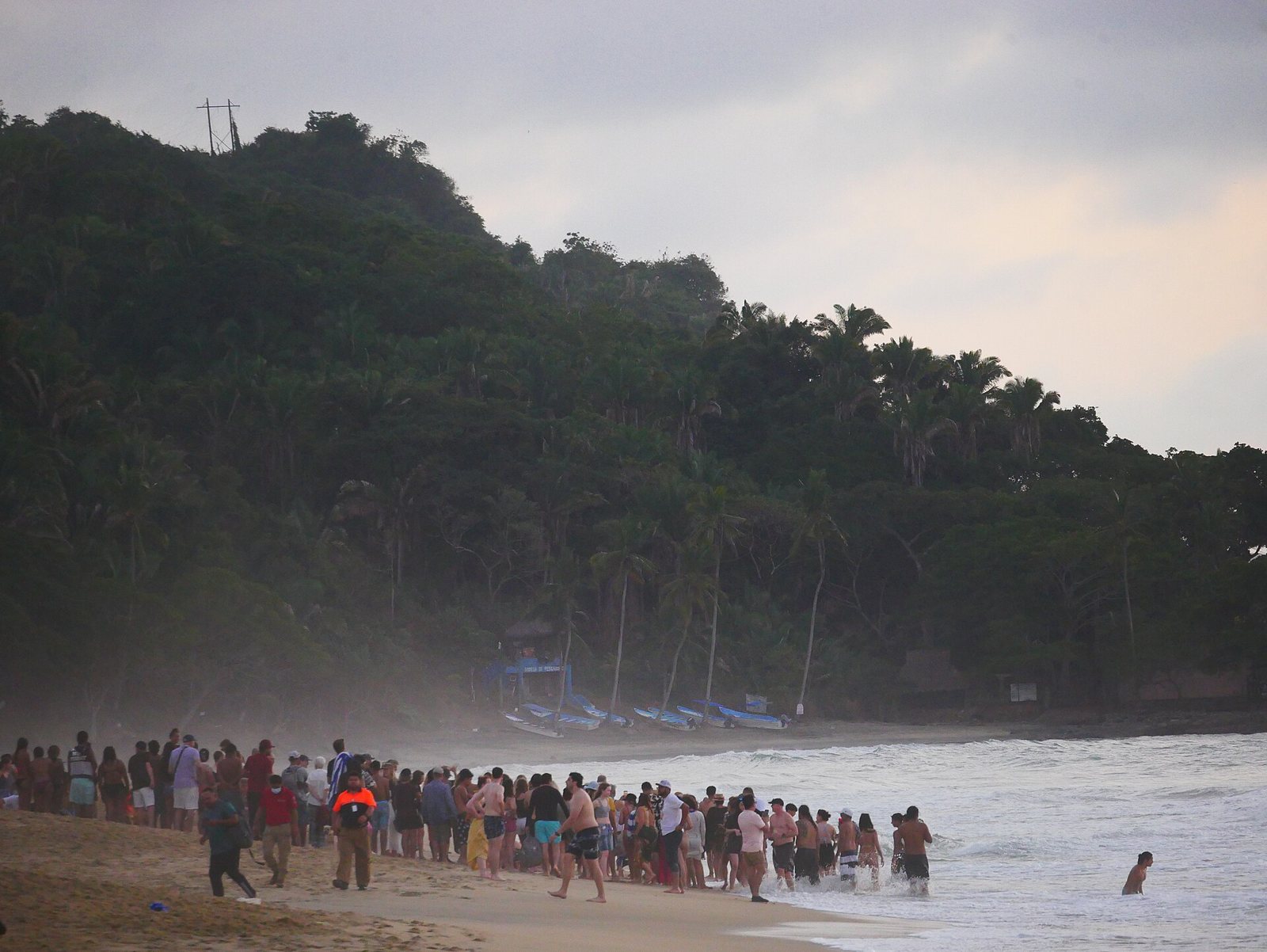 Visitors gathered for a sea turtle release on San Pancho beach, Nayarit (December 2024).
From fishery to turtle camp: a short history
For much of the 20th century, sea turtles were a legal commercial catch in Mexico. According to Mexico's protected areas agency (CONANP), turtle leather replaced crocodile skin in the markets, and that trade, plus egg poaching, drove much of their decline.
Olive ridleys took the hardest hit, making up close to 90% of Mexico's entire turtle catch, according to the species' conservation plan.
The damage reached the Puerto Vallarta area too. At the Playón de Mismaloya, a long nesting beach on Jalisco's south coast (not to be confused with Mismaloya Beach just south of Puerto Vallarta), arribadas of 20,000 to 30,000 females were reported in the 1970s. By 2004, only about 800 females were counted. Between 1989 and 1994, poachers took 75% to 100% of the nests on several Jalisco beaches.
Mexico responded in stages (see the timeline below), culminating in a total, permanent ban on May 31, 1990. It came at a cost: in Mazunte, Oaxaca, home to a turtle slaughterhouse, families lost their main livelihood almost overnight. That same village later became home to the Mexican Turtle Center.
Did it work? Largely, yes. CONANP calls the olive ridley a success story: at La Escobilla Sanctuary in Oaxaca, nesting never topped about 300,000 per year in the 1970s and 1980s, and today it tops one million. The species is still endangered, though.
Timeline
- 1960s–1970s: Mexico's turtle fishery peaks, with 75,000 to 350,000 turtles caught per year.
- 1966: The country's first turtle camps open at Rancho Nuevo (Tamaulipas) and Boca de Apiza (Colima).
- 1978–1990: What CONANP calls the turning point, when sea turtles go from "fishery resource" to endangered species.
- May 31, 1990: Mexico publishes a total, permanent ban on taking sea turtles in its waters.
- 1992: Grupo Ecológico de la Costa Verde starts protecting turtles in San Pancho.
- 1993: Turtle excluder devices become mandatory on Mexican shrimp trawlers.
- 1994: The Mexican Turtle Center in Mazunte, Oaxaca, created a few years earlier, opens to the public.
- 2006: Federal wildlife law bans the extractive use of sea turtles, their parts and products.
- January 2024: Playa Platanitos (Compostela, Nayarit) is declared a sanctuary.
From nest to ocean: a sea turtle's life cycle
- Nesting. A female comes ashore at night, digs a nest in the sand, lays her eggs, covers them and heads back to sea. An olive ridley lays about 100 to 110 round white eggs per nest, each 3 to 5 cm across, and may nest two or three times a season.
- Incubation. Eggs hatch after about 45 days, depending on sand temperature.
- Sand decides the sex. Sea turtles have no sex chromosomes. Nest temperature in the middle third of incubation decides whether hatchlings are male or female. At about 29°C (84°F) you get roughly half and half; above about 31°C (88°F), all females; below about 27.7°C (82°F), all males. That's why warming beaches worry biologists, and a female-skewed sex ratio has already been documented at La Escobilla.
- The dash to the sea. Hatchlings head straight for the water once they emerge. Lights from hotels, homes and flashlights confuse and disorient them along the way and lower their odds of survival.
- The long odds. Only about one in 1,000 hatchlings is estimated to survive to adulthood. The females that make it return years later to nest in the area where they hatched.
When is sea turtle season in Puerto Vallarta?
According to Semarnat, nesting in Mexico runs from May to September, and hatchling releases usually take place from July to November, since eggs incubate for roughly six to eight weeks. For olive ridleys specifically, the species' conservation plan puts nesting from July to January along most of Mexico's Pacific coast, though nests can turn up in any month.
Around Banderas Bay, Puerto Vallarta's tourism board puts the formal nesting season at August to December, with the first turtles arriving as early as mid-July. In practice:
- July and August: nesting begins and the first releases happen.
- September to November: your best odds of catching a release.
- December: some camps are still releasing hatchlings from the last nests.
Turtle season overlaps with the rainy season, and dates shift every year. Most camps don't release hatchlings every day or at a fixed time, so always check with the camp before you go.
Turtle camps near Puerto Vallarta and in Riviera Nayarit
Government agencies, universities, nonprofits and volunteer groups run turtle camps across the region. They patrol at night, move eggs to protected hatcheries and release the hatchlings. Nationwide, CONANP runs dozens of camps on the main nesting beaches, which produce more than 95% of Mexico's hatchlings. These are some of the best known in the area:
Boca de Tomates, Puerto Vallarta
On the Jalisco side of the bay, the Boca de Tomates turtle camp sits on the beach of the same name, near Marina Vallarta and the airport. It holds sunset releases that start with a short educational talk. If you're staying in Puerto Vallarta, it's the most convenient option. For more ideas, see our list of things to do in Puerto Vallarta.
Mayto and Jalisco's south coast
Puerto Vallarta's tourism board also points to the turtle camp in Mayto, a small fishing village south of Vallarta on Jalisco's Costalegre, which is quieter and less developed. Along that stretch of coast, south of Cabo Corrientes, lies the Playón de Mismaloya Sanctuary, described as Mexico's largest protected area for sea turtles.
Nuevo Vallarta
A turtle camp linked to CONANP works on the beach in Nuevo Vallarta, one of the busiest olive ridley nesting beaches on the bay. For scale, about 6,000 nests were counted along its 14 km (9 miles) of beach in 2010. In season, it has opened sunset releases to the public. Learn more about the area in our Nuevo Vallarta guide.
San Pancho
In San Francisco, better known as San Pancho, the Grupo Ecológico de la Costa Verde has protected sea turtles since 1992. Its government-certified volunteers patrol the beach at night and move eggs to a hatchery. Beach releases here have drawn locals and visitors alike, like the one in the photo above. Plan your visit with our San Pancho guide, our San Pancho beach guide and our look at San Pancho's circus and culture.
Further up the Nayarit coast
Farther north there are camps in Lo de Marcos, El Naranjo (Peñita de Jaltemba), Punta Raza (El Monteón) and Playa El Borrego (San Blas), among others. Several of them invite the public to releases during the season. If you're exploring that stretch of coast, check out our guide to Riviera Nayarit beach towns.
Platanitos and Playa Las Tortugas
South of San Blas, in the municipality of Compostela, this is one of the most important nesting areas in the state and, since January 2024, a federal sanctuary of about 80 hectares (roughly 200 acres). Long-running camps work here, including one tied to the University of Guadalajara, with a hatchery and a small turtle museum. It's far up the coast near San Blas, so plan it as a separate trip.
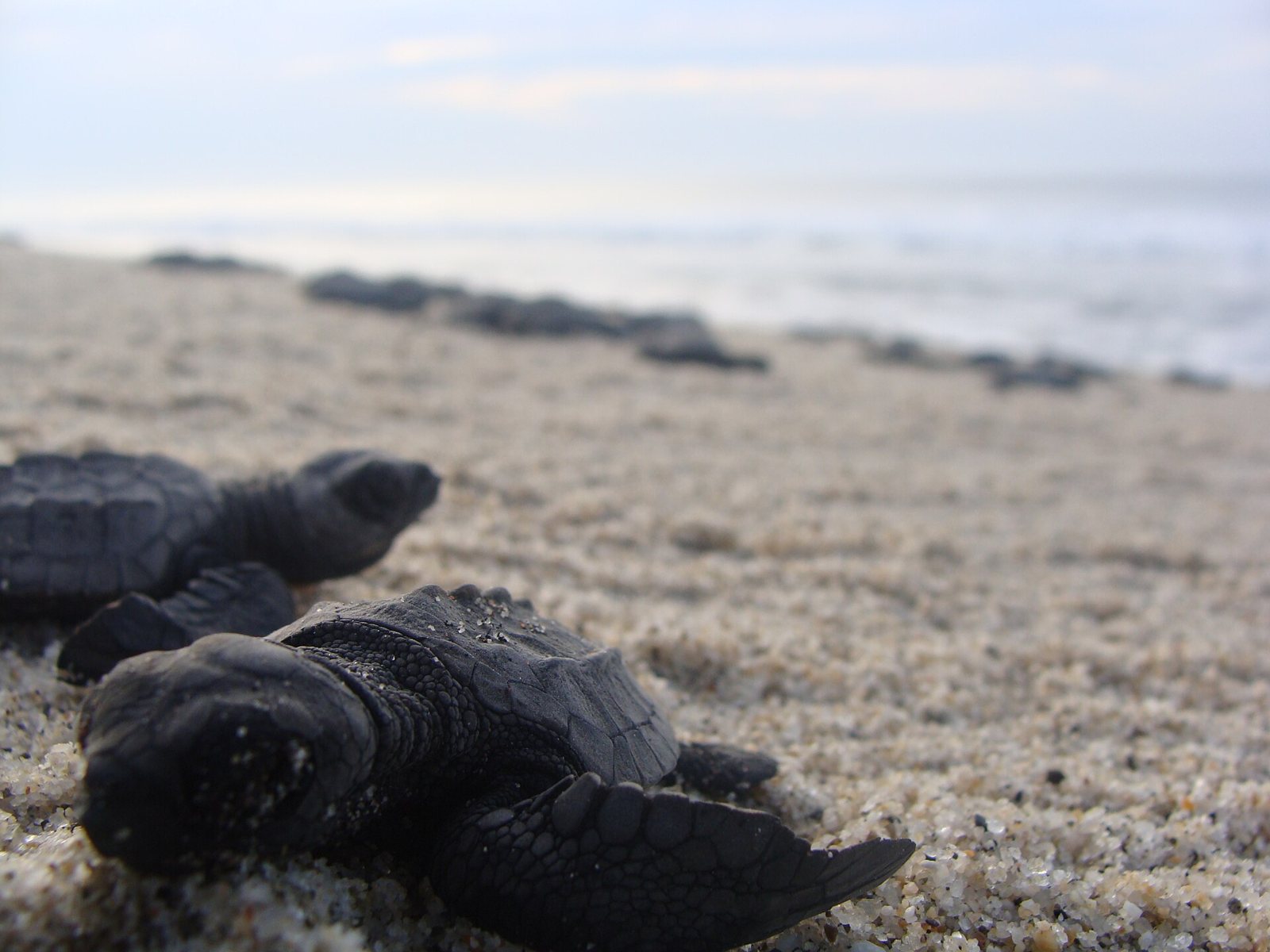 Olive ridley hatchlings on the sand, moments before reaching the water.
The threats sea turtles still face
The 1990 ban ended the legal harvest, but not the danger. The olive ridley conservation plan lists nest poaching and illegal sales of meat and eggs; bycatch in nets and on hooks, where turtles drown; artificial light and beachfront construction, which make females abandon nesting and disorient hatchlings; erosion and warming sand; and predators from raccoons, dogs and crabs to vultures and even egg-eating beetles. It also warns that poor practices, like holding hatchlings or running beach visits without protocols, can harm the species. That's why it matters which camp you visit.
How to join a turtle release responsibly
- Only go to authorized camps. Be wary of anyone offering to let you hold or "release" a turtle for money outside a camp. Keeping hatchlings around as a show puts their lives at risk.
- Follow the staff's lead. They decide when, where and whether anyone handles the hatchlings. Often you'll just watch.
- No flash and no white lights. Artificial light confuses turtles. If you need a flashlight after dark, use a red light.
- Don't carry them to the water. The crawl across the sand is part of the process, so don't pick them up or push them along.
- Arrive early. Releases usually happen around sunset and begin with a short talk.
- If you come across a nesting turtle, stay about 10 meters (30 feet) away, don't touch her or shine a light on her, and let the nearest camp or Profepa (Mexico's environmental enforcement agency) know.
- Respect marked nests and don't walk on or dig around them.
- Leave a donation. Taking part is usually free, but most camps rely heavily on donations.
Rules can differ from camp to camp and change from year to year, so check the current rules before you go.
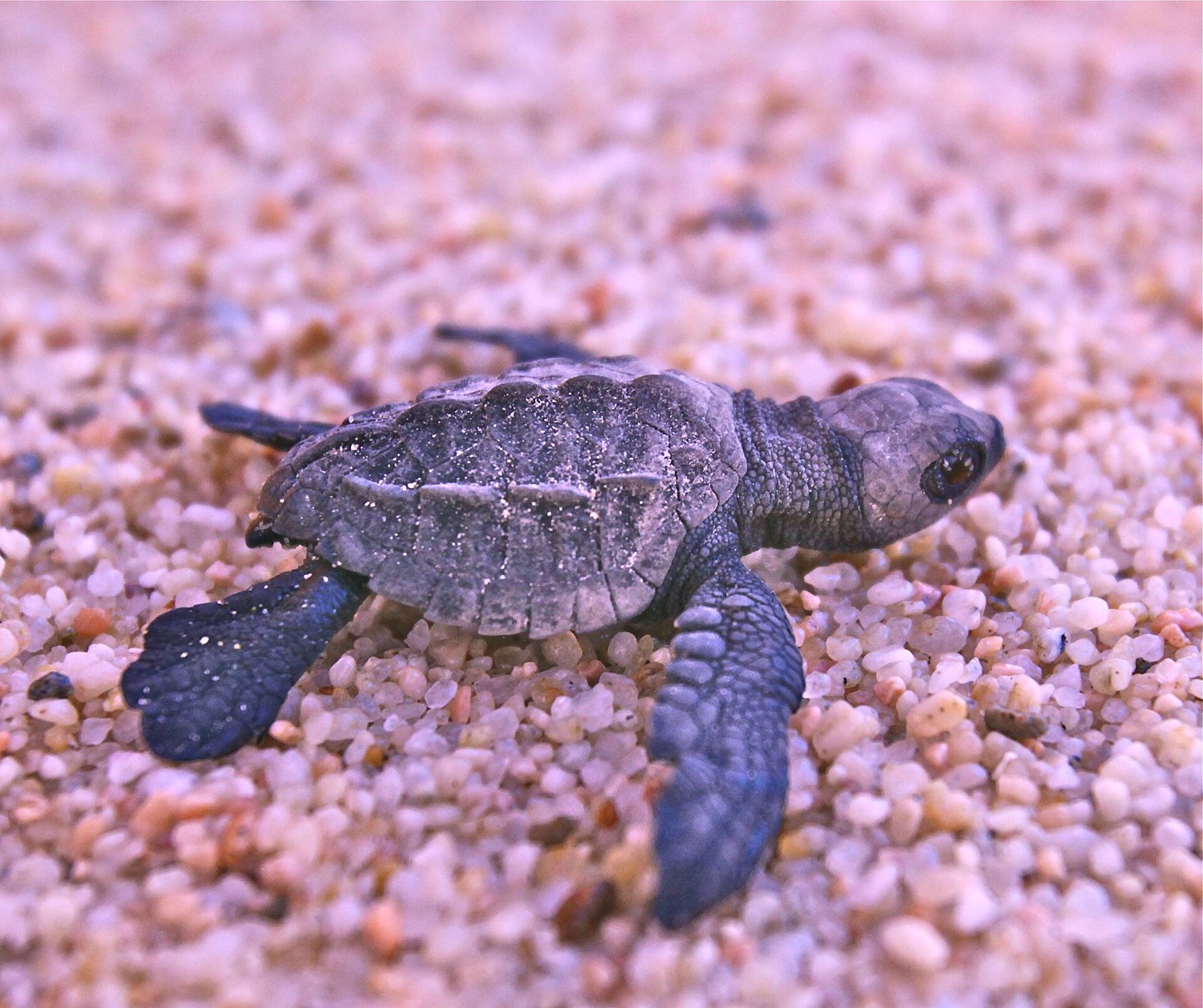 An olive ridley hatchling on a beach in Mexico.
Visit San Pancho on our Sayulita and San Pancho tour
Our tour does not include a turtle release, but it does take you to San Pancho, one of the Riviera Nayarit towns best known for protecting sea turtles, plus Sayulita. The Sayulita and San Pancho tour runs Tuesday, Thursday and Saturday. It's a full-day trip offered in English and Spanish, with a maximum of 17 people. It includes:
- Round-trip transportation
- Certified guide
- Tasting of traditional Mexican sweets
- A stop at San Pancho's plaza and beach
- Guided walk through downtown Sayulita
- Free time in Sayulita
- One or two bottles of water
Surf lessons are optional (extra cost), with a 50% discount for tour guests. Lunch is not included.
See dates and book the Sayulita and San Pancho tour →
Planning your turtle trip
Sample itineraries
- Half day (afternoon): If you're staying in Puerto Vallarta or Nuevo Vallarta, check in the morning whether the nearest camp has a release planned and arrive before sunset for the talk.
- Full day: Spend the day in Sayulita and San Pancho, on your own or with our tour, and save another evening for a release near your hotel.
What to bring
Light clothing, shoes that handle sand, biodegradable bug spray, a red-light flashlight if you'll stay after dark, a light rain jacket (it's rainy season) and some cash for a donation.
Budget and getting around
The release itself is usually free or by donation. Your main cost is getting there. Boca de Tomates and Nuevo Vallarta are a short ride from Puerto Vallarta's hotel zone, while San Pancho, Lo de Marcos or Platanitos call for a car, a ride or a full-day outing.
Etiquette
Camps in towns like San Pancho are community projects run largely by volunteers. Listen to the talk, don't rush ahead to the water's edge, keep your voice down around the hatchlings, and talk to your kids beforehand about why we don't touch turtles or shine lights on them. Watch the clock, too: Banderas Bay's Nayarit side (Nuevo Vallarta, Bucerías, Sayulita, San Pancho) runs on Central Time like Puerto Vallarta, but the rest of Nayarit is on Pacific Time, one hour earlier. If you're heading up to La Peñita or San Blas, confirm the release time in local time.
Visiting in winter instead? Swap turtles for whale watching in Puerto Vallarta.
Frequently asked questions
When is turtle season in Puerto Vallarta and Riviera Nayarit? Releases run roughly from July to November and, around Banderas Bay, can stretch into December. September through November is usually the best time to see one.
Where can I see a turtle release near Puerto Vallarta? The closest options are the Boca de Tomates camp in Puerto Vallarta and the camp in Nuevo Vallarta. Farther north, there are camps in San Pancho, Lo de Marcos and other coastal towns.
How much does it cost to join a turtle release? It's usually free or by voluntary donation, but each camp sets its own rules. Check with them directly.
Which species will I see? Almost certainly the olive ridley, the most common nesting turtle in Nayarit and Banderas Bay. Leatherbacks, black turtles and hawksbills also nest on this coast, but in much smaller numbers.
Can I touch or hold the hatchlings? Only if camp staff say so, and often they won't. The safest thing for the hatchlings is to watch without touching or shining lights on them.
Does the Sayulita and San Pancho tour include a turtle release? No. The tour visits San Pancho's plaza and beach and downtown Sayulita, but it doesn't include any turtle activities. See the tour details here.
Photos: Bethany McCarter / CC BY 4.0 via Wikimedia Commons · Luisalvaz / CC BY-SA 4.0 via Wikimedia Commons · Eder Omar Campos González / CC BY-SA 3.0 via Wikimedia Commons · Steve Jurvetson / CC BY 2.0 via Wikimedia Commons




