
Most visitors come to San Pancho for the wide, quiet beach. Stay a little longer, though, and you'll notice something else: kids practicing trapeze in an old warehouse, murals on nearly every wall, and a community center that turned a former milk-processing plant into the town library and recycling hub. It's no surprise this little village, officially San Francisco in the municipality of Bahía de Banderas, is often called the cultural capital of the Riviera Nayarit.
None of it happened by accident. San Pancho's arts scene grew out of the ruins of a 1970s presidential experiment, was nurtured by Mexican and foreign residents who decided to stay, and got an unexpected boost when one of the founders of Cirque du Soleil chose to retire here. Here's the full story, followed by tips on how to experience it yourself.
Before the Art: A 1970s "Model Town"
Why does a village of roughly 1,400 people (2020 census) have such a lively cultural life? Start with its buildings. Under President Luis Echeverría Álvarez (1970–1976), the federal government picked San Pancho as the hub of a development plan for the northern Banderas Bay coast. In 1972 it created the Bahía de Banderas Ejido Union, a pilot project that grouped eight local ejidos (communal landholdings).
The village got paved streets, drainage, electricity and schools, plus facilities you wouldn't expect in a fishing town: a hotel-management school, a hospital, a marine technology school, and a government-run CONASUPO agro-industrial complex that processed dairy, canned goods, soap, coconut oil and seafood. According to Spanish-language Wikipedia, there was even a short-lived "University of the Third World," which is said to have given the main street its name: Avenida Tercer Mundo (Third World Avenue).
The dream didn't last. By around 1988 nearly everything had been dismantled; only the hospital kept running (it's now an IMSS public hospital). The state tried to revive the warehouses with fruit-drying, furniture and fish-packing ventures, but none succeeded. For the bigger picture, see our San Pancho, Mexico guide.
Community Roots: Turtles, Recycling and the Jungle
Before the artists arrived, neighbors were already laying the groundwork. Frank Smith and Elvia García led volunteer beach cleanups and recycling workshops, and in 1992 they founded the Grupo Ecológico de la Costa Verde, which opened the area's first sea turtle nursery. In 2002, Eric Saracho and Gabriela Loreto of the University of Guadalajara's coastal campus in Puerto Vallarta (Centro Universitario de la Costa) settled in town; a few years later they founded the conservation group Alianza Jaguar. Around the same time, Nicole Swedlow, future founder of Entreamigos, arrived. Art, education and the environment grew up together here from day one.
The Bodegas: Old Warehouses, New Life
The old bodegas (warehouses) of the agro-industrial complex sat empty for about twenty years. Starting in 2006, Mexican and international artists began moving in with cultural and environmental projects. Today these rustic buildings along Avenida Tercer Mundo house four groups that define San Pancho:
- Colectivo San Pancho, the artists' collective based in "Bodega 3," which launched the Sinergiarte festival
- Entreamigos, the community education center
- Alianza Jaguar, focused on protecting the jungle and the estuary
- Bodega Circo, home of the children's circus
A 2018 local news story credits this community spirit with helping keep San Pancho free of large-scale development and mass tourism.
The Children's Circus of San Pancho (Circo de los Niños)
The Circo de los Niños de San Pancho started in 2011 thanks to Gilles Ste-Croix, a co-founder of Cirque du Soleil, and his wife, designer Monique Voyer. It began as a fundraising show with kids from the Entreamigos community center and grew into a full social circus school, which local press describes as the only one of its kind in Mexico.
Who Is Gilles Ste-Croix?
Ste-Croix was born in 1950 in La Sarre, Quebec. According to The Canadian Encyclopedia, he took up stilts almost by accident: while living on a commune, he built a pair out of a ladder to pick apples faster. In 1979 he and Guy Laliberté formed a stilt-walking troupe, Les Échassiers de Baie-Saint-Paul, and to raise money he walked about 90 km (56 miles) on stilts to Quebec City. That street troupe became Cirque du Soleil in 1984. Ste-Croix served as its creative director from 1988 to 2014 and helped create shows such as Alegría, Mystère, Quidam and "O". After a roughly 35-year career, he settled in San Pancho.
From a Benefit Show to a Circus School
- March 2011: The first show, Cuando aún no existían los sueños ("When Dreams Didn't Yet Exist"), premieres with Entreamigos kids, using equipment donated by Cirque du Soleil's Cirque du Monde program.
- 2014: After 24 months of training, 60 kids perform ¡Órale!, a 90-minute show staged in Plaza del Sol and later in Puerto Vallarta.
- Summer 2014: The Nayarit state government grants use of one of the old warehouses.
- October 2014: The Bodega Circo opens with Mexican instructors and 67 students in its first cycle.
- 2015: A dance studio and black-box stage are added, and more than 70 kids stage Dar a Luz. A performance forum came later, for a total of roughly 1,200 square meters (about 13,000 sq ft).
What the Kids Learn
The school teaches circus arts and dance to children and young people (ages 5 to 19, according to the organizers), plus adult training and master classes. A 2017 Thomson Reuters Foundation story described students practicing trampoline flips, acrobatics, juggling and tightrope walking. Some of the teaching staff have trained at professional circus schools, including Montreal's École nationale de cirque.
Since it began, the school has served more than 1,600 kids and teens. The nonprofit covers most of each student's training costs and awards scholarships every cycle.
The Annual Show
The highlight of the year is the annual fundraising show, traditionally staged in March at the circus's own venue. Each production tells a brand-new story through acrobatics, aerial acts, theater and choreography, often inspired by the classics:
- 2017: A Midsummer Night's Dream, adapted from Shakespeare
- 2019: Fausto (Faust)
- 2020: Sancho, inspired by Don Quixote's squire; it was canceled because of the pandemic, and in 2021 the circus held its fundraiser on Zoom
- 2026: Esperanza ("Hope"), a story that moves "from chaos to hope," featuring 47 young local performers
Ticket sales fund the school's youth programs. Shows usually take place in the evening, and tickets are sold in advance on the circus's official website. Check dates, times and availability directly with Circo de los Niños before you plan your trip.
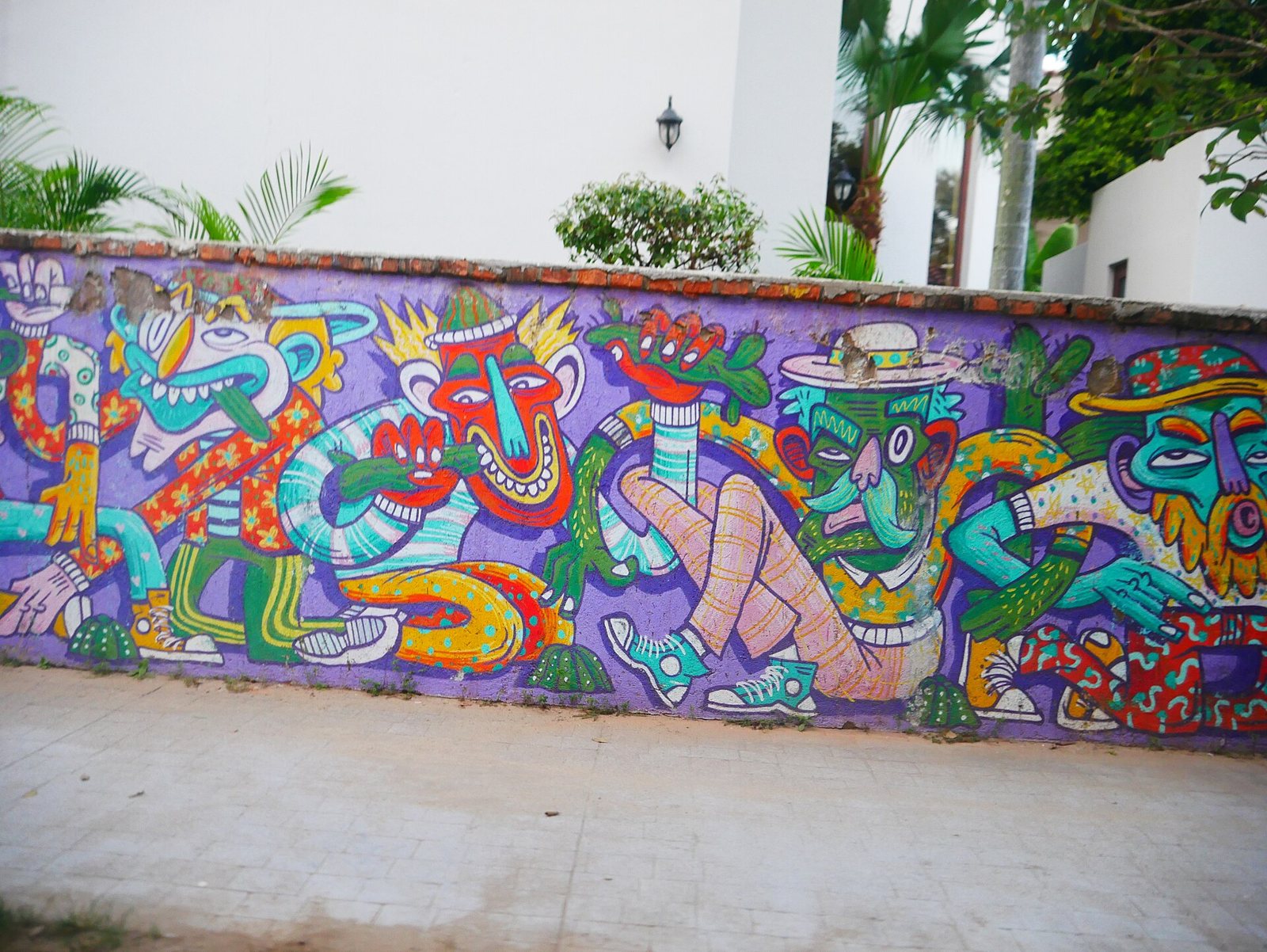 One of the murals along the way to the beach in San Pancho.
Entreamigos: Books, Recycling and Community
Entreamigos ("Among Friends") is San Pancho's other big success story. It began around 2006 with nothing more than a sidewalk table where founder Nicole Swedlow taught arts and crafts to local kids. In early 2009 it was granted the right to occupy and remodel an abandoned building on the main street: a former milk-processing plant that had been empty since the 1970s. According to a regional volunteer guide, the remodel relied on hundreds of volunteers and mostly recycled materials.
What you'll find there:
- A bilingual library for children and adults
- Classes and workshops, from languages and computers to art, sewing and screen printing
- A scholarship program for local students, from elementary school through university
- Recicla San Pancho, the town's recycling program, with collection bins around the village
- An eco-design center and shop selling items made from recycled materials, plus a thrift store
Mexico's environment ministry (Semarnat) has recognized Entreamigos as an environmental education and culture center, and it welcomes visitors and volunteers. Fun fact: Cirque du Soleil has donated used lighting, costumes and camera gear for student performances. If you'd like a look inside, reach out ahead of time.
Sinergiarte and the Colectivo San Pancho
The Colectivo San Pancho, an open group of Mexican and international artists, held the first Sinergiarte festival in 2006. To give you a sense of its scale, the 11th edition in 2016 took over Plaza del Sol from December 28 to 30, free of charge, with an opening parade, music, theater, circus acts, dancing horses, Indigenous art, workshops and food. The festival did a lot to earn San Pancho its artsy reputation. We couldn't find recent editions, so if you're visiting in December, ask locally whether one is planned.
Street Art, Huichol Crafts and God's Eyes
Outside festival season, art is everywhere:
- Murals on walls around town, especially on the way to the beach and around Plaza del Sol
- Galleries and art shops selling local art, textiles and crafts
- Huichol art at stands near the beach entrance, with Wixárika beadwork and jewelry. To decode the symbols, read our Huichol art guide
- A handicrafts market in Plaza del Sol on Tuesdays
- Live music several nights a week in high season (roughly December through April)
- A statue of the patron saint in a small plaza at the end of Avenida Tercer Mundo
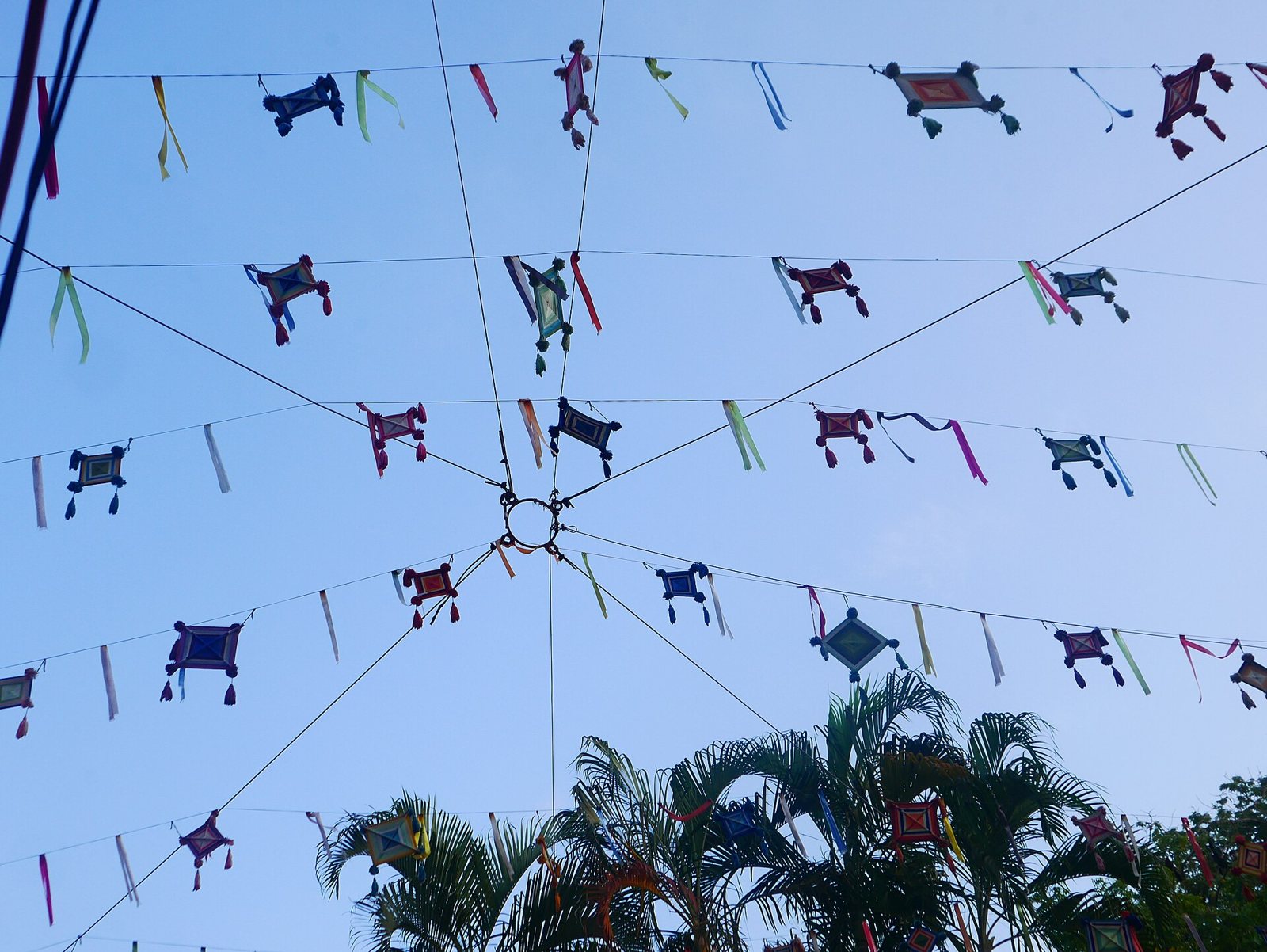 Woven ojos de dios decorating a street in San Pancho.
What Do God's Eyes Mean?
The colorful ojos de dios you'll see around town are called tsikuri (also spelled tzicuri) in the Wixárika language: colored yarn woven over a cross of two sticks. According to Wixárika tradition as described by México Desconocido, a parent weaves one when a child is born as a protective amulet, adding a diamond of a new color each year until the child turns five. The colors are tied to the sacred directions of the Wixárika worldview; black, for example, stands for the Pacific Ocean. If you buy one, look for pieces made by Wixárika artisans.
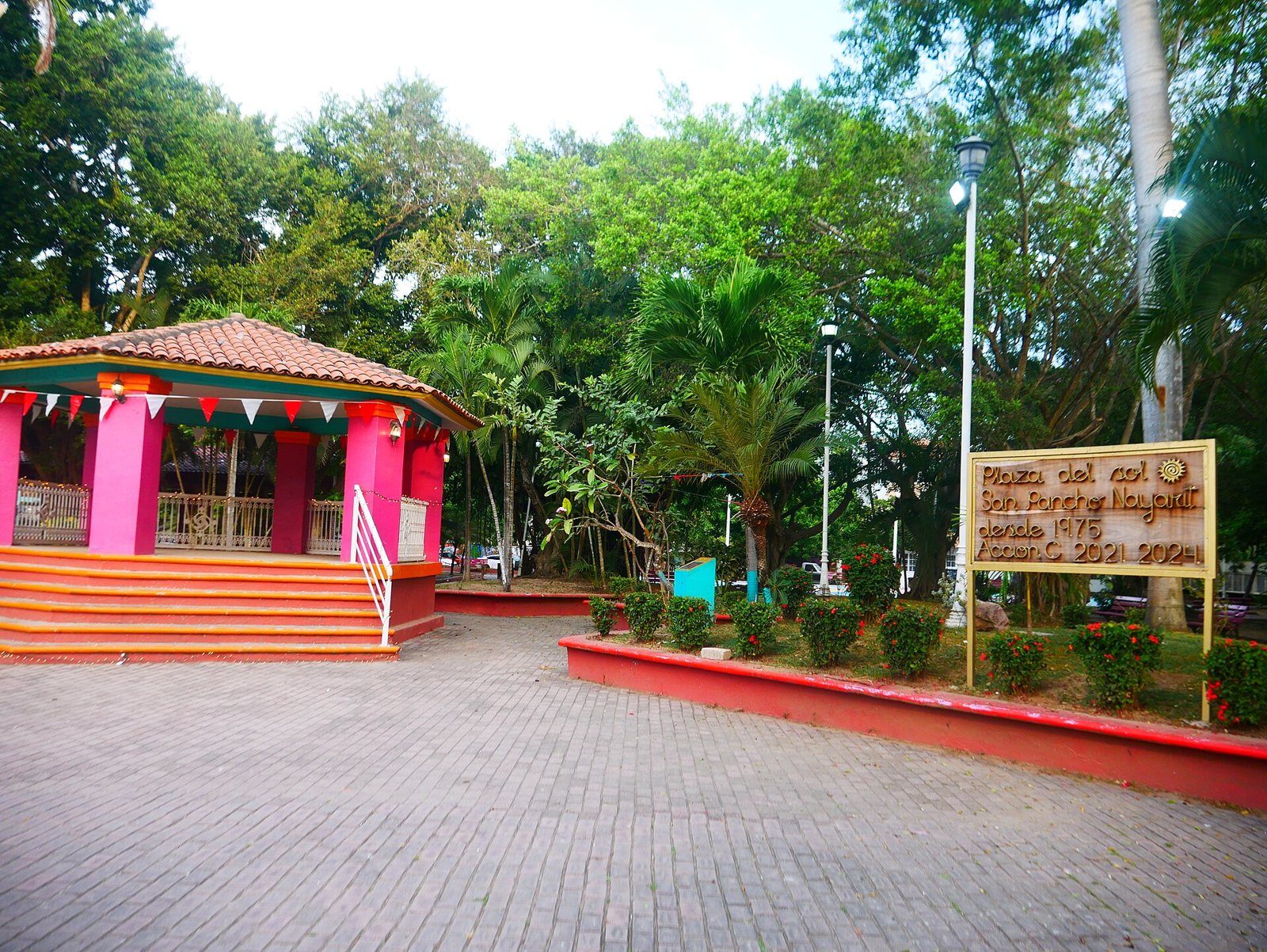 Plaza del Sol, the town's gathering place and home to markets and festivals.
Local Traditions: The Feast of St. Francis
San Pancho's biggest party honors its patron, St. Francis of Assisi, whose feast day is October 4. Celebrations start in late September and have been going for more than four decades. According to local accounts, each night a different neighborhood leads a candlelit procession with floats and costumed residents that ends with Mass at the parish church facing Plaza del Sol. Meanwhile, the plaza fills with food, music, a firework-spitting torito, the traditional torch run, a rodeo-style jaripeo and a fireworks tower. Check each year's program before you go.
A newer local tradition is polo; read about it in polo in San Pancho. And behind the village rises the jungle of the Sierra de Vallejo, protected since 2024 as the Sierra de Vallejo-Río Ameca Biosphere Reserve, a cause Alianza Jaguar championed for about twenty years. Nature lovers should also see our guide to sea turtles in the Riviera Nayarit.
San Pancho Cultural Timeline
- 1970–1976: Echeverría's development plan; the warehouses are built
- 1972: The Bahía de Banderas Ejido Union is created
- c. 1988: The complex is dismantled; only the hospital remains
- 1992: Grupo Ecológico de la Costa Verde is founded
- c. 2006: Artists move into the warehouses; Entreamigos and Sinergiarte begin
- 2009: Entreamigos takes over the old milk plant
- 2011: Circo de los Niños is founded
- 2014: Bodega Circo opens
- 2020: The pandemic cancels the annual show
- 2024: The Sierra de Vallejo-Río Ameca Biosphere Reserve is decreed
- 2026: The circus stages Esperanza
Visit San Pancho with Riviera Tours & Transfers
Want a taste of San Pancho without renting a car? Our Sayulita & San Pancho tour runs Tuesday, Thursday and Saturday, lasts a full day, is offered in English and Spanish, and travels in small groups of up to 17 people. It includes:
- Round-trip transportation
- Certified guide
- Tasting of traditional Mexican sweets
- Visit to San Pancho's plaza and beach
- Guided walk through downtown Sayulita
- Free time in Sayulita
- 1–2 bottles of water
- Optional: surf lessons at an extra cost, with 50% off for tour guests
Please note that the tour does not include visits to the circus, Entreamigos, the warehouses or any performances; those are separate activities. If you want to see the Circo de los Niños show, plan it as its own evening out. Lunch is not included.
Check dates and book the Sayulita & San Pancho tour →
Suggested Itinerary and Best Time to Go
Half day: Start at Plaza del Sol and the parish church, stroll down Avenida Tercer Mundo past the murals and warehouse facades, and finish by the ocean. On a Tuesday, browse the artisan market.
Full day: Add a visit to Entreamigos (book ahead) and the galleries, then save the afternoon for San Pancho Beach and sunset. For the town next door, see things to do in Sayulita or our guide to Riviera Nayarit beach towns.
When to go: March for the circus; late September through October 4 for the patron saint festival; December through April for more live music and open galleries. November through May is the dry season and the most comfortable for walking; August is the rainiest month.
Tips for Enjoying San Pancho's Arts Scene
- Buy circus tickets early; the annual show is a big local event. In 2026, guests had to show their purchase confirmation an hour before showtime to pick up physical tickets.
- Slow down. Many murals are tucked along side streets.
- Bring cash for markets and craft stands, and comfortable shoes for the cobblestones.
- Buy local art. It's one of the most direct ways to support the town's artists.
- Be respectful of community spaces. Entreamigos and the Bodega Circo work with children, so ask before walking in and don't photograph kids without permission.
- Budget: Walking the murals and plaza is free; your main costs will be circus tickets, art and food.
- We recommend confirming hours and availability directly with each place.
FAQ
Who founded the San Pancho children's circus? Gilles Ste-Croix, a co-founder of Cirque du Soleil, together with Monique Voyer, in 2011.
When is the Circo de los Niños show? It's usually held in March, in the evening, at the circus's venue in San Pancho. Dates change every year, so check the official website.
Why is San Pancho called the cultural capital of the Riviera Nayarit? Because of the cluster of arts and community projects in its old warehouses, plus its murals, galleries and festivals, which is rare for such a small village.
Can I visit Entreamigos? Yes. It welcomes visitors and volunteers; contact them in advance about hours and tours.
What is a God's eye (ojo de dios)? It's the Wixárika tsikuri, yarn woven over a cross of sticks, traditionally made to protect young children.
When is San Pancho's patron saint festival? It starts in late September and culminates on October 4, the feast of St. Francis of Assisi.
Does the Sayulita & San Pancho tour include the circus? No. The tour visits San Pancho's plaza and beach and downtown Sayulita; the circus and its shows are separate.
Photos: Luisalvaz / CC BY-SA 4.0 via Wikimedia Commons (all four photos)




